Comparison
Stair runner vs full carpet
Two ways to cover the same staircase, with genuinely different consequences for cleaning, replacement, noise and how the stairs look.
Written by the StairRunner.co editorial team · Updated 4 September 2026
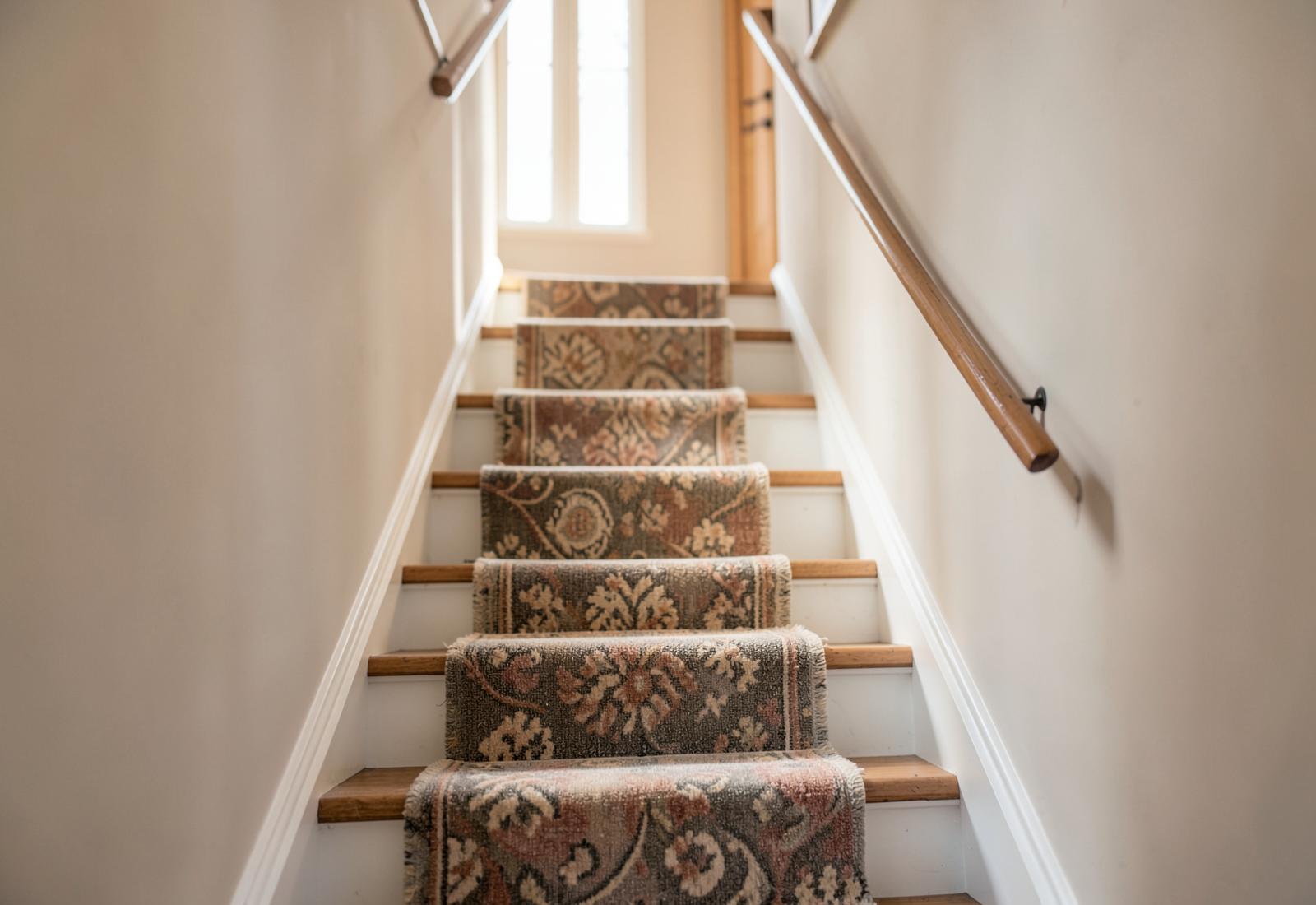
Side by side
| Factor | Stair runner | Full stair carpet |
|---|---|---|
| Appearance | Shows the staircase; the covering reads as a deliberate feature | Uniform, softer, quieter visually; hides the stair structure |
| Tread condition required | Margins must be presentable | Hides damaged or mismatched treads entirely |
| Noise reduction | Substantial in the walking zone | Greatest, including the edges and stringer |
| Material quantity | Lower | Higher |
| Fitting skill | Precise centring, even margins, finished edges | Standard stair fitting technique |
| Cleaning | One strip to vacuum, hard margins to wipe; traffic lanes concentrate | Whole surface to vacuum; edges and corners collect dust |
| Replacement | Swap the runner alone | Recover the full staircase |
| Reversibility | Removable, leaving small fixing marks in the treads | Removable, but exposed treads usually need refinishing |
How to decide
- Look at your treads first. If the timber outside the walking zone is damaged, patched or a different species, a runner will frame that problem rather than solve it.
- Think about who uses the stairs. Households with very young children, elderly residents or pets that take stairs at speed may prefer full-width coverage.
- Consider the replacement cycle. Stairs wear faster than any other floor. A runner lets you renew just the worn part.
- Be honest about cleaning. A runner puts all the traffic on one narrow band, so it shows lanes sooner unless you vacuum it regularly.
Hybrid approaches
A wide runner that leaves only a small margin gives near-full coverage while keeping the option of a single-strip replacement. A runner carried across a landing and into a hall maintains continuity without carpeting the treads wall to wall. Both are common and both depend on careful measuring and width selection.
Whichever you choose, the deciding factor for durability is the same: fibre and construction suited to stair traffic, fitted tightly over a firm pad.
Why the comparison keeps coming up
Most households only think hard about stair covering once: when the existing carpet is worn through, when a house is bought with bare or damaged treads, or when a renovation exposes timber that was always meant to be covered. At that point the question "runner or full carpet" arrives with no obvious default, because both formats are common, both look normal in a finished home, and neither is inherently better. What decides it is the staircase in front of you, not a general rule.
A stair runner is a strip of carpet, narrower than the tread, fitted down the centre of the flight and fixed at each step, leaving an exposed margin of timber on both sides. Full stair carpet is fitted the full width of every tread, wall to wall or string to string, so no timber is visible at all. Both are fixed using broadly the same fitting technique — tack strip or staples, a pad underneath, tension pulled into each crease — the difference is entirely in coverage width and what that width implies for everything downstream.
What full-width coverage actually buys you
The case for full carpet is rarely about looks alone. It solves three practical problems that a runner cannot. First, it hides tread condition completely — mismatched timber, old repairs, colour variation between treads, or boards that were never meant to be seen are all irrelevant once they are fully covered. Second, it reduces noise more than a runner can, because sound also travels through the exposed margins and the stringer, not just the walking zone; carpeting the whole width absorbs impact across the entire tread rather than a band down the middle. Third, it removes the exposed-edge safety question entirely: there is no hard timber margin next to the covering for a foot to catch on, which matters most on narrow stairs or where people habitually walk close to the wall rather than centre-stepping.
The cost of all this is that full carpet is an all-or-nothing commitment. Once the whole tread is covered, there is no fallback surface to fall back on if part of the carpet wears or is damaged — you are recovering the whole flight, not a strip. It also uses more material, and because it runs into every corner of every tread, a fitter needs to work the edges as carefully as the centre, which is a different, less forgiving kind of precision than centring a runner.
What a runner buys you instead
A runner's appeal starts with the staircase itself. On a flight with attractive timber, turned spindles, a painted stringer or a newel post worth looking at, full carpet erases all of it. A runner frames the structure instead of hiding it — the exposed margins read as a deliberate design choice, not an oversight, provided the timber underneath is in fit state to be seen. That last condition is the one people underestimate: a runner only looks considered if what is either side of it looks considered too.
The second reason people choose a runner is replaceability. Stairs wear faster than almost any other domestic floor, because every journey through the house crosses them and because the load concentrates on the front third of each tread. A runner lets you renew the part that takes that load without touching anything else. Over a decade of ownership this can matter more than the initial choice, particularly in a busy household where the runner may need replacing well before the rest of the house's flooring does.
A runner is also usually the lighter commitment in terms of material and can be less disruptive to change your mind about later — lifting a runner leaves small fixing marks in a band down the centre of each tread, which is a smaller repair than reclaiming a full flight of treads that have had staples and adhesive across their entire surface for years.
The condition of your treads decides more than taste
Before comparing appearance or budget, look honestly at what is either side of where a runner would sit. If the margins are sound, consistent timber that could be cleaned, sanded or refinished to a presentable state, a runner is viable purely on condition grounds. If the margins are patched, water-stained, mismatched from earlier repairs, or simply rough construction-grade timber that was never intended to be on display, a runner will draw attention to exactly the problem you are trying to solve, and full carpet becomes the practical answer regardless of any other preference.
This is worth checking before you fall in love with a runner in a showroom or online. Pull back any existing covering, if there is one, and look at what the treads outside the walking line actually look like. A tin of wood filler and some sanding may be all that stands between you and a runner; equally, discovering three different types of chipboard patch might settle the question in the other direction immediately.
Household factors that shift the answer
Beyond the staircase itself, who uses it changes the calculation. Very young children often use the full width of a tread rather than a narrow central line, especially when learning to climb and descend, and elderly residents sometimes favour one side of a staircase to use a wall for support, which can put their footfall outside a runner's margin. Pets — particularly dogs that take stairs at speed rather than one at a time — are more likely to catch a paw on an exposed edge than an adult walking deliberately. None of these groups make a runner unsafe by themselves, but they do reduce the margin for error, and in households with several of these factors together, full-width coverage removes a variable that a runner cannot.
Conversely, in a household of confident adult users where the staircase is a design feature as much as a route between floors, a runner's narrower footprint is rarely a practical issue and its appearance advantage tends to dominate the decision.
Cost is genuinely close, not a deciding factor
It is tempting to assume a runner is simply cheaper because it uses less material, and on material alone that is usually true. Labour narrows or erases the gap. Full carpet fitting is a well-understood, relatively standard trade skill. Runner fitting demands the same competence plus additional precision: centring accurately on every tread, keeping margins even along the whole flight, and finishing the exposed edges of the runner itself, which full carpet does not need because its edges are hidden against the wall or string. A fitter who quotes runner work at a premium over full carpet is usually pricing that extra precision, not overcharging. For a full breakdown of what drives the number, see stair runner cost and, for comparable labour-only figures, installation cost.
Cleaning and long-term wear in practice
Both formats need regular vacuuming on stairs specifically, because grit ground into the pile on a tread does more damage per footstep than on a flat floor, where the same grit is spread over a larger area. A runner concentrates every one of those footsteps onto a band perhaps a third to half the width of the tread, so it will show a defined traffic lane sooner than full carpet spreads the same wear across its whole surface. Against that, a runner gives you hard, wipeable margins that collect far less dust than carpet fibres do, and those margins are easy to clean with a cloth rather than a vacuum attachment.
Full carpet has no exposed timber to scuff or discolour, which suits households that would rather not maintain a finished wood surface at all, but it also has nowhere for dust and pet hair to go except into the pile at the corners and against the stringer, which are the hardest parts of any staircase to vacuum thoroughly. Neither format removes the need for routine care; they simply relocate where that care is needed. Detailed maintenance routines are covered in stair runner cleaning.
Resale and how a staircase reads to a buyer
Neither format reliably adds measurable value to a home on its own, and it is worth being sceptical of any claim that it does. What does affect how a staircase reads to a buyer or visitor is condition: a runner with a worn, matted traffic lane, or full carpet that is flattened, stained or coming away at the edges, reads as neglect regardless of which format it is. A tidy, well-fitted example of either format reads as cared-for. If you are covering stairs partly with resale in mind, spend the budget on quality and correct fitting rather than on choosing one format over the other for its own sake.
Frequently asked questions
- Which is safer, a runner or full carpet?
- Both improve grip over bare treads. Full carpet covers the whole tread, which helps where someone regularly steps near the edge. A well-fitted runner covers the walking zone. Fitting quality matters more than the choice itself — a loose covering of either kind is the real hazard.
- Which is cheaper?
- A runner usually uses less material. Labour can go either way, because a runner demands precise centring, even margins and finished edges, which is skilled and sometimes slower work than a wall-to-wall fit.
- Which is easier to keep clean?
- A runner concentrates cleaning on one strip and leaves hard margins you can wipe. Full carpet has no hard surface to clean but also no exposed timber to scuff. Runners show traffic lanes sooner because all the traffic is on one narrow band.
- Does either affect resale value?
- Neither reliably adds measurable value on its own. Condition matters far more than format — worn, stained or loose stair covering of any kind reads badly to buyers.
Related guides
- BasicsStair Runners: A Complete GuideWhat a stair runner is, how it differs from full carpet, and how to decide whether one is right for your staircase.
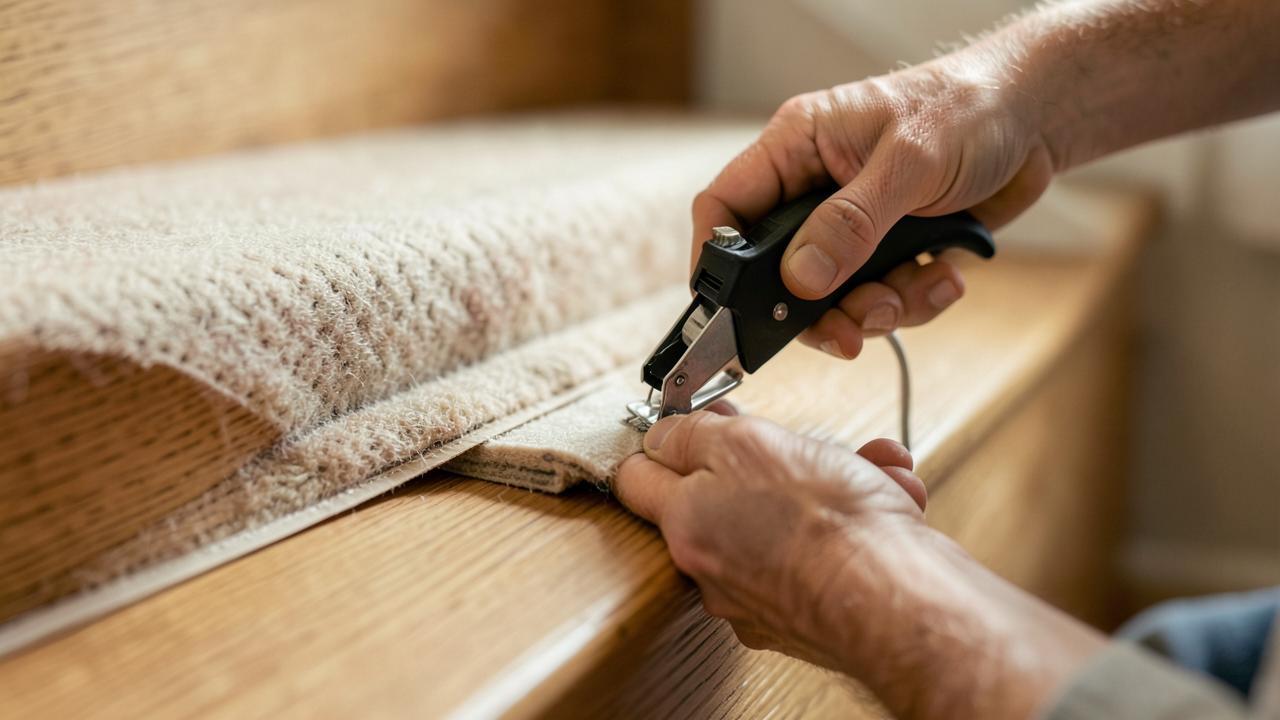 InstallationHow to Install a Stair RunnerWaterfall and Hollywood methods, staples versus rods, tools, sequence and quality checks.
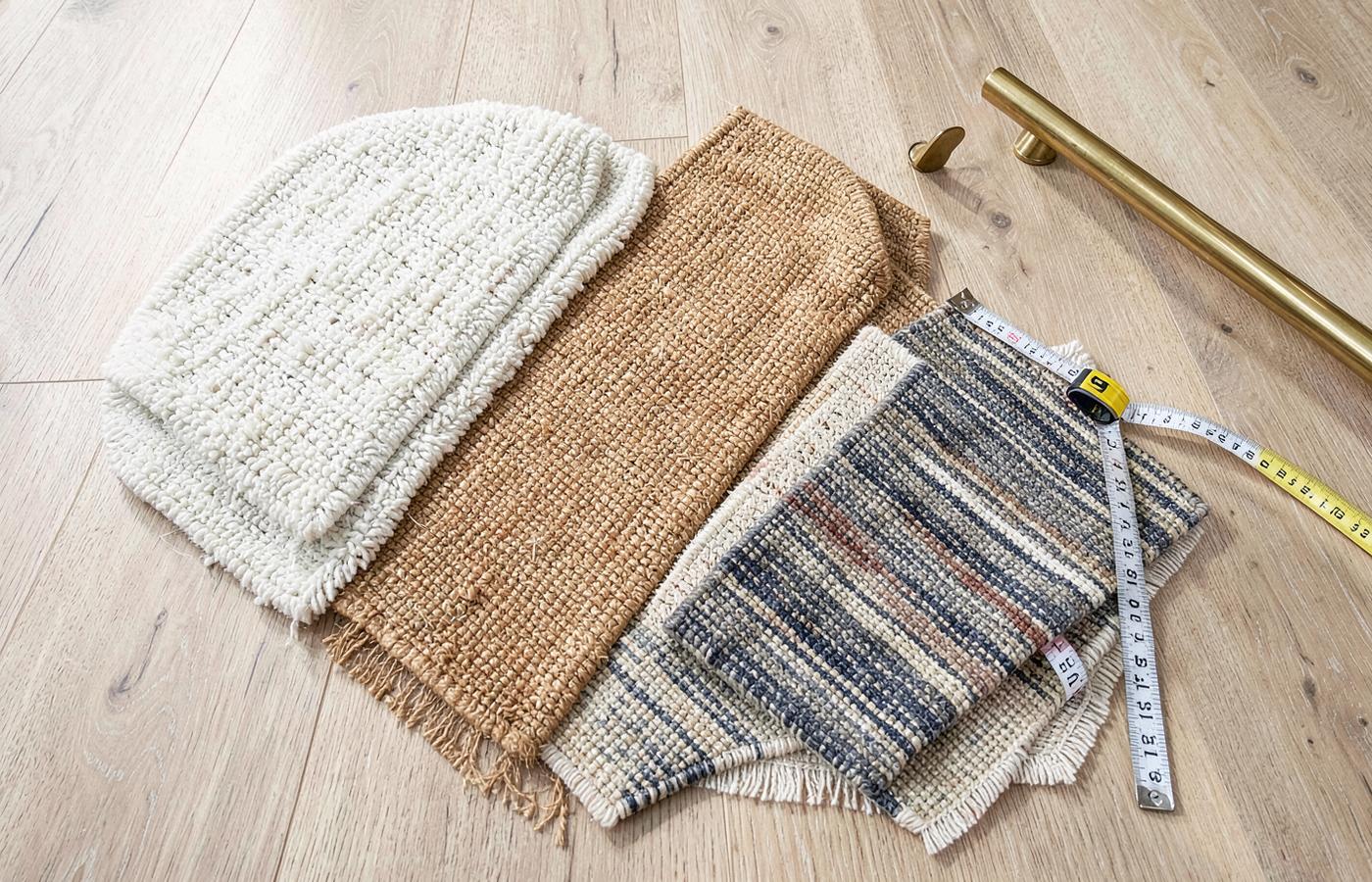 MaterialsStair Runner Materials ComparedWool, nylon, polypropylene, sisal and jute judged on stair-specific wear, comfort, cleaning and safety.
 CostWhat Affects Stair Runner CostThe material, labour and complexity variables behind a runner quote, and how to compare estimates fairly.