Measurement
How to measure for a stair runner
The formula, a worked example, and the special cases — winders, landings, bullnose steps and pattern repeats — that change the answer.
Written by the StairRunner.co editorial team · Updated 4 September 2026
Why measuring stairs is different from measuring a room
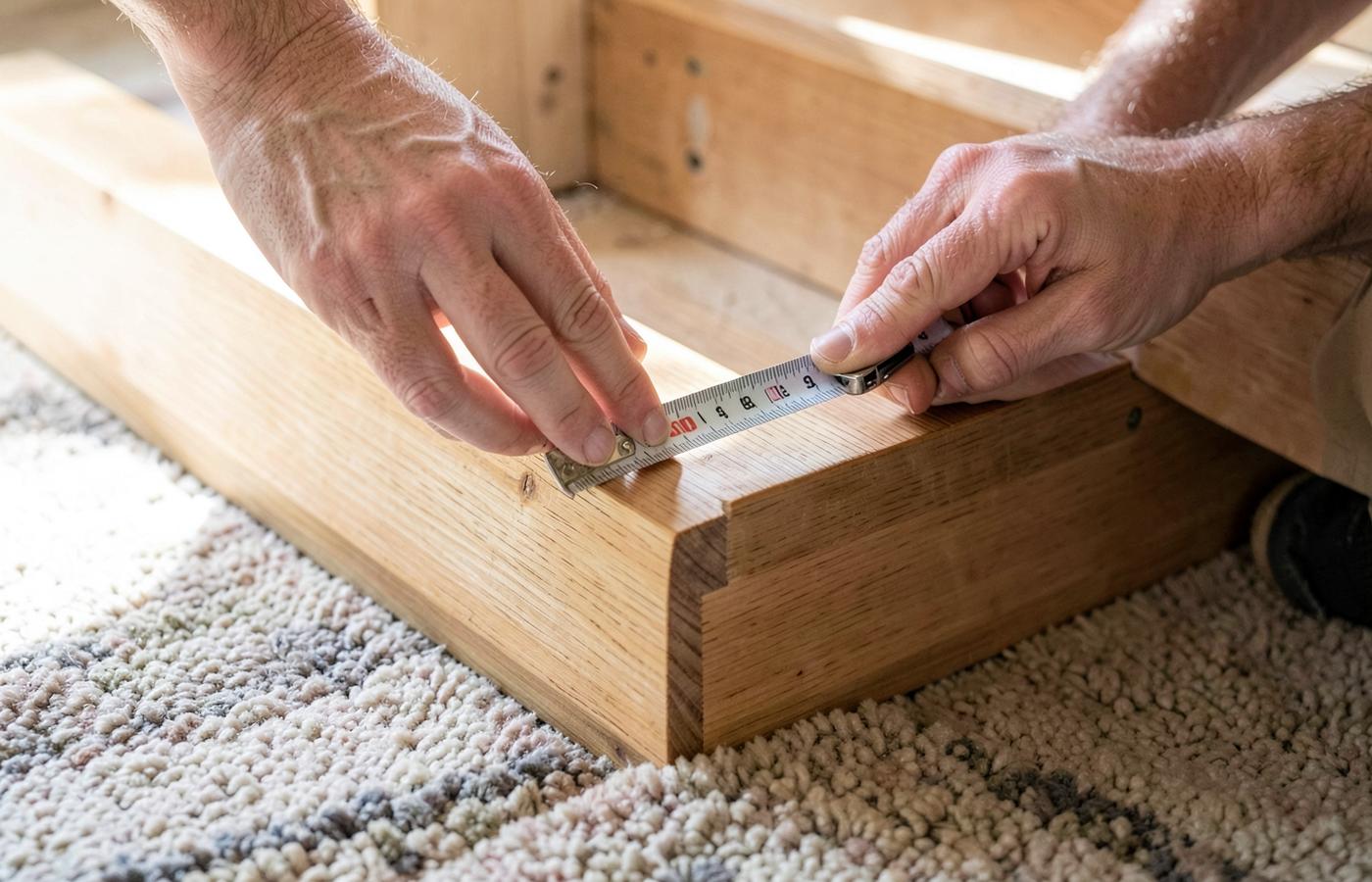
Measuring flat flooring is a matter of area: length times width, with an allowance for wastage at the edges. A staircase is not flat, and it is not one surface — it is a repeating sequence of horizontal and vertical faces joined at a nosing that consumes material every time the runner turns the corner. Two staircases with an identical vertical rise can need noticeably different lengths of runner if their tread depth, riser height or nosing profile differ. That is why a generic "length per step" rule of thumb is only a starting point, and why the formula below asks for your own measurements rather than an average figure.
The stair runner length formula
Written out, the calculation is:
Total length = ((tread depth + riser height + nosing allowance) × number of risers) + landing runs + waste allowance
The nosing allowance covers the fabric consumed as the runner curves over the projecting front edge of each tread. A shallow, square-edged tread uses less; a deep bullnose profile uses more. Measure the projection of your nosing and use that figure rather than a guess where the profile is pronounced.
Worked example
A straight flight of 13 risers, 10 in treads, 7.5 in risers, 1.25 in nosing wrap:
- Per step: 10 + 7.5 + 1.25 = 18.75 in
- Stair run: 18.75 × 13 = 243.75 in (20.3 ft)
- Waste at 10%: 24.4 in
- Order length: 268.2 in — about 22.4 ft, or 7.5 yd
Runner sold by the running foot is usually quoted in feet, so round up to the next whole foot. Woven runners sold by the yard round up to the next yard.
A second worked example, with a landing
A dog-leg staircase with two flights of 8 risers each, joined by a 40 in landing, treads 10.5 in and risers 7 in, nosing wrap 1 in:
- Per step: 10.5 + 7 + 1 = 18.5 in
- Both flights: 18.5 × 16 = 296 in
- Plus landing run: 296 + 40 = 336 in
- Waste at 12% (turn adds complexity): 40.3 in
- Order length: 376.3 in — about 31.4 ft, or roughly 10.5 yd
Notice the waste allowance moved up slightly from the first example. That is a judgement call, not a fixed rule — turns, joins and pattern-matching all justify a higher allowance than a plain straight flight.
Stair runner length calculator
Measure one typical step, count your steps, and the estimate below shows every part of the calculation so you can check it against an installer's figure.
Count risers, not treads.
Front edge to riser behind.
Tread surface to tread above.
Extra to curve over the tread edge.
Total straight length across landings.
10–15% typical; more for patterns.
| Length per step (tread + riser + nosing) | 18.75 in |
|---|---|
| Stair run (13 steps) | 243.8 in |
| Landing run | 0.0 in |
| Waste allowance (10%) | 24.4 in |
This is an estimate for planning and for sanity-checking a quote. Winder steps, curved flights, bullnose bottom steps and pattern repeats all change the figure. Have the staircase measured on site before cutting or ordering material.
How to take the measurements accurately
- Count the risers. Every step contributes one tread and one riser. The top riser finishes at the landing, so the riser count is the number to multiply by.
- Measure a typical mid-flight step, not the bottom one. Bottom steps are frequently deeper or bullnosed.
- Spot-check three steps. If tread depth varies by more than about ¼ in (6 mm), measure every step and total them individually.
- Measure the nosing projection from the face of the riser to the front edge of the tread above.
- Measure stair width at the narrowest point, usually where a skirting board or stringer intrudes.
- Record every figure in a simple table as you go — step number, tread depth, riser height, and any note about irregularity. This turns a fifteen-minute job into a document you or a fitter can check later without climbing the stairs again.
Choosing the width
Runner width is a proportion decision, not a fixed rule. The margin of visible tread on each side should look deliberate and stay even up the flight.
| Stair width | Common runner width | Margin each side |
|---|---|---|
| 32 in (81 cm) | 26–27 in (66–69 cm) | 2.5–3 in (6–8 cm) |
| 36 in (91 cm) | 27–30 in (69–76 cm) | 3–4.5 in (8–11 cm) |
| 42 in (107 cm) | 32–36 in (81–91 cm) | 3–5 in (8–13 cm) |
Narrow margins of under 2 in (5 cm) tend to read as a fitting error rather than a design choice, and they are awkward to clean. Very wide margins leave more timber exposed to wear. On a staircase that varies in width, set the runner to the narrowest step and centre it consistently; a runner that follows the wall will drift visibly. The full reasoning behind margin choice, including how it interacts with stringer style, is set out in the stair runner width guide.
Special cases
Landings
Measure a landing as a flat run and add it to the total. Where the runner turns across a landing, an experienced fitter will usually cut and re-join the material so the pile direction and pattern continue correctly rather than folding it round the corner. See how a runner is finished at the top of the stairs for the detail of that junction.
Winder stairs
Winders are wedge-shaped, so each one is measured on its own. Take the depth along the longest edge of the tread — the outside of the turn — because that is the line the runner must cover. Winders consume material quickly and are the main reason a real quote exceeds a straight-flight estimate. They are also the strongest argument for professional measurement and fitting. The winder stair runner guide covers how the material is shaped and joined around the turn.
Bullnose or curved bottom steps
A bullnose step is wider and rounded, so it needs its own measurement and often a separate piece of material shaped to the curve. Measure across the widest point of the curve, not the straight width above.
Patterned material
A pattern that must land in the same place on every tread needs extra material equal to roughly one pattern repeat per join. Ask the supplier for the repeat length before you order and add it to the waste allowance. Stripes and directional patterns also need a consistent pile direction, so the whole run should come from a single roll or dye lot.
Open-sided and narrow staircases
On an open-sided staircase, the runner's edge on the open side has no stringer to define it, so the margin has to be judged against the baluster line rather than a fixed board. Measure to the inside face of the balusters and keep a slightly wider margin than you would on an enclosed side, since an edge that overhangs an open side is both visually awkward and a genuine trip risk.
Common measurement mistakes
- Counting treads instead of risers, which loses a step of material.
- Measuring the bottom step and applying it to the whole flight.
- Ignoring the nosing wrap, which quietly shortens the runner by a foot or more.
- Ordering to the exact calculated length with no waste allowance.
- Setting width from the widest step, so the margins pinch further up.
- Forgetting to measure the landing separately, so the total quietly falls short by the landing's length.
- Measuring in a hurry with the tape held at an angle, which inflates every reading slightly and compounds over a long flight.
What to do with the finished measurements
Once you have a length and width you trust, use them consistently through the rest of the project. Quote the same figures to every supplier so comparisons are like for like, and keep the original notes — tread depth, riser height, nosing projection, width at the narrowest point — because a fitter will want to verify them on site rather than take a total figure on trust. If the numbers feed into a cost estimate, small rounding decisions here (whole feet versus exact inches) can move the total more than people expect on long flights.
Frequently asked questions
- Can I use a laser measure for stair runners?
- Yes, laser measures are excellent for long straight runs and landing dimensions, but a traditional steel tape is often more accurate for tight internal measurements like nosing wrap and riser height where the laser housing might not fit into the crease.
- How do I measure a staircase that turns twice?
- Treat it as three separate flights and two landings. Measure each flight individually using the standard formula, then add the full length and width of both landings to your total before applying the waste allowance.
- How do you calculate stair runner length?
- Add tread depth, riser height and a nosing wrap allowance to get the length used by one step. Multiply by the number of steps, add any landing runs, then add 10–15% for waste and pattern matching.
- How wide should a stair runner be?
- Choose the width that leaves an even margin of 3–5 in (7–13 cm) of visible tread on each side. On a 36 in (91 cm) staircase that usually means a 27–30 in (69–76 cm) runner.
- Do you measure treads or risers to count steps?
- Count risers. Every step contributes one tread and one riser to the runner path, and the top riser meets the landing, so the riser count is the reliable figure.
- How much extra should you allow for waste?
- 10% is a common allowance on a plain runner and a straight flight. Allow more for patterned material that must be matched step to step, for winders, and for a bullnose bottom step.
- What tools do I actually need to measure a staircase properly?
- A steel tape measure, a notepad or phone to log each step individually, and a straight edge for checking nosing projection are enough for most straight flights. A laser measure speeds up landings and long runs but is not essential.
- Should I measure before or after choosing the material?
- Measure the staircase first to know the length and width you need, then confirm the figure against the actual roll or batch once you have chosen a material, since pattern repeats and roll widths can change the final order quantity.
Sources and further reading
- Carpet and Rug Institute — carpet installation standards and guidance
- International Code Council — stair geometry provisions in the model codes
Where guidance differs between manufacturers, trade bodies or local building regulations, we say so rather than presenting one position as universal.
Related guides
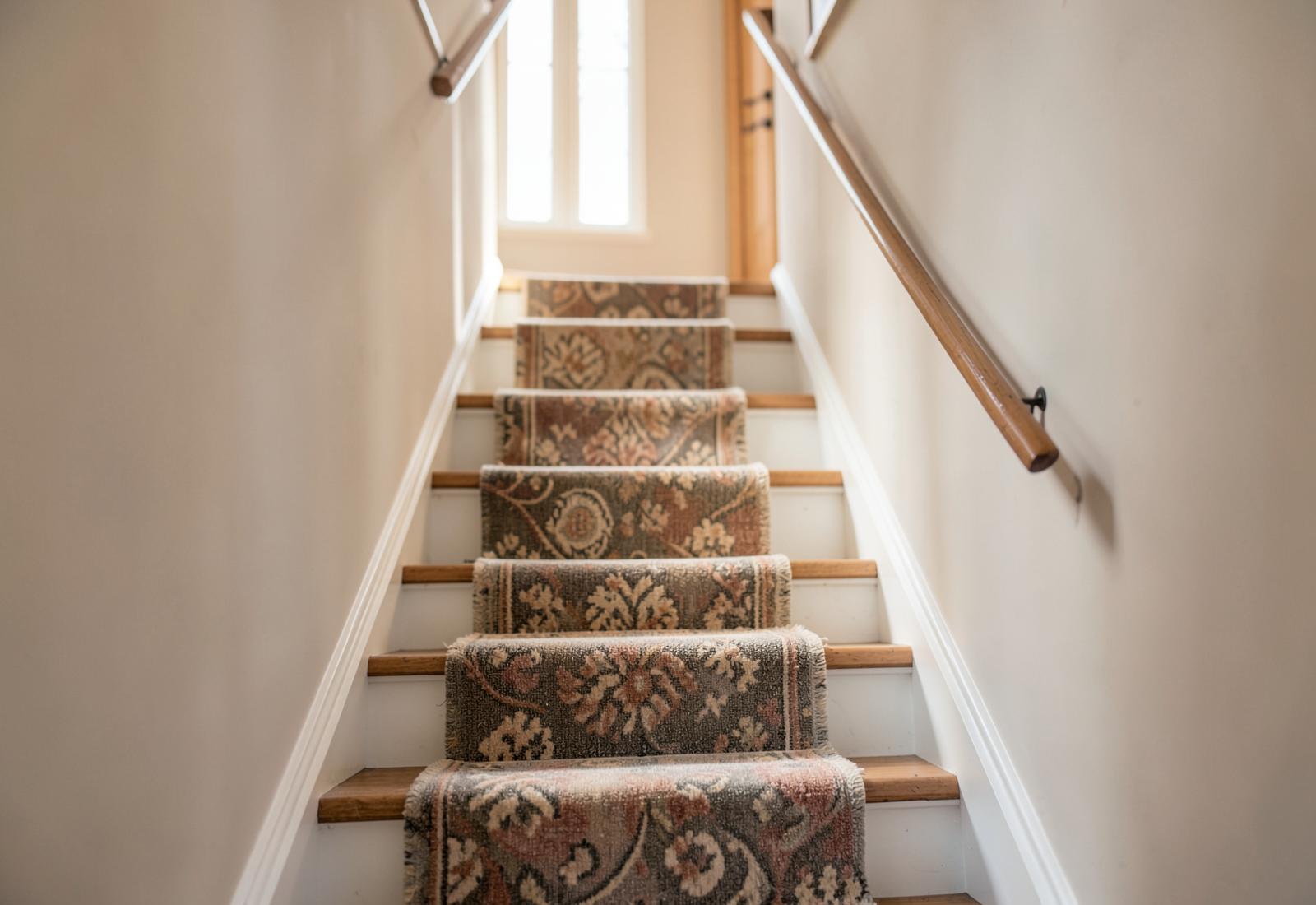 BasicsStair Runners: A Complete GuideWhat a stair runner is, how it differs from full carpet, and how to decide whether one is right for your staircase.
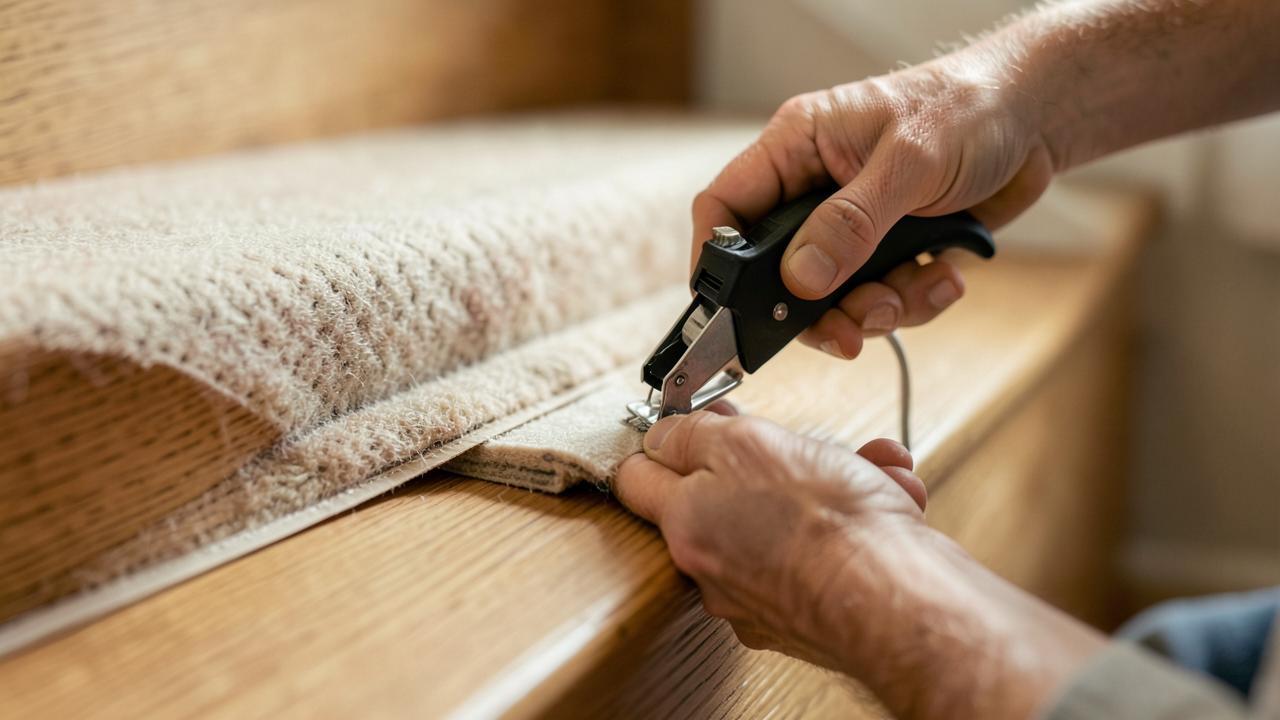 InstallationHow to Install a Stair RunnerWaterfall and Hollywood methods, staples versus rods, tools, sequence and quality checks.
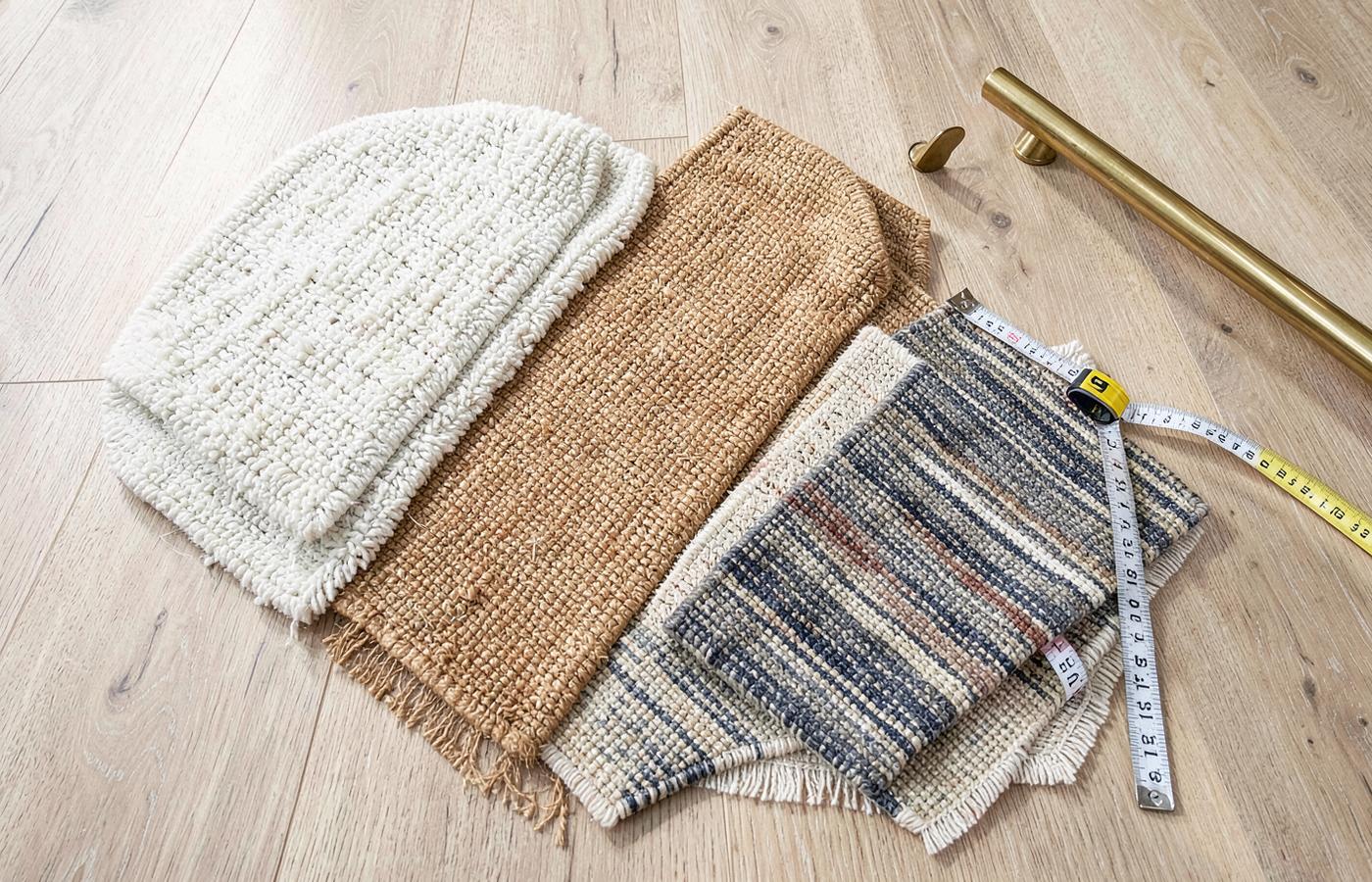 MaterialsStair Runner Materials ComparedWool, nylon, polypropylene, sisal and jute judged on stair-specific wear, comfort, cleaning and safety.
 CostWhat Affects Stair Runner CostThe material, labour and complexity variables behind a runner quote, and how to compare estimates fairly.
Measuring for a bullnose bottom step
A bullnose or curtail step is the rounded, wider step at the very base of many traditional staircases. Measuring it requires a different approach to the standard rectangular tread. Because the runner must curve around the outer edge of the bullnose, you cannot simply use a straight width measurement. Instead, use a flexible tape measure to follow the outer perimeter of the curve where the runner will sit. If you are fitting a separate piece of carpet to the bullnose, record the maximum depth and the total arc length. This is one of the most common areas for measurement errors, so recording the step as a "feature step" with its own specific dimensions is essential for a clean professional finish.
Calculating for stair runners on winders
Winder stairs are wedge-shaped steps used to turn a corner without a landing. Because they are narrow at one end and wide at the other, measuring them requires finding the "walking line" — typically the path taken about 30cm (12 inches) from the narrow end. However, for material estimation, you must measure the deepest part of the tread (the outer edge). A common professional technique is to measure the widest diagonal of the winder and add that to the total run. Winders consume material significantly faster than straight flights, and the waste allowance should be increased to at least 15-20% if the flight contains multiple turns, as pattern matching on curved sections requires more flexibility in where cuts are made.
Handling pattern repeats and wastage
When ordering a patterned runner, the "waste allowance" is not just for mistakes; it is for geometry. If a runner has a 30cm (12 inch) pattern repeat, and your step length (tread + riser + wrap) is 45cm (18 inches), the pattern will naturally shift on every step. To ensure the pattern lands in the exact same spot on every tread for a symmetric look, the fitter may need to trim and join the runner at the crease of every step. This "cut and shut" method consumes much more material than a continuous run. Always check the pattern repeat dimension on the manufacturer specification and, if in doubt, order an extra 20% to avoid being left short at the top of the flight where dye-lot differences would be most visible.