About
About StairRunner.co
An independent reference for people trying to make a good decision about what goes on their stairs.
Written by the StairRunner.co editorial team · Updated 4 September 2026
What this site is
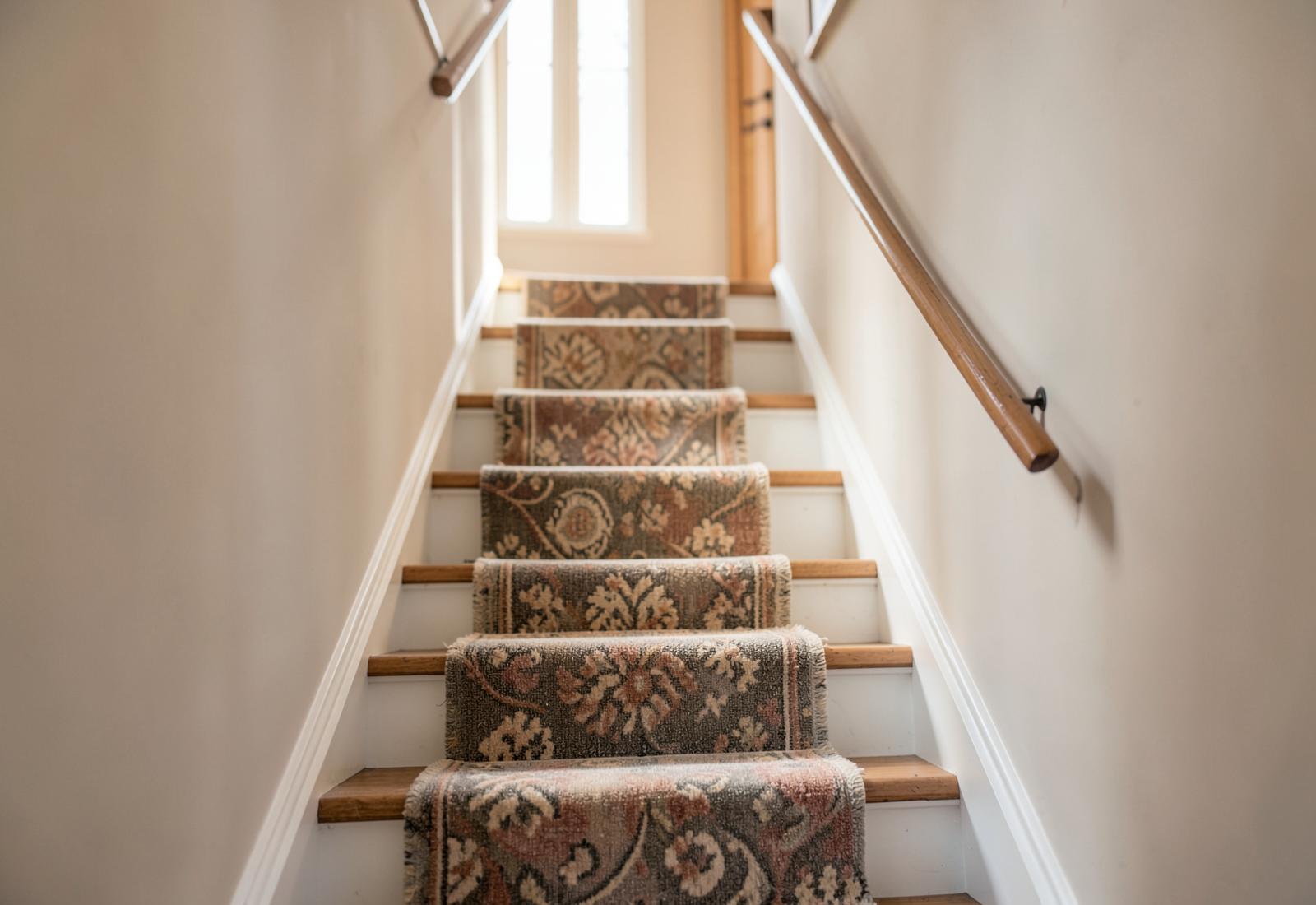
StairRunner.co is a specialist publication covering one narrow subject properly: stair runners and the staircases they are fitted to. That includes measuring, installation methods, fibres and constructions, cost structure, design decisions, and long-term care.
It exists because the information available on this topic is unusually poor. Most of it is either a product listing, a photo gallery with captions, or an article that avoids the specifics — the actual formula, the actual trade-off, the actual reason a job fails. Our aim is to publish the version a competent installer would give you if they had time to explain.
A staircase is one of the few surfaces in a home that combines heavy daily traffic, structural complexity and genuine safety consequence. Get a rug wrong and you replace a rug. Get a stair covering wrong and you can end up with a trip hazard, a runner that fails at the nosing within a year, or a job that has to be pulled up and refitted at real expense. That is a high enough stake to justify a site that only does this one thing, and does it thoroughly rather than broadly.
Why a narrow site
General home-improvement sites tend to treat stair runners as a subsection of "flooring" or "rugs", which flattens away the parts that actually make stairs different: the geometry of treads and risers, the way pile crushes differently at a nosing than on a flat floor, the fact that a runner has to be measured flight by flight rather than as a single rectangle, and the fact that an installation mistake is far more consequential underfoot on a stair than on a landing. Treating the staircase as its own subject, rather than an afterthought, is the entire reason this site exists in its current form.
Who it is for
- Homeowners planning a runner and trying to brief a supplier accurately.
- People checking whether a quote or a measurement looks right.
- Interior designers and specifiers who need the practical constraints.
- DIY fitters deciding whether their staircase is a realistic project.
- People replacing an existing runner who want to understand why the last one failed before choosing its replacement.
- Landlords and letting agents weighing durability and maintenance against appearance for a rental property.
These readers arrive at very different points in the process. Some are still deciding whether a runner is the right choice at all, and start with runner versus fitted stair carpet. Others have already chosen a material and need to get the measurements right before ordering. Others are past a failed installation and are trying to work out what went wrong before they pay for it to be redone. The site is structured so each of those readers can land on the specific guide they need without reading the rest.
How our guides are produced
- We define the question first. Each guide exists to answer one clear question, and it answers it in the opening paragraph rather than after a preamble.
- We ground the technical content in manufacturer documentation, trade association standards and published installation practice, rather than in other search results.
- We show the working. Where a calculation is involved, the formula and the terms are on the page so you can check them — the same approach behind our runner length calculator.
- We qualify what varies. Staircase construction, building regulations and fire-safety requirements differ by jurisdiction and by property. Where a figure is situational, we say so instead of publishing a false universal.
- We review guides on a schedule and when practice, products or standards change. Update dates change only when the content does.
How a guide gets written
The process starts with the question a reader is actually asking, phrased the way they would ask it — "how much runner do I need" rather than "stair runner measurement overview". We then work out what facts, formulas and decision points are genuinely required to answer it well, and only after that is the page drafted. Anything that does not serve the reader's decision is cut, including background history, generic styling advice unconnected to the mechanics of the staircase, and padding intended only to lengthen the page. A page is finished when a competent reader could act on it correctly, not when it reaches a target word count.
Where a topic overlaps with another guide — measurement feeding into cost, cost feeding into material choice — we link between them rather than repeating the explanation in full each time. This keeps each page focused and keeps the site internally consistent: if the measurement method changes, it changes in one place.
What we will not do
We do not invent credentials, professional affiliations, certifications, years of experience, awards or clients. We do not publish fabricated statistics, invented customer testimonials, or made-up national average prices. Where we cannot verify a figure, we explain the variables behind it instead of guessing — this is why our cost guide is structured the way it is.
Editorial contributors are currently unnamed. Rather than manufacture an expert persona, guides are attributed to the StairRunner.co editorial team. When named contributors with verifiable relevant experience join the site, they will be credited individually with real biographies.
Scope and limits
This site explains how stair runners work, how to measure and specify them, and how the common materials and methods compare. It does not replace a site visit from a fitter, and it is not a substitute for local building-regulation advice, particularly where fire escape routes, handrail requirements or accessibility rules are concerned. Where those topics come up, our guides say so explicitly and point you toward confirming locally rather than assuming a single rule applies everywhere.
Commercial position
The site does not currently carry sponsored placements or affiliate recommendations. If that changes, commercial content will be labelled clearly and separated from editorial guidance, and no commercial relationship will alter the substance of a recommendation. Our editorial policy sets out the detail.
How the site is organised
Guides fall into a small number of families, and knowing them helps you find the right depth of answer quickly. Foundational guides, such as measurement and width and margins, cover the mechanics that almost every other guide assumes you already understand. Decision guides, such as runner versus fitted carpet and wool versus synthetic fibre, help you choose between two genuinely competing options. Situational guides, such as winder and curved stair runners or fitting a runner over existing carpet, exist for staircases or circumstances that do not follow the general case. We link between these families deliberately, so a reader who starts with a decision guide can drop into the foundational mechanics whenever the decision depends on them, rather than having that detail repeated inline every time.
A separate glossary collects the terminology used across all three families in one place. We built it because stair-runner terminology is inconsistent across the trade — the same part is sometimes called a nosing and sometimes a bullnose edge, for instance — and a reader moving between guides, or between our guides and a fitter's quote, benefits from a single definitional reference rather than picking the meaning up piecemeal from context.
What "independent" means here
We use the word independent in a specific sense: no manufacturer, retailer or installer pays for placement, wording or a favourable comparison anywhere on the site. It does not mean opinions are neutral in every philosophical sense — we do take positions, including ones some readers will disagree with, such as recommending against a particular installation shortcut or steering away from a construction we think performs poorly on stairs specifically. Independence here means those positions are arrived at through research and are not for sale, not that we refuse to hold a position at all. A site that never recommends anything is not more trustworthy; it is simply less useful.
How disagreements between sources are handled
Trade guidance on stair runners is not perfectly consistent. Manufacturers sometimes describe their own products' suitability more generously than independent testing would, and long-standing trade conventions occasionally lag behind newer materials. Where we find a genuine disagreement between sources, we do not silently pick the version that is easiest to write about. We describe the disagreement, explain what is driving it where we can, and give a reasoned view rather than presenting a false consensus. This is slower to write than simply repeating a manufacturer's claim, but it is the only approach that holds up when a reader checks our guidance against their own research.
Feedback and how it changes the site
Reader messages sent through the contact page directly shape what gets written or revised next. A correction changes the page it concerns immediately once verified. A recurring question that is not yet answered anywhere becomes a case for a new section or, occasionally, a new guide. A note that an explanation was hard to follow is treated as seriously as a factual error, because a technically correct guide that cannot be understood has failed at its job just as thoroughly as an inaccurate one.
A note on scope creep
It would be easy to widen this site into general flooring, general home renovation, or general interior design, and each of those adjacent topics would likely bring more traffic than staying narrow does. We have deliberately not done this. The value of a specialist reference comes from covering its subject completely rather than covering many subjects thinly, and every guide added outside the staircase makes the ones inside it marginally less the focus of the site. If that changes in future, it will be a deliberate and disclosed decision, not a gradual drift.
Who works on this site
The site is produced by a small editorial team responsible for research, writing and fact-checking. We do not publish invented bylines or fictional biographies to make the team appear larger than it is. As the site grows, named contributors will be added with genuine, verifiable backgrounds rather than composite or aspirational ones, and until that point content is correctly attributed to the editorial team as a whole rather than to an individual who does not exist.
We think this matters more in a niche subject than in a broad one. A generic home-and-garden site can get away with vague authorship because no single guide carries much weight on its own. A site that people use to check a measurement before cutting an expensive length of carpet, or to decide whether a quote from a fitter is reasonable, should be honest about who stands behind that guidance and how it was produced.
How to use this site well
Start with the guide that matches the decision in front of you, not the one that sounds most authoritative. If you are choosing a material, start with the comparison guides. If you already know the material and need a length, start with the calculator and read the underlying measurement guide alongside it so you understand what the numbers mean, rather than treating it as a black box. If your staircase does not match the standard rectangular-tread case, check whether it fits one of the situational guides before assuming the general advice applies unmodified.
If you are ever unsure which guide applies to your situation, the fastest route is usually the glossary, which cross-references terminology back to the guides that explain it in full, or the contact page if nothing on the site quite matches what you are trying to work out.
That extra step of orientation is worth taking before you start following individual links, since a five-minute read of the right overview usually saves more time than jumping straight into a detailed guide that turns out not to match your staircase.
Corrections
If something here is wrong, we want to fix it. Send the page and the correction through the contact page. Substantive corrections are made to the page and reflected in its update date.