Cost
Stair runner installation cost
We do not publish average prices, because labour rates vary too much by region and staircase to make a single figure useful. What we can do is show you exactly how a quote is built.
Written by the StairRunner.co editorial team · Updated 4 September 2026
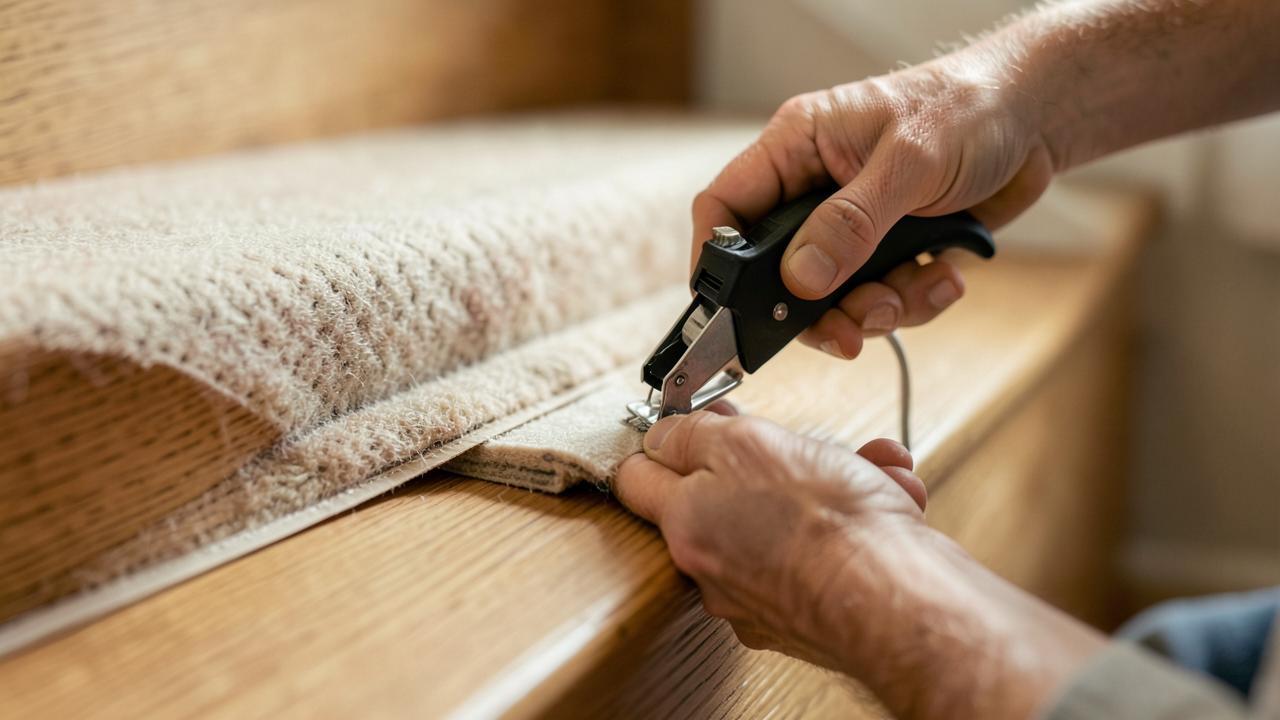
The components of a labour quote
| Line | What it covers | Why it varies |
|---|---|---|
| Per-step fitting | Tack strip, pad, tensioning, fixing, trimming | Step count; tread consistency; carpet stiffness |
| Landings | Separate cut, edge fixing, joins | Size, number of turns, whether bound edges are needed |
| Winders and curves | Templating and shaped cuts per step | Frequently priced at a multiple of a straight step |
| Open-sided stairs | Finishing a visible edge on one or both sides | Requires binding or careful tucking; skilled work |
| Removal and disposal | Lifting old carpet, pad, strip and staples; taking it away | Often excluded by default; disposal fees vary locally |
| Preparation | Securing squeaking treads, filling, sanding | Only discoverable once the old covering is up |
| Rods and hardware | Bracket templating and fitting per step | Adds meaningful time; see stair rods |
What raises the price legitimately
- Winders, pie steps and curved flights — each one is a template and a shaped cut.
- Open strings and bullnose bottom steps requiring finished edges.
- Pattern matching, through both time and extra material.
- Stiff natural-fibre backings that resist wrapping a nosing.
- A Hollywood fit rather than waterfall.
- Difficult access, no parking, or working around occupied rooms.
Comparing two quotes
- Normalise the scope — write out the same list of items for both.
- Check the step count each one used; miscounts are common.
- Confirm which fitting method is priced.
- Confirm the pad specification, not just that a pad is included.
- Check the waste allowance for pattern matching.
- Ask what happens, and what it costs, if the treads need repair once exposed.
How fitters actually build a per-step rate
A per-step rate is not arbitrary. It is built from an estimate of how long an average step takes, multiplied by an hourly or day rate, with a margin for the unpredictable parts of the job — trapped staples, an uneven tread, a fixing that will not bite cleanly into old timber. Fitters who quote confidently per step have usually done enough flights to know their own average pace; fitters who prefer a day rate for anything beyond a simple straight run are often responding to how much that average varies once winders, curves or heavy natural fibre are involved.
This matters when you compare quotes, because a lower per-step rate is not automatically cheaper if the fitter has priced fewer of the actual steps, excluded landings from the count, or is planning to raise a variation once the job starts. Ask for the step count the quote is based on and check it against your own count from the measurement guide.
Waterfall versus Hollywood, in labour terms
The fitting method you choose changes the labour content of every single step, not just the finish. A waterfall fit runs the carpet straight down over the nosing without following the angle of the riser underneath, which is faster to fit and forgiving of small tread irregularities. A Hollywood fit tucks the carpet into the angle where tread meets riser, giving a crisper, more tailored look at the cost of more time per step and more precision in the tensioning. If a quote does not say which method it assumes, ask — it changes both the look of the result and the number of hours behind the price.
What a site visit should establish before pricing
- An accurate step count, including any winders, and their individual widths.
- Whether landings are part of the run or will be a separate piece.
- The condition of the treads and risers under the existing covering, so far as visible.
- Which fitting method suits the staircase and your preference — see waterfall versus Hollywood.
- Access for delivery of materials and whether parking or a lift affects the job.
- Whether stair rods or another decorative fixing are wanted, which changes the fitting sequence.
Timeframes and what affects them
A straightforward straight flight with a plain runner is commonly a one-day job once the old covering is removed. Winders, curved stairs, pattern matching, or a full strip-out of old carpet, gripper and staples extend that, sometimes across two days if preparation reveals repairs. Ask for a realistic timeframe rather than an optimistic one, and ask what happens to your household access to the staircase overnight if the job is not finished in a day — this matters more in homes with only one usable staircase.
Warranties and comeback on workmanship
A labour price should come with some form of workmanship guarantee, separate from any manufacturer warranty on the carpet itself. Ask what it covers — typically re-fixing if the runner slips or a seam opens within a defined period — and get it in writing alongside the quote. A fitter who is reluctant to put a guarantee in writing is telling you something about how they expect the job to hold up.
Negotiating scope, not just price
If a quote is above budget, the more productive conversation is usually about scope rather than asking for a discount on the same job. Could the landing be carpeted separately later? Could you remove and dispose of the old carpet yourself to remove that line? Could stair rods be added at a later date rather than in the same visit? A good fitter can usually reprice a reduced scope quickly, and this tends to produce a fairer outcome than haggling over the original figure.
Where DIY changes the maths
Doing the work yourself removes the labour line but not the material, and a mis-cut custom length is usually unreturnable. On a plain runner and a simple straight flight the saving is real; on a patterned runner or a complex staircase the risk often exceeds it. That trade-off is worked through in DIY stair runner installation, and the full project picture is in what affects stair runner cost.
DIY prep that can reduce the professional bill
Some preparation work is safe to do yourself even if you intend to hire a fitter for the runner itself, and doing it in advance can shorten the paid visit. Clearing the staircase of furniture and wall art, vacuuming thoroughly, and removing any loose stair rods or old fixtures are all reasonable to do yourself. Removing old carpet and gripper is a larger undertaking — it is physical, it is dusty, and old staples are sharp — but a competent DIYer can do it safely with the right tools, and some fitters will happily discount their quote if the flight is already stripped back to bare timber when they arrive. Confirm this in advance rather than assuming it, since a fitter who has priced for removal will not automatically reduce the bill if you do it yourself without agreeing it first.
Regional and seasonal variation in availability
Fitter availability, rather than the underlying cost of the work, is often the biggest driver of how quickly you can get booked in and, indirectly, of price. Demand for home improvement work tends to rise around certain times of year, and a fitter with a full diary may quote higher simply because they do not need the job, while a quieter period can bring more competitive pricing for the same scope. It is reasonable to ask a fitter how soon they can start, since a long lead time sometimes signals a fitter worth waiting for rather than a reason to look elsewhere.
What a written quote should always contain
- The exact step count and whether landings are included or separate.
- The fitting method assumed — see waterfall versus Hollywood.
- The pad specification, by name or by density and thickness figures.
- Whether removal and disposal of the old covering is included.
- The waste allowance built in for the carpet, especially if it is patterned.
- Any workmanship guarantee, its length, and what it covers.
- Payment terms and what happens if the job runs over the quoted time.
Hidden costs to ask about explicitly
Some costs only appear once work is underway, and a careful quote will address them in advance rather than leaving them as a surprise. Ask specifically what happens if a tread is found to be damaged, squeaking, or unlevel once the old carpet is lifted — this is common in older houses and is not a sign of a bad quote, only of work that could not be assessed until the covering came up. Ask too whether disposal of the old carpet includes a tip or waste transfer fee, which some local authorities charge and which a fitter may pass on separately rather than folding into the headline price.
When a day rate makes more sense than a per-step price
For flights with heavy pattern matching, multiple winders, or unknown tread condition, some fitters prefer a day rate to a per-step quote, because the unpredictability makes a fixed per-step figure risky for both sides. A day rate is not automatically more expensive; it simply shifts the risk of the job overrunning from the fitter to a shared, transparent conversation about progress. Ask what happens if the job finishes early or late under a day rate before agreeing to it.
Tipping, extras and good practice on the day
Tipping a fitter is not standard practice in the way it might be in hospitality, but offering tea, clear access, and moving fragile items out of the way yourself is genuinely appreciated and can make a complex job run more smoothly. None of this should be expected to change the price, but it is a reasonable courtesy on a job that often takes a full day in someone's home.
Frequently asked questions
- How is stair runner installation priced?
- Most fitters price per step, sometimes with a minimum call-out, and add separately for landings, winders, curved or open-sided steps, removal of old covering, and any preparation work. Some quote a day rate instead for complicated flights.
- Why do two quotes for the same stairs differ so much?
- Usually because they include different things. One may assume you have removed the old carpet, exclude the pad, or price a waterfall fit where the other prices Hollywood. Ask both to itemise steps, landings, pad, removal, disposal and waste allowance before comparing.
- Does a patterned runner cost more to install?
- Yes. Centring and matching a repeat takes longer and consumes more material. The material allowance is the bigger of the two effects and should be shown separately in the quote.
- Is removal of the old carpet included?
- Often not, and disposal is frequently a separate line. Lifting old carpet, pad, tack strips and staples from a full flight is genuine work, and leaving hundreds of staples in the treads causes problems for the new fit.
- Should I always get a site visit before accepting a quote?
- Yes, for anything beyond a simple straight flight. A visit lets the fitter check the step count, tread condition and access, all of which affect the final price.
- Does a workmanship guarantee cost extra?
- It should not. Ask what a fitter's guarantee covers and for how long, and get it in writing alongside the quote rather than assuming it applies by default.
Related guides
- InstallationHow to Install a Stair RunnerWaterfall and Hollywood methods, staples versus rods, tools, sequence and quality checks.
 CostWhat Affects Stair Runner CostThe material, labour and complexity variables behind a runner quote, and how to compare estimates fairly.
- InstallationDIY Stair Runner InstallationAn honest assessment of doing it yourself: skills, tools, time, safety and the jobs worth handing over.
 MeasurementRunners on Winder, Curved and Open StairsMeasuring and fitting where treads are not rectangles: winders, pie steps, curves and open-sided flights.