Tools
Stair runner length calculator
Enter your step count and step dimensions to get a runner length, with every part of the arithmetic shown so you can check it against your own measurements.
Written by the StairRunner.co editorial team · Updated 4 September 2026

Stair runner length calculator
Measure one typical step, count your steps, and the estimate below shows every part of the calculation so you can check it against an installer's figure.
Count risers, not treads.
Front edge to riser behind.
Tread surface to tread above.
Extra to curve over the tread edge.
Total straight length across landings.
10–15% typical; more for patterns.
| Length per step (tread + riser + nosing) | 18.75 in |
|---|---|
| Stair run (13 steps) | 243.8 in |
| Landing run | 0.0 in |
| Waste allowance (10%) | 24.4 in |
This is an estimate for planning and for sanity-checking a quote. Winder steps, curved flights, bullnose bottom steps and pattern repeats all change the figure. Have the staircase measured on site before cutting or ordering material.
The formula, explained
A runner follows the surface of the staircase. On each step it travels horizontally across the tread, wraps over the nosing, and drops vertically down the riser to the next tread. So the material consumed per step is:
Per step = tread depth + riser height + nosing allowance
- Tread depth — the horizontal walking surface, measured from the face of the riser to the front edge.
- Riser height — the vertical face between one tread and the next.
- Nosing allowance — extra material for the curve where the runner wraps the projecting front edge. A Hollywood installation uses slightly more here than a waterfall.
Why the numbers are never quite identical step to step
On paper, every step in a flight should be the same size. In practice, older staircases settle, treads wear unevenly, and builders working to a plan on-site often finish with a slightly taller or shorter final riser to make the flight fit the floor-to-floor height exactly. A run built to a uniform "design" figure can therefore be a few millimetres out at the top or bottom step. That is rarely a problem for the runner's overall length, but it matters for exact tread-and-riser matching if you are colour- or pattern-aligning each step, and it is one reason a fitter templates in person rather than trusting a plan alone.
Worked example
Take a straight flight of 14 steps, each with a tread depth of 26 cm and a riser height of 18 cm, and a nosing allowance of 3 cm per step.
| Component | Figure |
|---|---|
| Per-step length (26 + 18 + 3 cm) | 47 cm |
| 14 steps × 47 cm | 658 cm |
| Top landing run (measured separately) | + 60 cm |
| Subtotal | 718 cm |
| Waste allowance at roughly 10% | + 72 cm |
| Order length | ≈ 790 cm |
Note that the waste figure here is illustrative, not a rule: a plain-coloured runner with no repeat might need only a small trimming margin, while a large patterned repeat could push the allowance considerably higher. Always confirm the actual figure with your supplier against the specific carpet you have chosen, as explained below.
Nosing allowance in more detail
The nosing allowance is the part of the calculation people most often get wrong, because it is small per step but compounds across a whole flight. It depends on two things: how far the tread projects past the riser face (the nosing "overhang"), and how the runner is fixed at that point.
- Waterfall fitting lets the runner fall straight down from the back of one tread to the front of the next, draping loosely over the nosing rather than being pressed into the angle. This generally uses slightly less material per step.
- Hollywood fitting tucks the runner into the joint between tread and riser at every step, following the exact profile of the nosing. This gives a crisper, more tailored line but consumes a little more material at each nosing because the carpet must wrap the curve closely rather than bridge it. See waterfall vs Hollywood for the full comparison.
If your nosing has an unusual profile — a rounded bullnose, a routed groove for a stair rod, or a metal edge strip — add a small extra margin on top of the standard allowance and confirm it with whoever is fitting the stair rods, since rod position can itself change how much wrap is needed.
What the calculator does not include
- Landings. Measure and add these separately — see landings and turns.
- Winders and curves. These consume more than a straight step and must be templated individually. See winder and curved stairs.
- Bullnose or curtail bottom steps, which usually need their own piece.
- Pattern matching waste, which depends on the repeat of your chosen carpet.
Winders: why per-step maths breaks down
The tread-plus-riser-plus-nosing formula assumes every step is a simple rectangle running straight across the stair. A winder step is wedge-shaped: it is much wider at the outer edge of the turn than at the inner edge, and the runner cannot simply be centred and cut to a uniform width without either narrowing the visible margin on one side or leaving too much uncovered tread on the other. Because of this, winders are usually measured and templated individually rather than folded into a formula, often using paper or card templates taken on site. Budget more material per winder step than for an equivalent straight step, and expect the fitter to treat this section as a separate task. The full method, including how many winders typically appear in a domestic quarter-turn or half-turn stair, is covered in winder and curved stair runners.
Pattern repeat and directional waste
Waste is not simply "a bit extra for mistakes" — it is largely driven by how the pattern on the carpet has to line up as it travels down the flight.
| Pattern type | Typical waste implication |
|---|---|
| Plain or textured, no visible repeat | Lowest — mainly trimming margin at each end and joins |
| Small all-over repeat | Low to moderate — occasional repositioning to avoid an awkward cut |
| Large one-directional repeat (e.g. a stripe or border) | Moderate — repeat must restart cleanly at defined points, such as each landing |
| Large two-directional or centred medallion pattern | Highest — the pattern must stay centred and aligned through winders and landings, often forcing extra length to reach the next clean repeat point |
Ask your supplier for the repeat size in centimetres and let them calculate the waste specific to that repeat and your flight length, rather than applying a flat percentage from a different job. See choosing a pattern for how pattern choice interacts with staircase shape more broadly.
Ordering rules that avoid an expensive shortfall
- Order slightly long, never slightly short. A few centimetres of surplus can be trimmed or tucked away at a hidden edge; a shortfall usually means re-templating and re-ordering the whole flight, with the matching dye lot possibly no longer available.
- Confirm the dye lot covers the full length in one piece if the flight is long, since carpet is woven or tufted in batches and later batches can differ subtly in shade.
- Get the final quantity from whoever fits it, after they have seen the staircase, not only from your own measurement or this calculator.
- Check the return policy on cut-to-order lengths before paying — most suppliers will not accept a return once a bespoke length has been cut.
Common errors when calculating length
| Error | Consequence | Fix |
|---|---|---|
| Measuring only one step and multiplying | Shortfall if steps are not perfectly uniform | Measure several steps and use the largest figures |
| Forgetting the nosing allowance entirely | Runner sits short at every step edge, looks pulled tight | Add 2–4 cm per step depending on fitting style |
| Folding landings into the per-step formula | Over- or under-orders the landing section | Measure landings separately, no riser component |
| Ignoring winders | Turn section cannot be cut from the straight-flight length | Template winders individually and add their own length |
| Using a generic waste percentage | Either wastes money or leaves too little for the actual repeat | Ask the supplier for a waste figure based on the real pattern repeat |
What to ask a fitter before you order
- Will you template the stair in person before cutting, especially at winders?
- What waste allowance are you using, and is it based on my actual pattern repeat?
- Will the runner be fitted waterfall or Hollywood, and does that change the length you need?
- Is there a spare offcut kept back for future repairs or rotation?
- What happens if the delivered length is short by the time fitting begins?
After the length: width and specification
Length is only half the order. Set the runner width and side margins from your clear tread width, then check the width against the roll sizes your carpet comes in, or specify a cut and bound custom width. The full measuring method, including how to handle awkward flights, is in the measuring guide. Once you have both figures, it is worth reading how they interact with underlay thickness, since a thicker pad changes the effective nosing wrap slightly and can shift your length calculation by a small but real margin on longer flights.
Frequently confused terms
Length is the total run of carpet from top to bottom, including landings. Run sometimes refers only to the straight sections between turns. Drop is occasionally used for the vertical riser component alone. When getting quotes from more than one supplier, confirm which of these terms they mean before comparing figures, since a mismatch in terminology is a common source of quotes that look different but are actually describing the same job.
Frequently asked questions
- How do you calculate stair runner length?
- For each step, add the tread depth, the riser height and an allowance for the nosing. Multiply by the number of steps, add any landing lengths, then add a waste allowance for pattern matching and finishing. The calculator on this page does that arithmetic and shows its working.
- How much waste should I allow?
- Allowance depends on the pattern and the staircase. A plain runner on a straight flight needs the least; a large two-directional pattern, winders or multiple landings need considerably more. Ask your supplier for their figure for your specific carpet rather than using a generic percentage.
- Should I include the top landing in the calculation?
- Only if the runner continues across it. Measure landings separately and add them; do not fold them into the per-step formula, because a landing has no riser component.
- Is a calculator accurate enough to order from?
- It gives a reliable planning figure from accurate inputs. It cannot see your staircase. Have the supplier or fitter confirm the final quantity before you buy cut-to-order material, which is normally non-returnable.
- Why does my calculated length differ from my fitter's quote?
- Fitters usually add their own waste allowance, round up to the nearest saleable length, and may include material for a spare offcut used to rotate worn sections later. Ask them to itemise the difference so you can see which of these applies.
- Do I measure along the pitch line or step by step?
- Either method should agree if done carefully. Measuring step by step (tread plus riser plus nosing, repeated) is easier to check and correct one step at a time, which is why the calculator uses it. A pitch-line tape measurement is a useful cross-check on a straight flight.
- How do I calculate for a landing that turns 90 degrees?
- Measure the longest length and the widest width of the landing area. Most landings are best treated as a separate rectangular piece of carpet that is joined to the straight flights at the nosing.
- Should I subtract the space for stair rods from my length?
- No. Stair rods sit on top of the runner; they do not replace any part of it. In fact, you may need a few extra centimetres to allow for the 'tuck' that some rod styles require.
Related guides
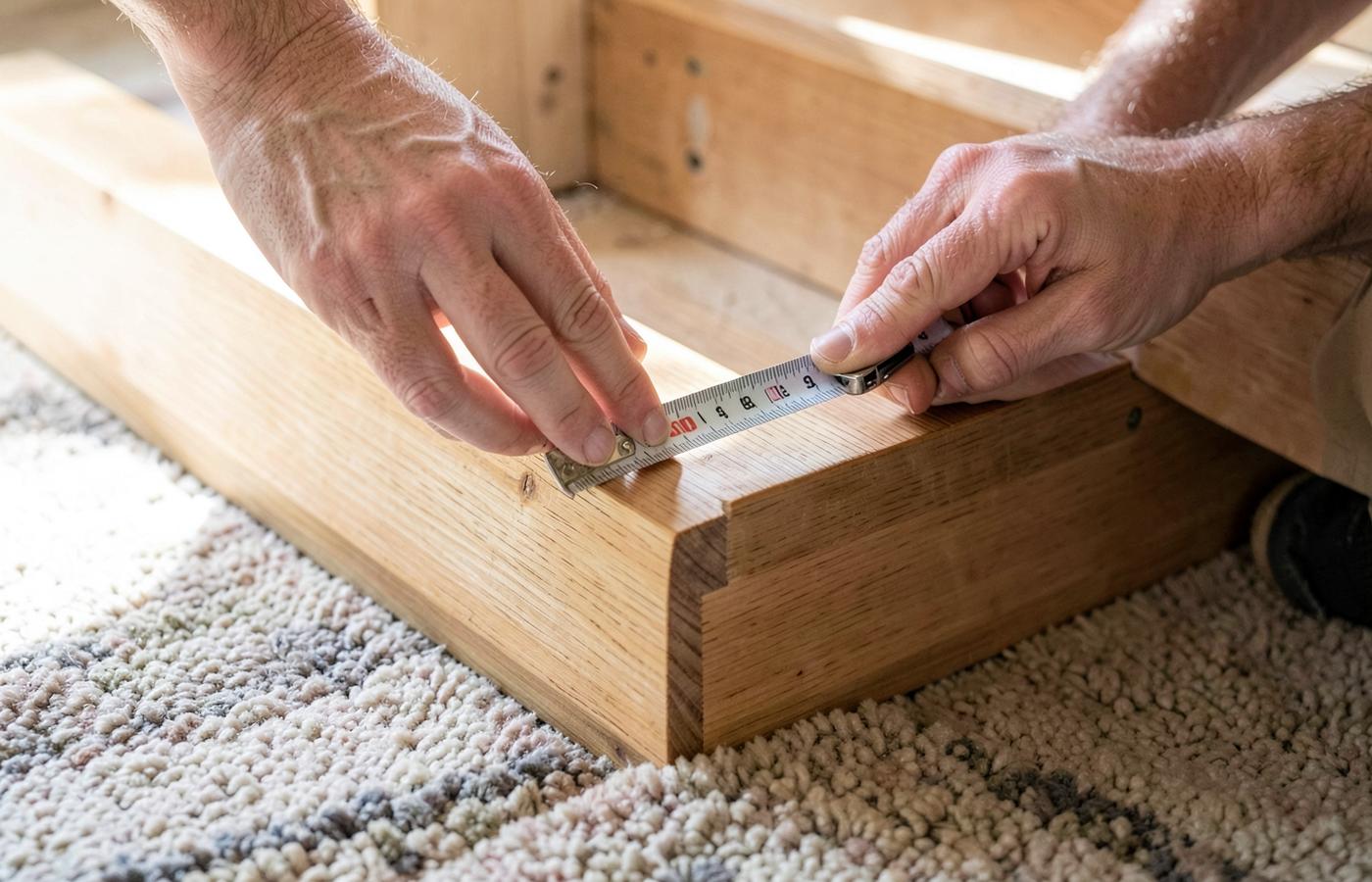 MeasurementHow to Measure for a Stair RunnerThe tread-plus-riser formula, waste allowance, winders and landings, plus a calculator that shows its working.
 BuyingCustom Stair Runners and Carpet by the FootBroadloom cut to length, edge binding options, made-to-measure runners and what customisation really costs you.
- MeasurementWhat Width Should a Stair Runner Be?How to set runner width and side margins from your stair width, stringers, balusters and pattern.
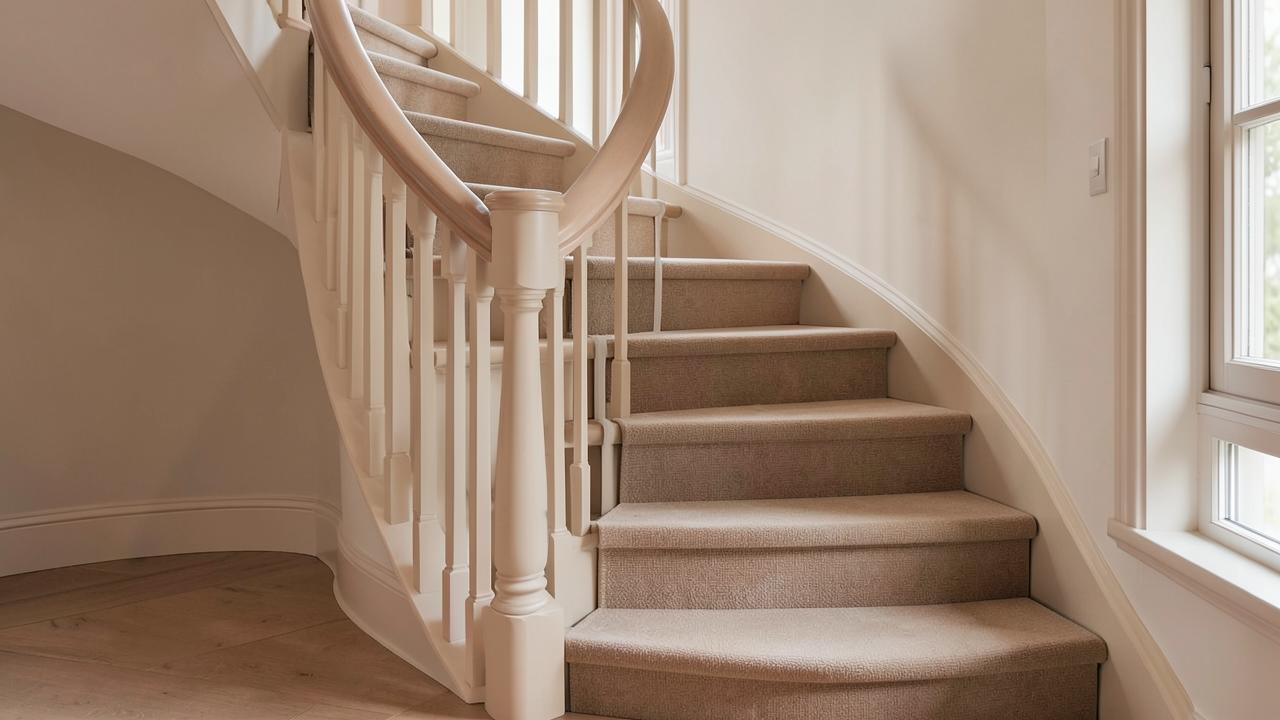 MeasurementRunners on Winder, Curved and Open StairsMeasuring and fitting where treads are not rectangles: winders, pie steps, curves and open-sided flights.
Rounding and the "just-in-case" metre
In the world of bespoke stair runners, there is a significant price and stress difference between being 10cm over and 10cm under. If your calculation suggests you need 7.2 metres, it is almost always safer to order 8 metres. This "just-in-case" material serves three purposes: it allows the fitter to avoid a structural flaw or stain in the middle of a roll, it provides a buffer if a step measurement was slightly off, and the remaining offcut is invaluable for future repairs or for "rotating" the runner later to move wear away from the nosings.
Spiral and flared stairs: when the formula fails
The standard "tread + riser + nosing" formula assumes the staircase travels in a single direction. Spiral staircases and flared bottom steps (where the step gets wider as it approaches the floor) defy simple arithmetic. For these, the runner must be templated using the "outer string" measurement — the longest possible path the carpet has to travel. On a flared step, the width is also changing, meaning you may need to order a wider roll of carpet than for the rest of the flight, leading to significantly more waste. If your stairs are anything other than rectangular, treat the calculator's result as a "minimum possible" figure and expect a professional fitter's estimate to be 20-30% higher. See thewinder guide for more on complex shapes.
The cost of a measurement error
If you under-order by even a few centimetres, you cannot simply "patch in" a new piece of carpet. Any join in a runner is a point of weakness and a visible blemish. Because carpet is produced in batches (dye lots), a second order of the "same" carpet may be a slightly different shade, making a repair obvious. This is why professionalmeasurement is the most critical step in the process. It is also worth considering the widthcarefully; a runner that is too wide for the stairs can't be "squeezed" in without buckling.