Design
Stair runner margins and the perfect reveal
The margin is the frame that defines your stair runner. Getting the proportions right is as important as the carpet itself, turning a simple path into a architectural statement.
Written by the StairRunner.co editorial team · Updated 4 September 2026
The philosophy of the reveal
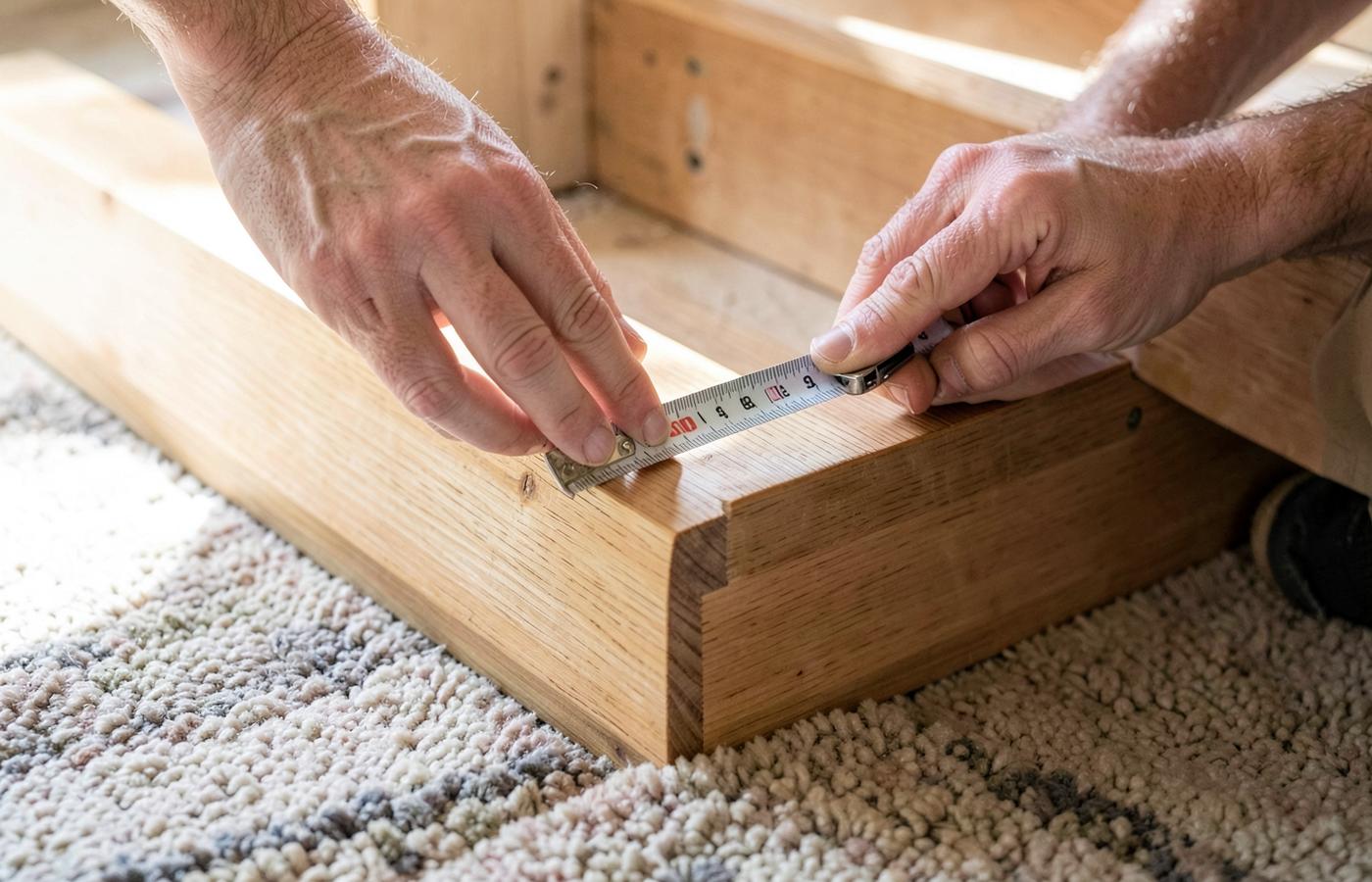
In interior design, the "reveal" is the intentional exposure of a structural or underlying element to create a sense of depth and contrast. With a stair runner, the reveal is the margin of wood, stone, or paint that frames the textile. This margin serves several purposes: it highlights the craftsmanship of the staircase, creates a clean vertical line that draws the eye upward, and provides a secondary colour or texture to complement the carpet.
Without a margin, a staircase can feel heavy and monolithic. The margin introduces air and rhythm into the design. It allows the runner to "float" on the staircase, making the whole structure feel lighter and more intentional. Understanding the philosophy of the reveal is the first step in deciding how wide your margins should be.
Standard widths and the Rule of Thirds
While there are no hard laws in interior design, there are several "rules of thumb" that can help you find the right balance.
| Total Stair Width | Recommended Margin (Per Side) | Resulting Runner Width |
|---|---|---|
| Narrow (75cm - 80cm) | 4cm - 5cm | 65cm - 70cm |
| Standard (85cm - 95cm) | 6cm - 8cm | 70cm - 80cm |
| Wide (100cm - 110cm) | 10cm - 12cm | 80cm - 90cm |
| Grand (120cm+) | 15cm+ | 90cm+ |
The "Rule of Thirds" is sometimes applied here, though usually loosely. In this context, it suggests that the two margins combined should occupy roughly one-third of the total width, with the runner occupying the remaining two-thirds. However, most modern designs prefer a wider runner (closer to 75-80% of the total width) to ensure a safe and comfortable walking surface.
Visual impact of narrow vs wide margins
The width of your margin completely changes the "temperature" of the room.
Narrow Margins (2cm - 4cm): These create a very tailored, "fitted" look. They are often used in modern, minimalist homes where the staircase is a clean, unadorned structure. Narrow margins make the runner feel like part of the stairs themselves rather than an addition. They are also practical for very busy households as they maximise the carpeted area.
Wide Margins (10cm - 15cm): These are a bold design choice. They create a strong sense of path and momentum. Wide margins are best suited for grander staircases or when the stairs themselves are a major feature (e.g., beautifully restored antique oak). A wide margin can make a runner look more like a decorative ribbon, which can be incredibly elegant.
Symmetry and the challenge of the stringer
In a perfect world, every staircase would be perfectly square and symmetrical. In reality, they rarely are. One side of your stairs might be against a wall (with a "stringer" board), while the other side is open with spindles and a handrail.
A common mistake is to measure the margin from the wall on one side and the edge of the tread on the other. This often results in an asymmetrical look because the stringer board takes up several centimetres of space. You should measure your margins from the most visible "inner" points. On the wall side, this is usually the face of the stringer. On the open side, it is usually the edge of the tread or the line of the spindles.
If your staircase tapers (gets narrower or wider as it goes up), you have a choice. You can keep the runner width constant and let the margins vary, or you can have a custom runner made that tapers with the stairs. The former is much more common and usually looks fine as long as the variation is not extreme.
Painting and finishing the margins
Since the margins are visible, their finish is critical. The most common choice is to paint the stairs. If you are doing this, you must paint the entire tread and riser, not just the margins. While it might seem like a waste of paint to cover the area that will be under the carpet, it ensures that if the runner shifts slightly over time, or if you choose a slightly narrower replacement in the future, there are no unpainted gaps.
Popular finishes for margins include:
- Eggshell or Satin Paint: Durable and easy to clean. High-gloss can be too slippery.
- Natural Stain and Lacquer: Best for hardwood stairs. It celebrates the grain of the wood.
- Contrasting Colours: A black margin with a cream runner, or a dark grey margin with a striped runner. This creates a high-impact, graphic look.
Ensure the paint is fully cured (usually 24-48 hours) before the runner is installed. The pressure of the grippers and the tension of the carpet can ruin fresh paint. For more tips, see painting stairs for a runner.
The role of the margin in sound and light
The margin is not just a visual feature; it affects the acoustics and lighting of the staircase. A wider margin means more exposed hard surface, which can lead to slightly more sound reflection than a narrower margin. However, this is usually negligible compared to the sound-dampening qualities of the runner itself.
In terms of light, a light-coloured margin (like white or pale oak) can help to brighten a dark hallway by reflecting light back into the space. A dark margin can have the opposite effect, which might be desired if you are going for a moody, sophisticated "boutique hotel" vibe.
If you are installing tread lighting (LED strips under the nosing or recessed into the stringer), the margin width will determine where the light falls. You usually want the light to wash over the margin rather than being buried under the carpet.
Margin considerations for winders
Winders present a unique challenge for margins. Because the steps are wedge-shaped, a constant-width runner will naturally have varying margins. On the "inside" of the turn, the margin will be very narrow (or non-existent), while on the "outside" of the turn, the margin will be very wide.
To maintain a sense of balance on winders, fitters often "pivot" the runner. This involves slightly angling the carpet on each winder so that the margins remain as consistent as possible along the "path of travel." This is a skilled job and is one of the reasons why professional installation is recommended for complex flights. You can read more about this in fitting runners to winders.
Margins and pattern interaction
The pattern of your runner should influence your margin choice.
- Striped Runners: These benefit from very clean, consistent margins. The straight lines of the stripes will highlight any wonkiness in the margins.
- Bordered Runners: If your runner has its own woven border, the margin is the second "frame" for the design. You don't want the margin to be so wide that it competes with the runner's own border.
- Solid Colours: These give you the most flexibility. A solid runner can handle wider or narrower margins without losing its impact.
Common design mistakes with margins
1. Margins that are too narrow: A margin of less than 2cm often looks like the carpet was simply measured incorrectly. It lacks the intentionality of a proper reveal.
2. Ignoring the bannister base: If your bannister spindles sit on a base rail that is on top of the treads, you must measure your margin from the base rail, not the edge of the stair.
3. Uneven paint lines: If you are painting the stairs, use high-quality painter's tape to get a crisp line. Even though the runner will cover the middle, a wobbly line at the edge of the margin will be very visible.
4. Not considering the landing: The margin should ideally continue seamlessly onto the landing. If your runner is 70cm wide on the stairs, it should stay 70cm wide as it crosses the landing.
Technical installation within a margin
When installing a runner, the grippers are placed in the centre of the staircase. The fitter must ensure that the grippers and staples are never visible in the margin. This requires precision. The underlay is also cut to be slightly narrower than the runner (usually by 1-2cm) so that the edges of the carpet can be "tucked" down, creating a clean, slightly rounded edge that hides the substructure.
If you are using stair rods, the brackets will be installed in the margins. This is another reason why the margin width matters—you need enough space for the bracket to sit comfortably and for the screw to bite into the wood without splintering the edge.
The psychological effect of the margin
A well-proportioned margin creates a sense of order and cleanliness. It frames the ascent. Psychologically, it makes the staircase feel like a destination rather than just a transition. In a narrow hallway, a generous margin can actually make the space feel wider because it creates more "visual floor"—the eye sees the full width of the stairs, even if the walking path is narrower.
Conversely, a very tight margin can feel "cosy" and "enclosed," which can be a great choice for a cottage or a back staircase where a sense of snugness is desired.
Summary: How to choose your margin
To choose your perfect margin, start by measuring your total stair width. Subtract a range of possible runner widths (e.g., 60cm, 70cm, 80cm) and look at the resulting margins. Use painter's tape to mark out these widths on your stairs. Walk up and down. Look at them from the bottom and the top.
Consider the style of your home. Is it traditional? (Go for 8-12cm). Is it modern? (Go for 4-6cm). Is it narrow? (Go for the minimum safe margin). By taking the time to visualise the margin, you ensure that your stair runner will look as good in reality as it does in your imagination.
Frequently asked questions
- What is the standard margin for a stair runner?
- A typical margin is between 5cm and 10cm on each side. The goal is to create a visual balance that frames the runner without making the walking path feel too narrow or the margins feel like wasted space.
- Should the margin be the same on both sides?
- Ideally, yes, for symmetry. However, on staircases where one side is a wall and the other is an open spindle rail, you might adjust the margins slightly to compensate for the visual "weight" of the spindles.
- How does the margin affect the look of a narrow staircase?
- On a narrow flight, a smaller margin (around 5cm) is often better to maximise the width of the runner for safety and comfort, while still providing the "reveal" that defines a runner.
- Do I need to paint the margins before installing the runner?
- Yes, the margins (and the entire tread/riser surface that will be visible) should be painted or finished before installation. It is nearly impossible to paint them cleanly once the carpet is fixed in place.
- Can I have no margin at all?
- If there is no margin, it is no longer a runner; it is a wall-to-wall carpet. The margin is the defining aesthetic feature of a stair runner installation.
Related guides
 InstallationHow to Install a Stair RunnerWaterfall and Hollywood methods, staples versus rods, tools, sequence and quality checks.
- MeasurementWhat Width Should a Stair Runner Be?How to set runner width and side margins from your stair width, stringers, balusters and pattern.
- InstallationPainting Stairs Around a RunnerOrder of work, durable paint systems, the exposed border detail and curing before fitting.