Measurement
What width should a stair runner be?
Width is the decision that most affects how a finished runner looks, and it is set by your staircase rather than by a rule of thumb.
Written by the StairRunner.co editorial team · Updated 4 September 2026
Step by step
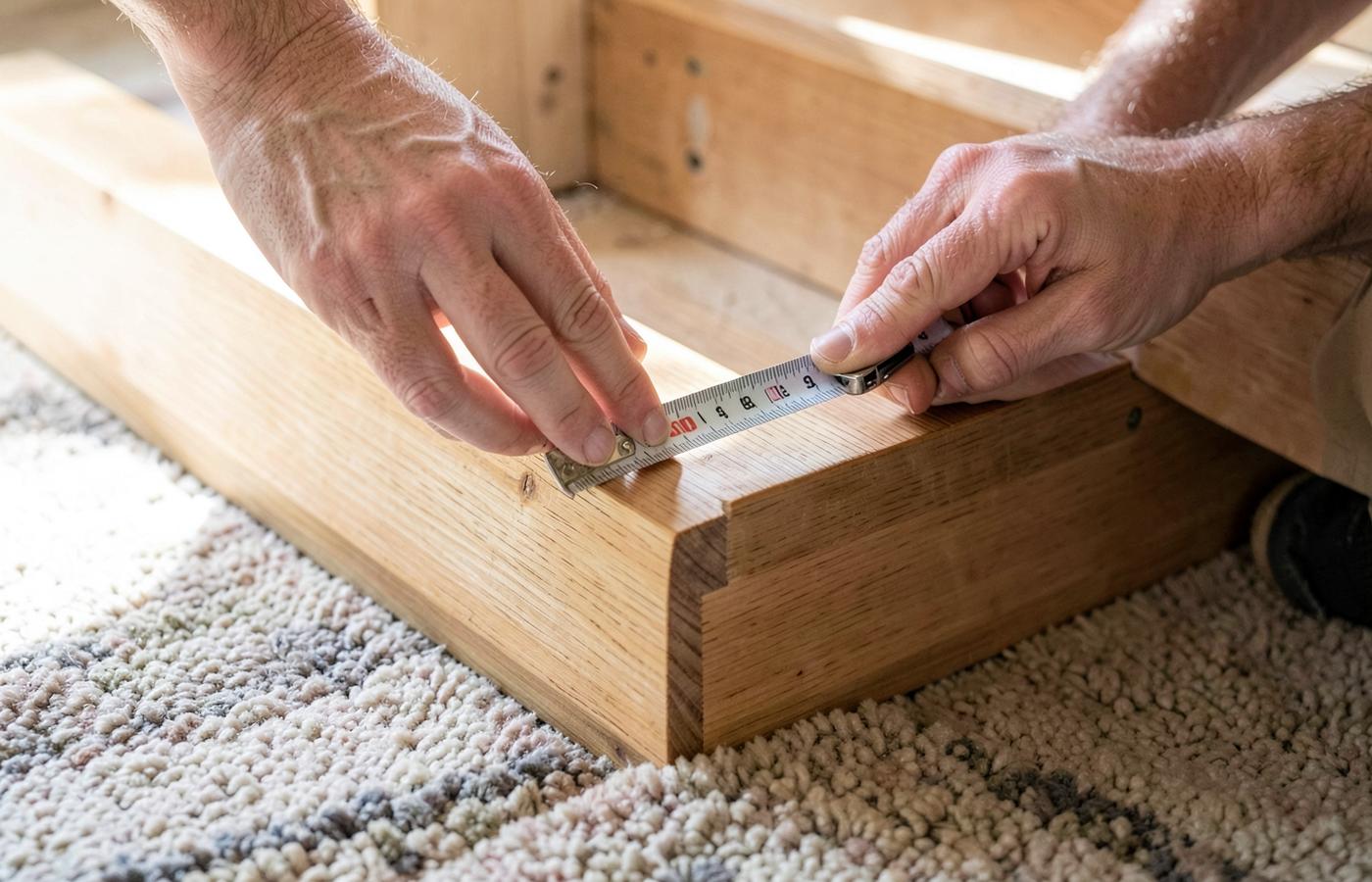
- Measure the clear tread width at the narrowest point of the flight, from the face of the wall or string on one side to the other. Measure three or four treads — older staircases are rarely consistent.
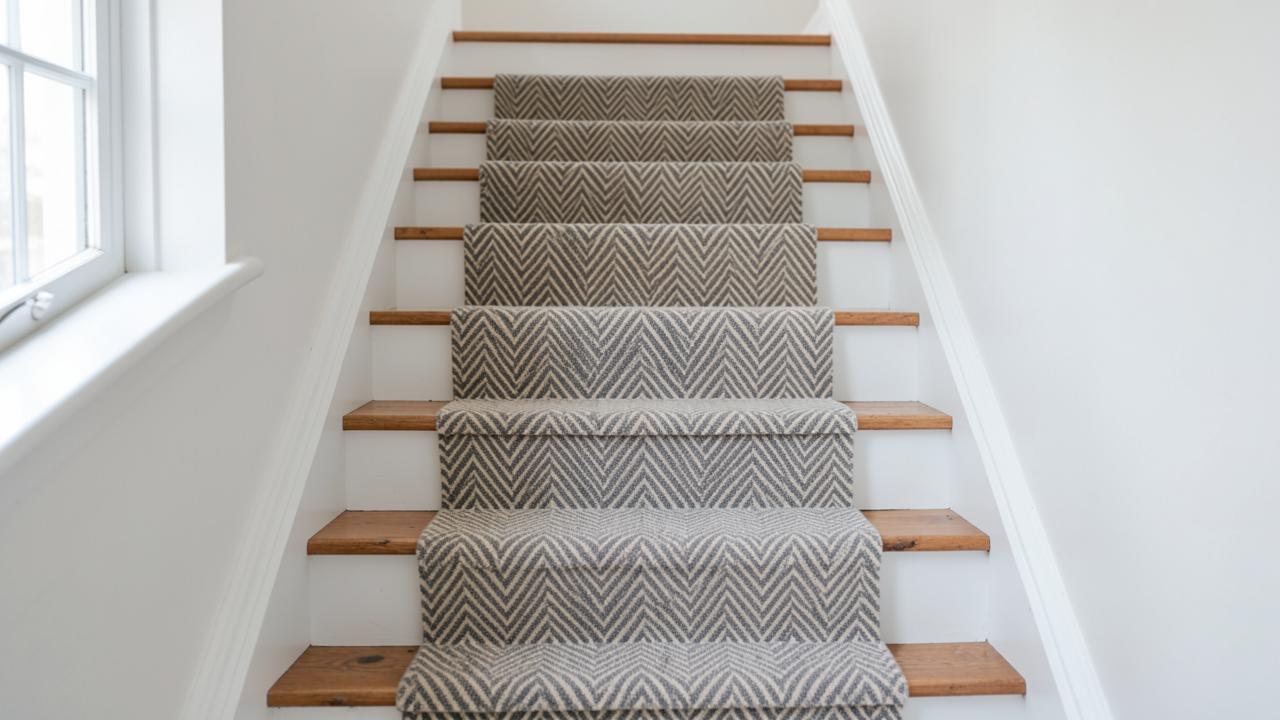
- Decide the margin. Wider margins show more of the staircase and suit attractive timber; narrower margins give more coverage and a softer feel.
- Subtract both margins to get your target runner width.
- Check availability. Round to the nearest width your carpet is supplied in, or specify a cut and bound custom width.
- Re-check the margin with the actual width. Adjust the margin, not the symmetry.
What changes the answer
| Factor | Effect on width |
|---|---|
| Narrow staircase (under ~800 mm) | Reduce margins to about 75–100 mm so the runner does not look like a ribbon |
| Wide staircase (over ~1100 mm) | Margins can grow, but very wide margins make the runner look undersized |
| Open string with balusters | Set the margin from the baluster line, not the tread edge |
| Varying tread widths | Size to the narrowest tread so the margin never disappears |
| Large pattern repeat | Choose a width that lets the repeat centre cleanly |
| Poor-quality tread margins | Go wider to cover, or plan to paint or refinish the exposed timber |
Width, rods and pattern
Fix the width before ordering anything else. Stair rod length is derived from it, and pattern centring depends on it. Reversing that order is how people end up with rods that overhang awkwardly or a herringbone whose V sits off-centre for the entire flight.
Consistency through the house
Keep the width the same on every flight that can be seen at once, and carry it through onto any landing or hallway run. Where an upper flight is genuinely narrower, changing width is acceptable — but keep the margin consistent instead, because that is the line the eye follows.
Once width is settled, work out length with the runner length calculator.
Why width is the first decision, not a late one
Width is easy to treat as a minor specification detail decided at the point of ordering, but it actually governs several other decisions that are much harder to change later. The margin either side of the runner sets how much of the timber stringer or tread edge is on permanent display, which affects whether that timber needs refinishing. The width also determines whether a stair rod needs to be cut down, and it interacts directly with any pattern repeat, since a design that does not centre cleanly within the chosen width will look off-balance for the entire length of the flight. Settling width early, before choosing carpet pattern or rods, avoids reworking those decisions later.
Measuring a staircase properly
A tape measure across a single tread is a starting point, not a final answer. Older staircases in particular are rarely perfectly consistent: skirting, plaster and stringers can vary by a centimetre or more between the top and bottom of a flight. Measure at least three points — near the top, the middle and the bottom — and use the narrowest reading as your working width. On a staircase with winders, measure the winder treads separately, since their usable width at the narrow end of each pie-shaped tread is often considerably less than the straight flight above or below.
Margins: the decision that actually shapes the look
Margin, not overall runner width, is what most people notice when they look at a staircase, because it is the amount of visible floor either side of the carpet running consistently down the flight. A narrow margin gives a fuller, more enveloping look and suits a plainer staircase with less attractive exposed treads. A generous margin shows more timber and suits a staircase where the stringers, treads or balusters are a feature worth displaying — a restored period stair, for example, or one in a hardwood the owner wants visible.
There is no fixed correct margin, but there is a firm rule about consistency: uneven margins are the most visible fitting error on a staircase, because the whole flight is usually seen from a single vantage point at the top or bottom, and any drift in the margin line draws the eye immediately. If a perfectly equal margin is not achievable because of an obstruction, a curved wall or an out-of-square stringer, prioritise making the margin look equal from the main viewing angle, even if it is not mathematically identical at every point.
Open strings, balusters and where to measure from
On a closed staircase with walls on both sides, the tread width is simply wall to wall. On an open-string staircase with balusters on one or both sides, decide whether the margin should be measured from the outer tread edge or from the baluster line, since the two can differ by several centimetres. Measuring from the baluster line usually gives a cleaner visual result because it aligns the runner edge with a vertical element the eye already reads as a boundary, rather than leaving an awkward strip of tread visible beyond the balusters.
Fitting width to available roll widths
Runner material is manufactured in a limited set of standard widths, and very few households will find their ideal calculated width matches a stock roll exactly. The practical approach is to calculate your ideal width and margin first, then compare it against the nearest stock widths above and below, and choose whichever produces the most visually even result once the margin is recalculated. Where no stock width gives an acceptable margin, a custom cut and bound runner can be ordered to the exact width you need, generally at a higher cost than a stock roll.
Pattern repeat and width working together
A patterned runner needs its repeat to divide evenly, or at least symmetrically, into the chosen width so the design centres correctly. A large motif that does not divide cleanly can end up looking cut off at one edge, or with the design's centre line sitting visibly off the runner's centre line. This is far easier to solve before ordering than after, so review the pattern repeat dimensions from the carpet supplier alongside your chosen width, and see pattern matching on stairs for the specific method.
Special cases worth planning for
- Very narrow staircases. Below roughly 800 mm clear width, keep margins tight, since a wide margin on a narrow stair can make the runner look disproportionately thin.
- Curved or sweeping staircases. Width can appear to change visually on a curve even when it has not, because the outer and inner edges travel different distances; measure and check the margin at several points around the curve.
- Landings and turns. Decide early whether the runner continues at the same width across a landing or changes, since this affects how much material is ordered and how the pattern is planned across the turn.
- Rental properties. A standard stock width with a simple, symmetrical margin is usually the pragmatic choice, since it can be replaced easily by a future tenant or owner without custom remeasuring.
Width and household practicalities
Width decisions are not purely visual. In households with pets or young children, a slightly wider runner with a narrower margin reduces the amount of bare, potentially slippery tread either side, which matters most for anyone who is unsteady on their feet. Conversely, a household that values the staircase as a design feature — a striking timber handrail, painted stringers, or an architecturally notable stair — often prefers a narrower runner that leaves more of that feature visible. Neither preference is wrong; the point is to decide deliberately rather than default to whatever width a supplier happens to stock.
Common width mistakes
- Measuring once, at the bottom. The bottom of a flight is often the widest point; using it as your only measurement risks a runner that is too wide further up.
- Ignoring skirting board thickness. A newly fitted or replaced skirting can be thicker than the original, narrowing the usable tread width without anyone noticing until the runner is cut.
- Choosing width from a photograph. A width that looks right in someone else's house depends entirely on their stair width and margin proportions, which are almost never the same as yours.
- Deciding width after choosing a pattern. This risks a repeat that cannot centre cleanly, forcing an unwanted compromise late in the process.
Width on stairs with a handrail or balustrade close to the tread
Where a handrail post or balustrade sits close to the tread edge, check that your chosen margin does not place the runner edge directly beneath it, since dust and grit accumulate there and the area is awkward to vacuum cleanly. A margin adjusted slightly to sit clear of the post line is a small change that saves a recurring cleaning nuisance. This is also worth checking alongside non-slip considerations where handholds and tread edges interact.
Frequently asked questions
- How wide should a stair runner be?
- Measure the clear tread width, decide on an equal margin each side, and subtract both margins. Margins of roughly 100–125 mm (4–5 in) per side are a common starting point on a typical domestic staircase, but the right answer depends on your stair width and how much timber you want to show.
- Should the margins be equal on both sides?
- Yes, wherever the staircase allows. Unequal margins are the single most noticeable fitting fault because you see the full flight at once from below. Where a wall on one side and an open string on the other force a compromise, favour visual symmetry from the main approach.
- What are standard stair runner widths?
- Runner rolls are commonly sold around 63–90 cm (25–36 in) wide, with 27 in and 32 in being frequent. Widths vary by supplier and region, so confirm the actual roll width rather than assuming a standard.
- Is a wider runner safer?
- A wider runner covers more of the tread, which helps if people step near the edges. But safety comes mainly from fitting quality and nosing coverage, not width. Do not widen beyond what leaves a tidy, even margin.
- What happens if my staircase tapers along its length?
- Measure every tread rather than one, and base your width and margin on the narrowest point. Fitting a single fixed width down a tapering flight, sized to an average, risks the runner overhanging the tread edge where the staircase is at its tightest.
- Can I change runner width partway up a staircase?
- It is possible where a flight changes width at a half-landing or turn, and in some houses it is unavoidable. Keep the margin, rather than the runner width, as the consistent visual reference, since that is what the eye actually tracks down a flight.
Related guides
- MeasurementHow to Measure for a Stair RunnerThe tread-plus-riser formula, waste allowance, winders and landings, plus a calculator that shows its working.
 DesignStair Runner Patterns ExplainedHerringbone, chevron, stripes, plaid, geometrics and animal prints judged by how they behave on a staircase.
 BuyingCustom Stair Runners and Carpet by the FootBroadloom cut to length, edge binding options, made-to-measure runners and what customisation really costs you.
 ToolsStair Runner Length CalculatorWork out runner length from your step count, tread, riser and nosing, with the formula shown in full.