Measurement
Runners on winder, curved and open stairs
Straight flights are arithmetic. The moment a tread stops being a rectangle, the job becomes templating — and the measuring rules change with it.
Written by the StairRunner.co editorial team · Updated 4 September 2026
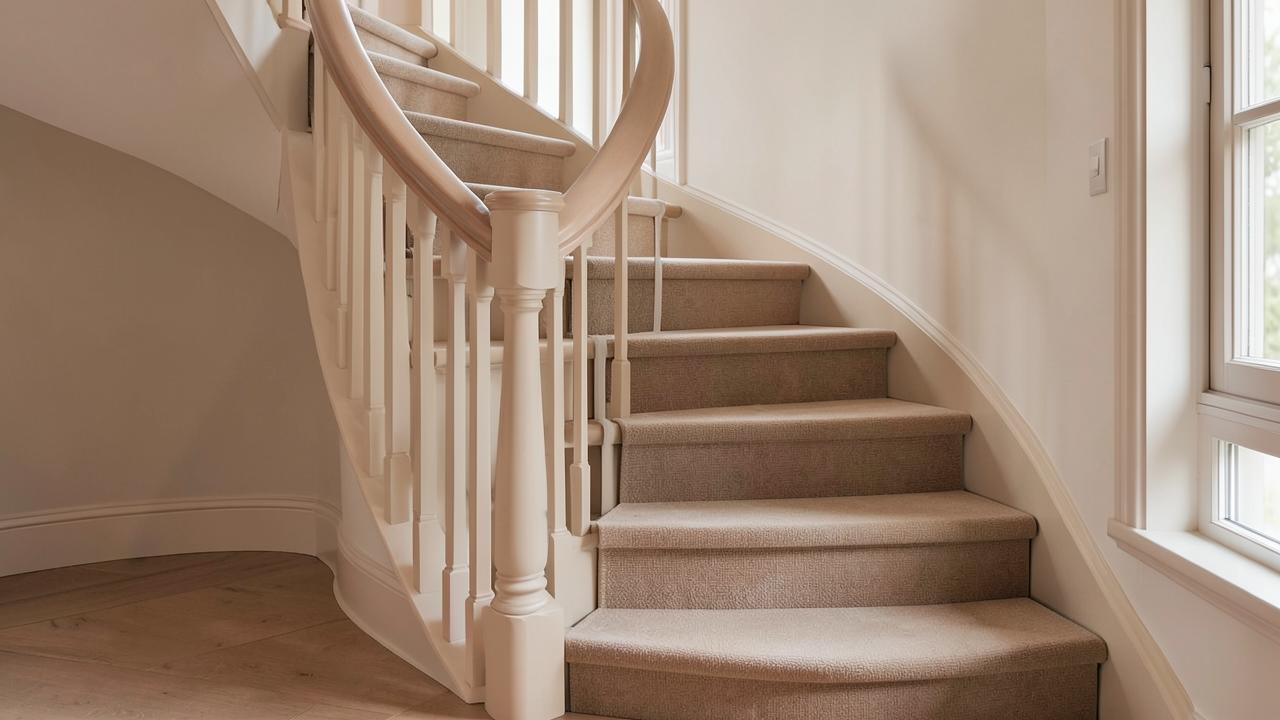
The geometry problem
On a straight step, every point across the width has the same tread depth, so one measurement covers the step. On a winder — a triangular or wedge-shaped tread used to turn a flight — the depth at the wide end can be several times the depth at the narrow end. The runner does not travel down the centre of the tread; it travels along its own line, and it is that line you must measure.
Measuring an irregular flight
- Fix your runner width and margins first, and mark the centre line of the runner on every step, including the winders.
- On each winder, measure tread depth along both edges of the runner and along its centre line.
- Take the largest of those depths and add the riser height plus your nosing allowance. That is the material length that step consumes.
- Repeat for every irregular step; do not average them.
- Add the straight steps using the standard per-step formula from the measuring guide.
- Add a waste allowance on top — larger than you would use on a straight flight, and larger again for a pattern.
The four difficult configurations
| Configuration | Main challenge | Usual approach |
|---|---|---|
| Winders / pie steps | Depth varies across the tread | Individual templates; size to the longest path |
| Curved / helical flight | The runner must follow a curve without wrinkling | Shaped pieces per step; a flexible-backed carpet |
| Open-sided stairs | An exposed edge with no wall or string to hide it | Bound or serged edge, set to the baluster line |
| Bullnose / curtail bottom step | A rounded step wider than the flight above | Its own cut piece, often with a finished edge |
Material choices that make it easier
Flexible-backed carpets shape far better around curves than stiff latex-backed natural fibres. Small or non-directional patterns tolerate the rotation a winder imposes; large directional ones do not, and a herringbone that turns a corner will visibly change direction. If your staircase turns, weight your carpet choice toward flexibility and pattern forgiveness.
When to hand it over
Irregular stairs are the clearest case for professional fitting. The material cost of a mistake is high, the templates are unforgiving, and the visual result depends on judgement built through repetition. If you want to save money on a flight with winders, do the preparation and removal yourself and let a fitter cut and fit. Costs are broken down in stair runner installation cost.
Why irregular stairs behave differently
A straight flight is a repeating unit: the same tread depth, the same riser height, the same width, step after step. That repetition is what makes the standard measuring method reliable — you measure one typical step, multiply, and add margin. A winder breaks the repetition. Because the outer edge of a winder travels further around the turn than the inner edge, the same physical step presents a completely different depth depending on where across its width you measure. A runner is a fixed-width strip, so wherever it sits on that step, it is crossing a tread depth that is unique to that position — not to the step as a whole.
The practical effect is that no single number describes a winder step. You are really measuring a family of possible depths and choosing the one that applies to the exact path your runner will take once its width and margins are fixed. Skip this and the calculation you have already done correctly for the straight steps will not save the job — the winders sit in the middle of most flights, and an error there throws off the fit of every step beyond it.
Understanding winder terminology
A winder is a tapered tread used where a staircase turns instead of using a flat landing. A run of two or three winders typically replaces a 90-degree landing turn, and a longer run can achieve a full 180-degree turn without a landing at all. Each winder in the set is sometimes called a pie step, because its plan shape resembles a slice cut from a circle or a wedge cut from a rectangle. The point where the narrow ends of the winders meet is the pivot, and it is usually close to the newel post around which the stair turns.
A kite winder is a specific, common layout of three winders per quarter turn, so called because the middle step's plan shape resembles a kite. It is worth learning this term because it is what a fitter or joiner will use when discussing your staircase, and it tells you immediately how many individually templated pieces to expect in that turn.
Curved and helical flights
A curved staircase — sometimes helical, sometimes a single sweeping bend — presents a related but distinct problem. Instead of a series of discrete wedge-shaped treads, the entire flight bends continuously, and a runner has to bend with it while staying flat against every tread and true against every riser. The runner cannot be cut as one long continuous strip through a curve the way it can on a straight run; it is fitted step by step even though the eye reads it as one continuous line once installed.
The backing of the material matters more here than almost anywhere else on the staircase. A stiff, dense backing resists the twist a curve demands and will show cracking or lifting at the edges within months. A softer, more flexible backing follows the curve without complaint but may need a more supportive underlay to stop it feeling loose underfoot. This is one of the clearest cases where the right choice depends on the staircase shape rather than on taste alone — see how to choose carpet for a stair runner for how backing type interacts with other performance factors.
Open strings, half-landings and bullnose steps
An open string stair has one or both sides exposed, usually with balusters rising directly from the treads rather than from a closed board. On a closed string, the runner's edge disappears against the skirting or string board and a raw edge is invisible. On an open string, that same edge is on permanent display, so it must be bound, serged or otherwise neatly finished, and its distance from the tread edge has to be set consistently all the way up the flight or the inconsistency will be obvious from below.
A bullnose or curtail step is a rounded or scrolled bottom step, usually wider than the flight above it, designed as a visual full stop at the base of the stairs. Because its plan shape is curved rather than rectangular, it cannot be cut from the same running length as the rest of the runner. It is treated as its own piece, shaped to the step and often finished with a bound edge that follows the curve, and this is one of several reasons a bottom step is priced and handled separately from the flight above it — see stair runner installation cost for how fitters typically itemise this.
A half-landing — a flat platform partway up a turning flight — removes the winder problem entirely for that section, at the cost of floor space the stair occupies. Where a runner crosses a half-landing, it is generally treated as a short flat run rather than a stepped one, and the transition at each end needs the same clean, secure fixing as the top and bottom of the main flight; see finishing a runner at the top of the stairs for how that transition is usually handled.
Common mistakes on irregular stairs
- Measuring only the centre line. On a winder, the centre line is rarely the longest path; measure both edges of the runner's intended position as well.
- Averaging depths across a run of winders. Each winder is a different shape from its neighbours even within the same turn; averaging hides the one that actually needs the most material.
- Choosing pattern before shape. A bold directional pattern picked for a straight flight can look disjointed the moment it has to rotate through a turn.
- Underestimating waste. Shaped offcuts cannot usually be reused elsewhere on the same job, so the effective waste percentage on a flight with winders is higher than the simple length calculation suggests.
- Treating the open side as optional finishing. On an open-sided stair, an unfinished or inconsistent edge is visible from across the room, not hidden as it would be against a wall.
Living with a runner on an irregular stair
Once fitted, a runner on a winder or curved flight wears in broadly the same way as one on a straight flight, with one difference worth watching: the narrow end of a winder tread concentrates foot traffic into a smaller area than the wide end, so wear and crushing can show there first. When you carry out routine stair runner cleaning, pay particular attention to these narrow points, and if you ever plan to rotate or replace sections of a runner to even out wear, remember that shaped winder pieces are usually cut for one position only and cannot be moved to a straight step the way a simple rectangular piece sometimes can.
Frequently asked questions
- Can you fit a stair runner on winder stairs?
- Yes, and it is standard professional work — but each winder is templated and cut individually because the tread depth changes across its width. Winders are the main reason a runner installation moves from straightforward to skilled.
- How do you measure a winder step for a runner?
- Measure the tread depth at the wide end, at the narrow end and at the centre line of the runner, then take the largest of the relevant depths plus the riser and nosing allowance. Always size to the deepest path the runner will follow; you can trim, you cannot add.
- Do winders use more material?
- Considerably. Each shaped piece leaves offcuts that cannot be used elsewhere, and pattern matching across a turn compounds it. A flight with three winders can need noticeably more carpet than the same number of straight steps.
- What about open-sided stairs?
- Where a tread edge is exposed, the runner side must be finished rather than simply tucked. That means a bound or serged edge and careful alignment against the balusters, and it is priced as extra work.
- Can a curved staircase use the same runner as a straight one?
- Only if the material is flexible enough to shape around the curve without the backing cracking or the pile distorting. A stiff natural-fibre weave that looks fine on a straight flight can pucker badly on a helical one, so the material decision has to be made with the curve in mind, not after.
- Why does a winder installation cost more than the same number of straight steps?
- Each winder is measured, templated and cut as an individual piece rather than run off a repeating pattern, which takes longer and produces more unusable offcut. The labour is priced per shaped step because the skill and time involved does not scale down the way straight-step fitting does.
Related guides
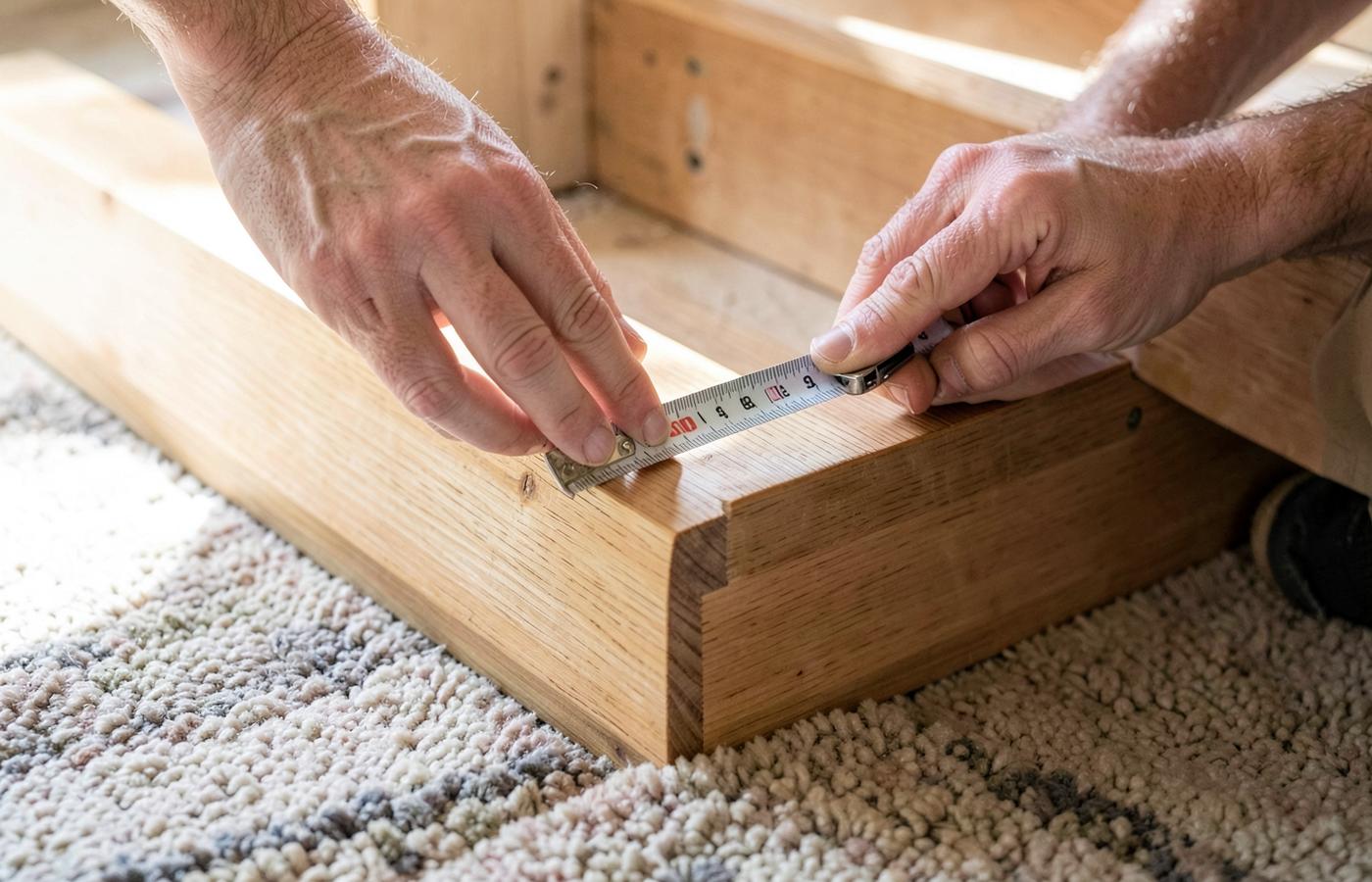 MeasurementHow to Measure for a Stair RunnerThe tread-plus-riser formula, waste allowance, winders and landings, plus a calculator that shows its working.
 InstallationStair Runners on Landings and TurnsCarrying a runner across a landing, around a turn and into a hallway without breaking the line.
 CostStair Runner Installation CostHow fitters build a labour price, what raises it, and how to compare two quotes that look different.
 ToolsStair Runner Length CalculatorWork out runner length from your step count, tread, riser and nosing, with the formula shown in full.