Installation
How to measure for a stair runner
Accurate measurement is the difference between a professional finish and a costly mistake. Whether you have a simple straight flight or complex winders, this guide walks you through every millimetre.
Written by the StairRunner.co editorial team · Updated 4 September 2026
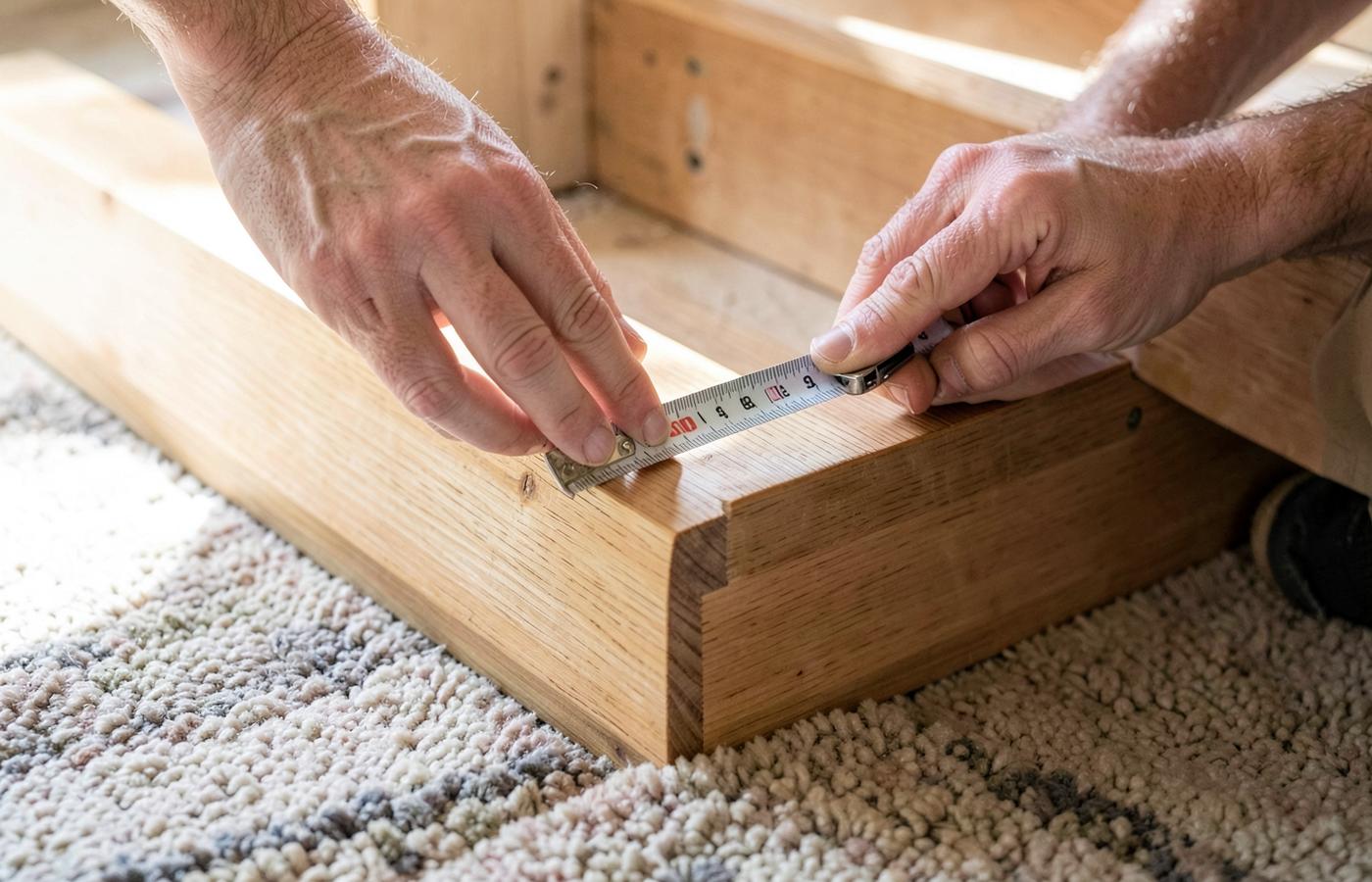
Preparation: The right tools for the job
Before you even look at a tape measure, you need the right mindset and the right equipment. Measuring for a stair runner is not like measuring a flat room; you are dealing with verticality, tension, and the way fabric behaves when bent over a sharp corner.
You will need:
- A high-quality steel tape measure (at least 5 metres).
- A notebook and pen (digital notes are fine, but sketches are better).
- A piece of string (useful for measuring around complex nosings or winders).
- A calculator.
- A helper (measuring a long flight alone is difficult and prone to error).
Start by sketching your staircase from a bird's-eye view. This doesn't need to be an architectural masterpiece, but it must clearly show the number of steps, any turns, and any landings. Label each step (e.g., Step 1, Step 2, Winder 1, Landing).
Understanding stair anatomy for measurement
To measure accurately, you must use the same terminology as the professionals. A single step consists of three components that the runner must cover:
- The Tread: The horizontal surface you step on.
- The Nosing: The front edge of the tread that usually overhangs the riser.
- The Riser: The vertical surface between two treads.
When measuring, you are essentially calculating the "path" the carpet will take. If you are using the Waterfall installation method, the carpet will drop straight from the nosing to the next tread. If you are using the Hollywood method, the carpet will wrap tightly under the nosing and follow the riser down. The Hollywood method requires slightly more carpet per step.
Measuring a straight flight of stairs
| Step Component | Measurement Method | Example (cm) |
|---|---|---|
| Tread | Front of nosing to the back of the step. | 25cm |
| Riser | From the tread up to the bottom of the next nosing. | 20cm |
| Nosing | The curve around the front edge. | 3cm |
| Total per step | Tread + Riser + Nosing | 48cm |
For a straight flight, measure the first and last step to ensure they are the same size. If they are, you can multiply the "Total per step" by the number of steps. However, in older homes, stairs are rarely uniform. It is always best practice to measure the entire length of the flight in one go by running the tape measure down the centre, following the contours of every single step.
Measuring winders: The expert challenge
Winders are the wedge-shaped steps that allow a staircase to turn 90 or 180 degrees. These are the most common source of measurement errors. Because they are wider at one end than the other, you cannot simply measure the centre.
To measure a winder for a runner:
- Identify the path the runner will take. This is usually the centre of the flight.
- Measure the tread along this path. Since the runner is a straight piece of fabric being bent, the "outside" edge of the runner will travel a longer distance than the "inside" edge.
- Measure the longest point of the winder that the runner will cover. If your runner is 60cm wide, find the 60cm wide path on the winder and measure the length of the step at the widest point of that path.
- Repeat this for every winder. Never assume two winders are identical.
When installing, winders usually require the carpet to be "eased" or mitred. This consumes more material than a straight step. Always add an extra 15-20cm of length for every turn or winder set to allow the fitter room to work.
Calculating width and margins
The width of your runner is a design choice, but it is limited by the width of your stairs. A standard staircase is often around 85-90cm wide. To create a classic look, you want a visible margin of wood on either side.
A common margin is 5cm to 10cm. If your stairs are 90cm wide and you want a 5cm margin on each side, your runner width will be 80cm. If you want a more dramatic 10cm margin, the runner will be 70cm wide.
When measuring width, check several steps. In many houses, the staircase tapers slightly as it goes up. If the top of the flight is 88cm wide and the bottom is 92cm, you must size your runner based on the narrowest point to ensure your margins remain consistent. For more on this, visit stair runner width guide.
Accounting for pattern repeats
If you have chosen a striped or patterned runner, simply measuring the length is not enough. The patterns must align across the steps to look professional.
If a runner has a 30cm pattern repeat, and your step length (tread+riser) is 45cm, the fitter will have to "waste" a portion of the carpet on every step to ensure the pattern starts at the same point on each nosing.
Formula for pattern waste: Take your total length measurement and add the length of one full pattern repeat for every single step. This is a "worst-case" calculation, but it ensures you don't run short. For complex patterns, we strongly suggest consulting with your supplier before ordering.
Landings: Half-steps and turns
Landings are treated as very long treads. If your runner continues onto a landing, measure the length of the landing in the direction of travel.
If the runner turns 90 degrees on a landing, you have two options:
- The Mitre: The runner is cut at a 45-degree angle and joined. This requires extra length to allow for the pattern match.
- The Overlap: One piece of runner ends, and the next starts, often with a slight overlap or a hidden seam.
Always measure the full footprint of the landing area you wish to cover. If the landing is large, you might consider using a matching rug or full-width carpet instead, which we discuss in stair runner landing ideas.
Measuring for stair rods
If you plan to add decorative stair rods, you must measure for them while measuring for your runner. Stair rods are not just a generic length; they must be wider than the runner but narrower than the staircase.
Standard practice is to order a rod that is 10cm wider than the runner (5cm on each side). If your runner is 70cm wide, a 80cm rod is appropriate. However, you must ensure that the brackets of the rods have enough space on the exposed stair margin to be screwed into the wood without being too close to the stringer.
Measure the distance between the edge of the runner and the wall or stringer. If this margin is only 4cm, a 10cm-wider rod will hit the wall. In this case, you would need a shorter rod or a different bracket style. For more on the aesthetic side, see stair rods and hardware.
Material specific measurement considerations
Different materials behave differently when measured and installed. A thick wool pile will "bulk out" the nosings much more than a thin sisal flatweave.
- Wool: Can be stretched slightly during installation. A tight measurement is usually fine.
- Sisal/Jute: Very little "give." If you measure short, you cannot stretch it to fit. Add an extra 2% to your total length just to be safe.
- Synthetic: Behave similarly to wool but can be more prone to "creeping" during the install. Precision is key.
The 10% Waste Rule (and why it matters)
In the flooring industry, the "10% rule" is standard. This extra material covers:
- Minor measurement errors.
- Cutting and trimming at the ends.
- The thickness of the carpet and underlay "eating" up length as it bends.
- Accidental damage during installation.
For stairs, this rule is even more important. If you are 5cm short at the top of a 15-step flight, the entire runner is useless. You cannot "patch" a stair runner without it being visible and potentially dangerous. Always round your measurements UP to the nearest 10cm before adding your waste percentage.
Measuring for underlay and grippers
While you are measuring for the runner, you should also calculate your requirements for underlay and grippers.
Underlay for a runner is typically cut slightly narrower than the runner itself (about 1cm on each side) to ensure it is not visible from the side. You need the same length of underlay as you do carpet, though you can often use offcuts for the treads.
Grippers are needed for every tread and riser. For each step, you will need two pieces of gripper, each slightly narrower than the runner width. Total gripper needed = (Number of steps x 2) x (Runner width - 2cm).
Common measurement pitfalls to avoid
1. Measuring only one side: Stairs are often slightly wonky. Measure the width at the top, middle, and bottom.
2. Ignoring the nosing wrap: If you are doing Hollywood style, you must account for the extra 2-4cm per step required to wrap under the nosing.
3. Forgetting the height of the underlay: A thick 10mm underlay adds length to every step. If you have 15 steps, that's 150mm (15cm) of extra length needed just for the padding thickness.
4. Not checking for squareness: Use a carpenter's square to check if your risers are at a true 90-degree angle to the treads. If they aren't, the carpet will "wander" to one side as you install it, requiring more width adjustment.
5. Measuring the stringer, not the tread: Some stairs have a decorative moulding where the tread meets the wall. Measure the flat walking surface, not including the moulding, to determine your available width.
When to call a professional
If your staircase has more than one set of winders, a "bird"s-eye" curve, or if you are planning to use a very expensive material like bespoke woven silk or heavy Axminster, do not measure it yourself. A professional fitter will charge a small fee for a survey, but this is insurance against a multi-thousand pound mistake.
Professional fitters use laser measurers and can create templates for complex winders using brown paper. This ensures that the patterns match perfectly even on the turns. If you are unsure, read our guide on finding a stair runner installer.
Documenting your measurements
Once you have your numbers, create a final sheet. It should look something like this:
- Number of straight steps: 12
- Length per straight step: 48cm
- Number of winders: 3
- Length per winder (at widest path): 65cm
- Landing length: 120cm
- Top/Bottom additions: 20cm
- Subtotal: (12*48) + (3*65) + 120 + 20 = 891cm
- Total with 10% waste: 980cm (9.8 linear metres)
- Required Width: 70cm
Having this clear breakdown will make ordering your runner much smoother and will help the supplier confirm if your order makes sense for your staircase type.
Final check before ordering
Before you click "buy," go back to the stairs one last time. Walk the flight slowly. Look at the nosings—are any damaged or extra large? Look at the stringers—is there any decorative moulding that might interfere with a 70cm width? Are there any radiators or doors at the bottom that will limit how far the runner can extend?
Taking ten extra minutes to double-check your measurements can save you days of frustration and hundreds of pounds in wasted material. Measuring for a stair runner is a slow process, but it is one where precision is rewarded every time you look at your perfectly fitted flight.
Frequently asked questions
- Do I need to measure every single step?
- On a straight flight, you can measure one step and multiply, but it is always safer to measure the total length by running the tape over every nosing. For winders, every step MUST be measured individually as their dimensions vary.
- What is the standard waste allowance for a stair runner?
- We recommend a 10% waste allowance for straight flights. For staircases with multiple winders or complex pattern repeats, this should be increased to 15-20% to ensure enough material for matching.
- How do I measure the nosing?
- Measure from the point where the riser meets the tread, over the curved edge (the nosing), to the point where the carpet will meet the next riser. Ensure the tape follows the contour exactly as the carpet will.
- Should I include the landings in my runner measurement?
- Yes, if you want the runner to continue across a landing. Measure the length and width of the landing area, and remember to account for how the runner will turn if it needs to change direction.
- Does the underlay affect the measurement?
- The thickness of the underlay and the carpet itself adds a small amount to the required length. Measuring "tight" with a tape measure is usually sufficient, as the 10% waste allowance covers the extra needed for the thickness.
Related guides
- MeasurementHow to Measure for a Stair RunnerThe tread-plus-riser formula, waste allowance, winders and landings, plus a calculator that shows its working.
- MeasurementWhat Width Should a Stair Runner Be?How to set runner width and side margins from your stair width, stringers, balusters and pattern.
 ToolsStair Runner Length CalculatorWork out runner length from your step count, tread, riser and nosing, with the formula shown in full.