Installation
Stair runners on landings and turns
Landings are where a runner installation is judged. A flight of straight steps is repetitive work; the landing is the piece that requires a decision.
Written by the StairRunner.co editorial team · Updated 4 September 2026
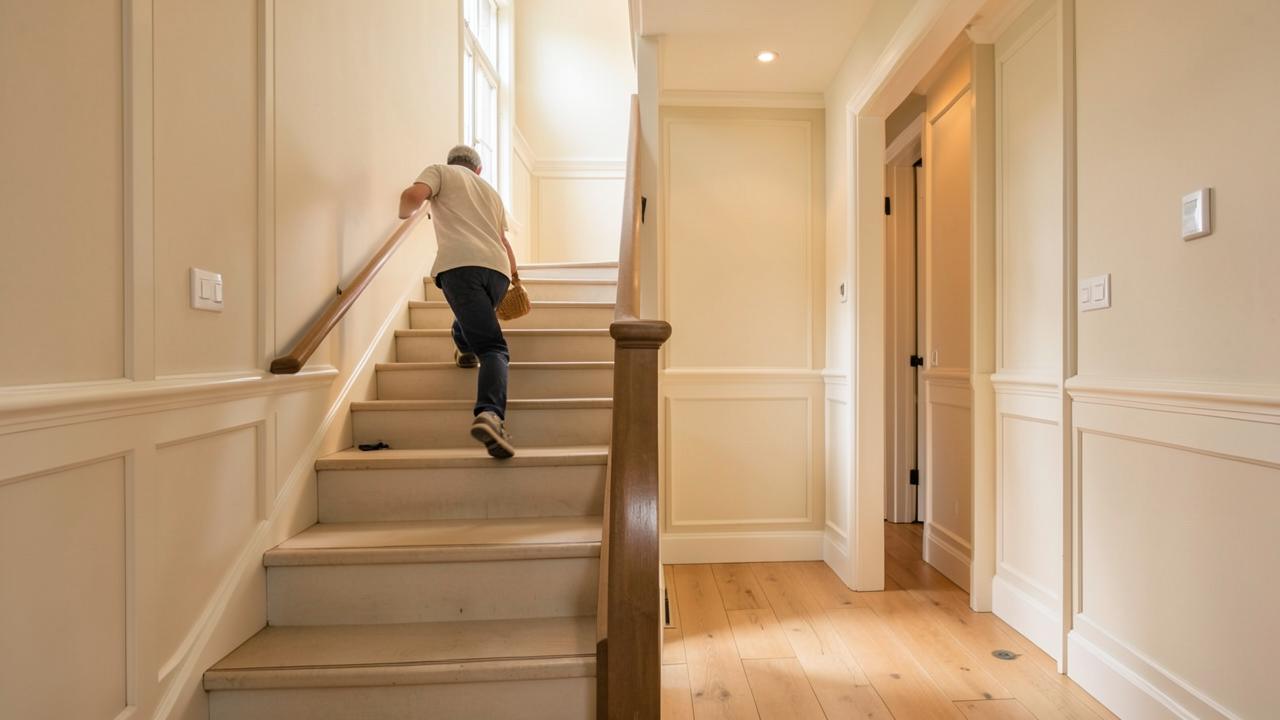
The four common landing situations
| Situation | Usual treatment | Watch for |
|---|---|---|
| Small half-landing, straight through | Continuous run across, no join if the length allows | Tension changes on the flat; the runner can ripple |
| Quarter landing, 90° turn | Separate landing piece, or a mitred join | Pattern rotation and pile direction change |
| Large landing used as a space | Fitted landing carpet, runner stops at the edge | Making the two pieces read as one scheme |
| Landing into a hallway | Runner continues as a hall runner, or stops at a threshold | Trip risk at any change of level or thickness |
Continuous or separate?
A continuous run looks seamless and is the right answer whenever the roll length and the geometry allow it. But continuity costs material: turning a runner around a landing without a join means cutting and folding in a way that discards a surprising amount. Ask your supplier to price both options. On a plain carpet the difference is often small; on a patterned one it can be substantial.
Tension and the flat run
On the treads, tension is created by pulling the runner into each crease. On a landing there is no crease to work against, so the piece has to be stretched and fixed at its perimeter instead — tack strip around the edges, or a fixed and bound edge where the runner stops. A landing section fitted with the same technique as the flight will loosen and ripple within months. This is one of the clearest signals of a rushed job.
Carrying the runner into a hallway
- Keep the width consistent between stairs and hall if they are visible at the same time; a change in width mid-view reads as an accident.
- Deal with the level change where carpet meets hard floor. A proper threshold bar or a bound edge fixed down avoids both a trip point and a fraying edge.
- Think about the bottom step. A bullnose or curtail step at the base is a separate fitting problem and often needs its own cut piece.
Measuring a flight with landings
Measure each straight run and each landing separately, then add them. Do not try to fold the landing into a single stair calculation — the geometry is different and you will under-order. Our measuring guide and calculator handle the flight; add landing dimensions plus the supplier's waste allowance on top.
Why landings are a different fitting problem
Everything about fitting a runner on a stepped flight relies on the crease between tread and riser: it gives the fitter a fixed point to tension against and a natural place to hide a join. A landing removes that crease entirely. The runner has to be tensioned outward across a flat plane instead, held only at its perimeter, which is a genuinely different mechanical problem even though the tools involved are the same. Understanding this distinction is the key to spotting a landing that has been fitted properly versus one that has simply had the stair method extended onto a flat surface and hoped for the best.
Deciding whether to treat the landing as part of the stair or as its own room
The decision usually comes down to how the landing is used and seen. A small half-landing that exists purely to change stair direction, glimpsed only in passing, almost always reads better as a continuation of the same runner, keeping the eye moving in one uninterrupted line. A generous landing that people stand on, that furniture sits against, or that serves as a genuine hallway space benefits from being treated as its own floor: either fully carpeted to the walls, or finished in a hard flooring that the runner then meets and stops against. Mixing the logic — a narrow runner-width strip crossing a wide, otherwise bare landing floor — rarely looks resolved.
Types of landing turn and what each demands
| Turn type | Geometry | Runner implication |
|---|---|---|
| Straight-through half-landing | No change of direction, just a flat pause | Simplest case; runner usually continues at the same width |
| Quarter turn (90°) | Direction changes once, landing is roughly square | Needs a mitred join, a turned piece, or a stop-and-restart |
| Half turn (180°) | Two quarter turns with a landing between them | Often two separate landing pieces, or a generous fitted landing carpet |
| Winder-based turn | Direction changes gradually across tapered treads, no true flat landing | See our dedicated winder runner guide |
Pattern direction: the detail that gives a rushed job away
On a plain runner, direction barely matters. On anything with a directional design — a border, an arrow motif, a diagonal weave, or even just a pile that catches light differently depending on viewing angle — the landing is where direction has to be actively managed rather than assumed. Carpet pile itself has a nap, and light reflecting off pile leaning one way looks a noticeably different shade to pile leaning the other way, even when it is physically identical carpet. A landing piece cut with the nap running the wrong way against the flights either side of it will look mismatched in colour even though it came from the same roll. Ask your supplier explicitly how nap direction will be handled at the landing before cutting starts, particularly with patterned or textured runners.
Fixing methods on a flat landing
Because there is no crease to tension against, landings rely on perimeter fixing: tack strip around the edge of the piece, adhesive, or a combination of both depending on the substrate. Get the strip or adhesive line right up to walls and any threshold, since a landing piece that is under-secured at even one edge will work loose faster than a stepped run would, simply because there is more open, flexible area for foot traffic to disturb. A generously sized, well-fitted pad matters just as much here as on the stairs themselves — see the underlay guide for choosing the right density for a flat, heavily walked area.
Handling a landing with a rug-like feel
Some homeowners deliberately want the landing section to look like a fitted rug rather than a continuation of the stair runner — bound edges visible on all sides, perhaps a contrasting border. This is a legitimate design choice and can look excellent, but it changes the fitting approach: a bound, rug-style piece is usually loose-laid or lightly secured rather than fully fixed, which is only appropriate where the landing itself is not a primary thoroughfare and where a rug pad underneath prevents slipping. On a busy landing that people cross constantly, a fully fixed edge is the safer choice regardless of the aesthetic preference.
Where landings intersect with the top-of-stairs decision
A landing does not exist in isolation — it is also where the top of one flight has to terminate, and potentially where the bottom of the next flight begins. Read this guide alongside finishing a runner at the top of the stairs, since the two decisions are made together in practice: the termination method at the top of a flight is often chosen specifically because of what the landing does next.
Budgeting extra material for landings
Landings are one of the most common places a stair runner project runs short of material, because their consumption does not scale the way a simple stepped flight does. A continuous turn around a landing can use considerably more length than the flat floor-to-wall distance suggests, once folding, turning and pattern alignment are taken into account. When budgeting with the cost guide, treat landing sections as their own line item with their own waste allowance rather than folding them into a single average figure for the whole staircase.
Landings on curved and sweeping staircases
A curved staircase rarely has a true flat landing in the way a straight flight with a quarter turn does; instead the turn happens gradually across a series of tapering treads. This removes the flat-fixing problem discussed above but replaces it with continuous shaping, tread by tread, along the whole curve. Treat a curved run as a specialist job from the outset, and read it alongside our winder and curved stair guide, since the two share much of the same fitting logic.
Checking a landing installation once it is finished
- Walk across the landing at a normal pace, not carefully, since that is how it will actually be used day to day.
- Press down at every edge and corner of the landing piece, which is where perimeter fixing most often falls short.
- View the join and any pattern transition from the bottom of the lower flight, the angle from which it will be seen most often.
- Check the pile direction and shade match in both daylight and artificial light, since nap and dye differences can appear more or less obvious under different lighting.
Frequently asked questions
- Should the runner continue across the landing?
- Usually yes if the landing is small and reads as part of the flight. On a large landing that functions as a room, a separate fitted piece or a stopped runner with a clean edge often looks better and wastes less material.
- How do you join a runner at a landing?
- The join should sit at the back of a tread or at the landing edge, not on a nosing, and the pile direction must run the same way on both sides. A join placed on a nosing wears through first and is visible from the bottom of the flight.
- What about a landing that turns ninety degrees?
- The runner has to change direction, which means either a mitred join, a separate landing piece, or a deliberate pause where the runner stops and restarts. All three are legitimate; the choice depends on the pattern and how visible the landing is.
- Does pattern direction matter across a landing?
- It matters a great deal. When the runner turns, a directional pattern turns with it, and pile direction changes apparent colour. Decide before ordering whether the landing piece follows the lower flight or the upper one.
- Should the landing carpet match the stair runner exactly?
- It should match closely in colour, pile height and construction even if it is a different product, because the eye compares the two surfaces at close range. A near-miss in shade is usually more noticeable than a deliberate, acknowledged contrast.
- What happens to pattern repeat across a landing?
- A patterned runner's repeat has to restart or be deliberately aligned on the far side of a landing, since the flat run breaks the regular tread-and-riser rhythm the pattern was designed around. Plan this with your supplier before cutting.
- Does a half-landing need its own underlay?
- Yes. A flat area takes a different kind of load and wear pattern to a stepped run, and it benefits from its own correctly sized pad piece rather than an offcut from the stair sections.
Related guides
 MeasurementHow to Measure for a Stair RunnerThe tread-plus-riser formula, waste allowance, winders and landings, plus a calculator that shows its working.
 InstallationHow to Install a Stair RunnerWaterfall and Hollywood methods, staples versus rods, tools, sequence and quality checks.
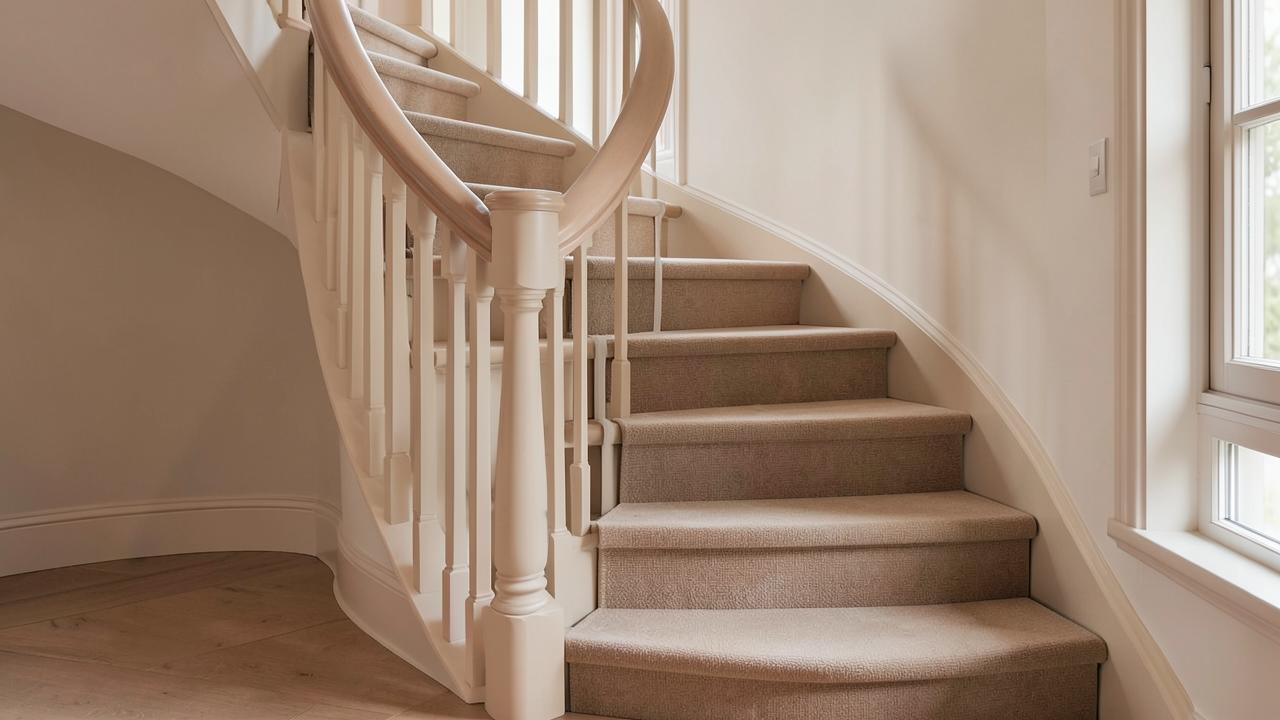 MeasurementRunners on Winder, Curved and Open StairsMeasuring and fitting where treads are not rectangles: winders, pie steps, curves and open-sided flights.
- InstallationFinishing a Stair Runner at the TopThe four ways to end a runner at the top step, and how to pick the one your staircase allows.