Installation
Stair runner hardware: The complete guide
Hardware is the backbone of any staircase installation. Beyond the surface beauty of a runner lies a complex system of fixings, supports, and decorative accents that ensure your stairs remain safe, silent, and stylish for decades.
Written by the StairRunner.co editorial team · Updated 4 September 2026
The fundamental distinction: Structural vs. Decorative
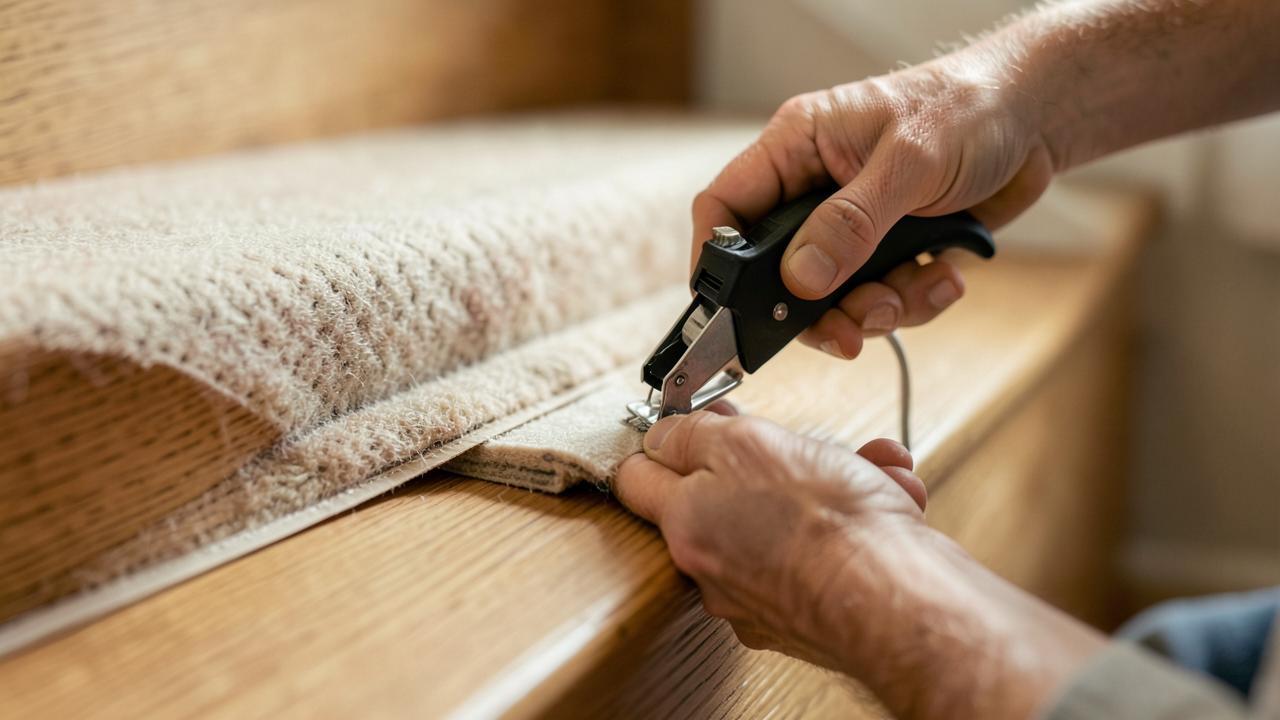
In the world of high-end UK interiors, the term 'hardware' covers a vast spectrum. At the foundation of every successful stair runner installation is the structural hardware. These are the components that you rarely see, but which do 100% of the work in terms of safety. The most important of these is the carpet gripper, or tack strip. On a staircase, these are not just nailed down as they would be in a bedroom; they are strategically placed in the 'crock' (the crease where the riser meets the tread) to provide a mechanical lock for the carpet.
Decorative hardware, by contrast, includes the stair rods and clips that have become synonymous with classic runner design. It is a common misconception among homeowners that the rods 'hold' the carpet in place. While this was historically true in the 18th and 19th centuries, modern installation techniques use staples and grippers for the heavy lifting. The rods today are an aesthetic choice, a punctuation mark at the end of a design sentence. They add weight, visual interest, and a sense of luxury, but they are not a substitute for proper fixing.
Understanding this distinction is the first step in planning your project. If you rely solely on decorative hardware, your runner will eventually 'creep' or slide, creating a dangerous trip hazard. Conversely, ignoring decorative hardware in a traditional setting can make the stairs look unfinished. The goal is a perfect marriage of the two: invisible strength and visible elegance.
Tack strips and gripper: The invisible anchors
| Gripper Type | Best For | Key Benefit |
|---|---|---|
| Dual Purpose | Standard wool runners | Universal pin height and strong grip |
| Architectural | High-traffic commercial | Wider strip with more pins for extreme tension |
| Pre-nailed Wood | Softwood or plywood stairs | Fast installation with integrated nails |
| Concrete/Stone Fix | Stone or masonry stairs | Specialized adhesive-backed or masonry nails |
Not all grippers are created equal. For a staircase, a professional fitter will usually specify a 'dual purpose' gripper. This type of hardware features zinc-coated pins that are angled specifically to bite into the backing of the carpet. On a stair, these strips are cut into lengths that are slightly shorter than the width of the runner and fitted approximately 12mm away from the riser. This gap allows the carpet to be 'tucked' into the crease, creating the sharp, clean line that characterises a professional fit.
In high-end residential work, we often see 'Architectural' gripper. This is a wider strip, typically 25mm to 32mm, featuring three rows of pins instead of the standard two. This hardware is essential for heavy, dense runners like deep-pile Wiltons or stiff natural fibres like sisal. The extra row of pins provides the necessary tension to prevent the material from stretching over time—a common issue on frequently used flights. For more on material compatibility, see our guide tosisal stair runners.
The role of staples and pneumatic fixings
While the gripper provides the primary tension, staples provide the 'stay-put' power, particularly under the nosing (the front edge of the step). A professional stair installation uses a pneumatic or heavy-duty electric staple gun. The staples themselves are high-gauge, usually galvanized to prevent corrosion in damp environments or when the carpet is being cleaned.
The placement of these staples is a fine art. They are driven through the pile and into the timber, usually in the crease where they are hidden by the pile or the rod, and along the underside of the nosing. A well-placed staple is completely invisible to the naked eye but holds the carpet with hundreds of pounds of force. This is what allows for a 'Hollywood' fit, where the carpet hugs the contour of the stair perfectly. Without this hardware, you are left with the 'Waterfall' look, which is less formal and often less secure.
Underlay hardware: The compression layer
Underlay is often overlooked in discussions about hardware, but on a staircase, it functions as a critical mechanical component. The underlay must be dense—usually a 9mm or 11mm high-density rubber. Its job is to protect the carpet fibres from the 'grinding' action that happens when a foot hits the sharp edge of a timber tread.
The hardware used to fix the underlay is just as vital. It should be stapled securely to the tread, but it must stop just short of the gripper strips. If the underlay overlaps the gripper, the pins won't be able to bite into the carpet, and the whole installation will fail. Furthermore, the underlay should never wrap over the nosing in a way that creates a rounded edge. The goal is to maintain the 'sharpness' of the stair, which is a key visual cue for safety. For a deeper dive, read our article on stair runner underlay.
Decorative Stair Rods: Materials and Finishes
Once the structural integrity is guaranteed, we turn to the decorative hardware. Stair rods are the most impactful aesthetic choice you will make for your hallway. They consist of a bar, two brackets, and two finials. The material choice here is paramount.
Solid Brass: In the UK, solid brass remains the premier choice. It has a weight and 'heft' that cheaper alloys cannot match. It is available in various finishes: Polished Brass (bright and traditional), Antique Brass (mellow and aged), and Satin Brass (modern and understated). The advantage of solid brass is its longevity; it will not rust, and if it tarnishes, it can be polished back to its original glory.
Chrome and Nickel: For modern or 'transitional' homes, chrome and nickel offer a cooler tone. Polished chrome is highly reflective and works well with monochrome designs, while brushed nickel has a softer, warmer silver tone that hides fingerprints better—an important consideration in a busy family home.
Black and Bronze: Matt black hardware has seen a surge in popularity, particularly when paired with light oak stairs and neutral runners. It provides a sharp, graphic contrast. Oil-rubbed bronze offers a similar dark tone but with a subtle copper undertone that works beautifully in period properties.
Finial designs and architectural styles
The 'finial' is the decorative end-cap of the stair rod, and it defines the hardware's style.
- The Ball Finial: The most classic and versatile choice. It suits almost any home, from a Georgian townhouse to a modern semi-detached.
- The Acorn Finial: A staple of Victorian and Edwardian design, symbolizing growth and longevity. It adds a touch of traditional gravitas.
- The Pineapple Finial: A traditional symbol of hospitality, often found in grander homes. It is a more ornate and formal option.
- The Flat or End-Cap Finial: For contemporary interiors, a simple flat cap allows the rod to feel like a structural element rather than an ornament. This is often the best choice for minimalist designs.
When choosing finials, consider the scale of your staircase. A grand, wide staircase can carry a larger, more ornate finial, whereas a narrow, steep flight in a cottage might be better served by a smaller, simpler design. The finial should never project so far that it becomes a trip hazard or catches on clothing.
Stair clips: A minimalist alternative
If you find full stair rods too 'heavy' for your design, stair clips (or carpet clips) are an excellent alternative. These are small, decorative brackets that fix only the edges of the runner. They give the appearance of holding the carpet without the horizontal bar.
Clips were popular in the late 19th century and have recently enjoyed a resurgence in modern interior design. They are particularly effective on narrower stairs, where a full rod might feel like it's 'shortening' the treads. When specifying clips, it is even more important to ensure the structural fixing is perfect, as the clips provide zero mechanical support to the centre of the runner. They are purely a visual frame.
Hardware for 'Difficult' Stairs: Winders and Curves
Not every staircase is a straight flight. Winders (steps that turn a corner) and curved stairs present unique hardware challenges. On a winder, the tread is triangular, meaning the 'crease' where the rod would sit is angled.
For these steps, we often recommend omitting the decorative rods and relying on invisible structural fixings. A straight rod on an angled step can look awkward and 'wrong'. However, if the client insists on rods throughout, a specialist fitter can use shorter rods or custom-angled brackets, though this significantly increases the complexity and cost of the installation. Clips are often a better solution for winders, as they can be placed at the edges of the angled step without creating an awkward horizontal line.
On curved or 'spiral' stairs, the hardware must be even more flexible. Specialised curved gripper strips or individual tack-nails are used to follow the sweep of the staircase. This is truly the realm of the master craftsman, as the tension must be perfectly uniform across a constantly changing geometry.
Metal vs. Wood: Material trade-offs
While metal hardware dominates the market, timber stair rods are a valid and beautiful option, particularly in country houses or 'Arts and Crafts' interiors.
Wood rods are typically made of oak, ash, or maple and can be stained to match the staircase itself or the runner's binding. The hardware (brackets) for wooden rods is usually metal, providing a nice contrast. The trade-off with wood is durability; it can be dented by heavy objects or vacuum cleaners more easily than metal. However, wood offers a warmth and tactile quality that metal cannot replicate. In a home with a lot of natural timber, a matching oak rod can create a very harmonious and integrated look.
Acoustics and Vibration: The hidden role of hardware
One of the primary reasons people install runners is to reduce noise. The choice of hardware directly affects this. A loose rod will rattle every time someone walks past, which can be incredibly frustrating. High-quality brackets often feature a small nylon or rubber insert that grips the rod, preventing metal-on-metal contact and eliminating noise.
Furthermore, the weight of the hardware contributes to the acoustic damping. Solid brass rods act as a 'mass loader,' helping to press the carpet into the timber and dampening the vibrations of the step. This is why a professionally fitted stair with solid hardware feels so much more substantial and quiet than a DIY job with lightweight fixings.
The physics of stair safety: Why hardware fails
Understanding why hardware fails is key to preventing accidents. The most common failure mode is 'pull-out'. This happens when a screw or staple is driven into poor-quality timber or a previous hole, and under the stress of daily use, it simply works its way loose.
Another failure mode is 'shear'. This happens when the pins on a low-quality gripper strip snap off because the carpet is under too much tension. This is why we insist on architectural-grade hardware for stiff natural fibres. If the pins fail, the tension is lost, and the runner will bunch up, creating a trip hazard. Regular inspections of your hardware—checking for loose screws or rattling rods—is a simple but effective safety measure for every homeowner.
Installation: The importance of the pilot hole
If you are attempting a DIY installation or overseeing a builder, the most important technical detail is the pilot hole. Most UK staircases are made of hardwoods like oak or even older, seasoned softwoods that have become incredibly brittle over time.
Attempting to drive a brass screw directly into the wood will almost certainly result in the head of the screw snapping off. This is a disaster, as removing the broken shank is difficult and often damages the visible timber. A professional will always drill a pilot hole that is slightly smaller than the shank of the screw. This relieves the pressure while still providing maximum grip. For more fitting tips, see our guide on how to install a stair runner with rods.
Commercial vs. Residential Hardware
Hardware requirements for commercial spaces—hotels, offices, or boutique shops—are significantly higher than for domestic homes. In a commercial setting, the hardware must meet strict fire safety and durability standards.
We typically specify 'Heavy Contract' gripper and extra-thick rod brackets. The finish must also be more robust; a PVD (Physical Vapour Deposition) coating is often used on brass-coloured hardware to ensure the colour never wears off, even with thousands of footfalls a day. In a home, this might be overkill, but in a hotel, it is an essential investment to avoid costly replacements every few years.
Sustainable Hardware: Eco-friendly choices
As homeowners become more conscious of their environmental impact, hardware choices are also coming under scrutiny. Solid metal hardware is inherently sustainable because it is incredibly long-lasting and 100% recyclable at the end of its life.
Avoid hardware made of 'mystery' alloys or those with heavy plastic components. Choosing locally manufactured hardware also reduces the carbon footprint of your project. Several UK-based manufacturers still produce high-quality stair rods and fixings, supporting local craft and reducing transport emissions. By choosing a classic design that won't need to be replaced when trends change, you are making the most sustainable choice of all.
Hardware and Lighting: The visual interplay
The way your hardware interacts with the lighting in your hallway can transform the space. Bright polished finishes like chrome or polished brass will catch the light from overhead pendants or floor-level LED strips, creating a sense of movement and brilliance.
Satin or brushed finishes are more subtle, diffusing the light rather than reflecting it. This can make a hallway feel calmer and more intimate. If you have low-level 'step lights', the hardware will cast shadows across the tread, which can be a beautiful design feature but must be managed carefully to ensure the stairs remain safe to navigate in the dark.
The 'Living Finish': Embracing patina
A final word on hardware aesthetics: the 'living finish'. Many of the most beautiful UK homes use unlacquered brass hardware. Unlike lacquered brass, which stays shiny until the lacquer eventually cracks and peels, unlacquered brass oxidises naturally.
Over time, it develops a deep, rich patina that is unique to your home. The areas that are touched frequently will stay brighter, while the recessed areas will darken. This 'wear pattern' is a sign of a well-loved home and is highly prized by interior designers. If you choose this path, your hardware will literally get more beautiful the more you use it.
Building a hardware specification list
Before you order, create a comprehensive hardware list to avoid delays. A typical flight of 13 steps will need:
- 13 lengths of dual-purpose gripper (cut to width)
- 1 box of 10mm high-density underlay
- 1 pack of galvanized staples (500+ count)
- 12 or 13 stair rods (depending on top step preference)
- 24 or 26 brackets with matching screws
- 24 or 26 finials
- Adhesive for any concrete or stone sections
Always order a few 'spares' of the decorative components. Finishes can vary slightly between production batches, so having a spare rod and bracket from the same batch ensures you can replace any future damage without a noticeable difference in look.
Summary: The value of the right hardware
In conclusion, the hardware you choose for your stair runner is the bridge between a good idea and a great staircase. It provides the safety that allows you to walk with confidence, the acoustic damping that makes your home feel solid, and the aesthetic flourish that makes your hallway memorable. By investing time and budget into high-quality fixings and rods, you ensure that your staircase is not just a way to get from floor to floor, but a masterpiece of design and engineering. For more information on all aspects of your project, from costs tocleaning, explore the rest of our guides.
Frequently asked questions
- What is the most important piece of hardware for stair safety?
- The hidden fixings—tack strips (gripper) and staples—are the most critical. They ensure the runner is tensioned correctly and cannot move. Decorative rods do not provide this safety and should never be used alone to secure a carpet.
- Can I use standard carpet gripper on stairs?
- While possible, it is better to use specialised 'dual purpose' or 'stair-specific' gripper. These often have different pin heights and stronger adhesives or nails to cope with the specific stresses of a staircase.
- Do I need hardware for a winder step?
- Yes, but it is more complex. You often need to use staples or specialized short-tack strips to follow the changing angles. Decorative rods are frequently omitted on winders because they cannot follow the turn gracefully.
- Is it worth buying solid brass hardware?
- Solid brass is far superior to plated metal for stairs. Plating can wear through in high-traffic areas, revealing a base metal that may rust or look unsightly. Solid brass can also be re-polished if it tarnishes.
- How do I choose between rods and clips?
- Rods provide a continuous horizontal line that emphasizes the width of the runner. Clips are smaller, 'puncturing' the corners of the tread, offering a more minimalist accent. The choice is purely aesthetic, as neither provides structural support.
Related guides
- InstallationHow to Install a Stair RunnerWaterfall and Hollywood methods, staples versus rods, tools, sequence and quality checks.
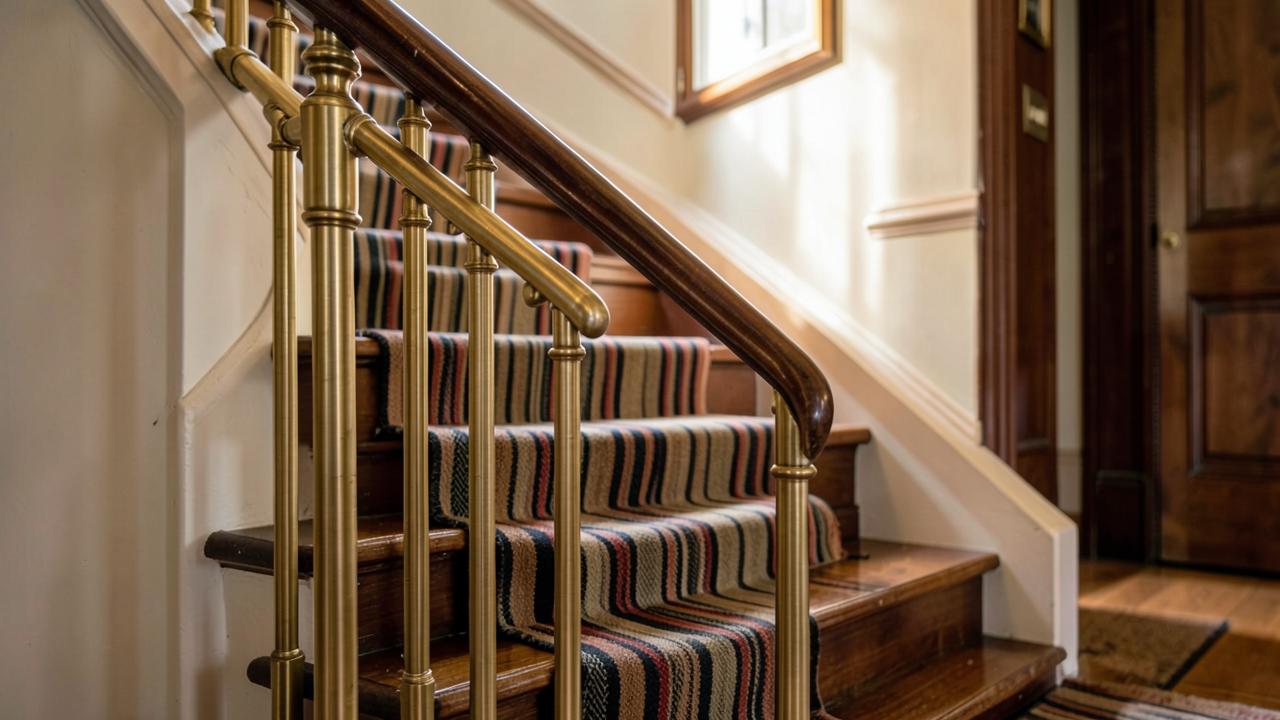 InstallationStair Rods, Clips and Runner HardwareHow stair rods, clips, brackets and bars actually work, when they hold a runner and when they are decorative.
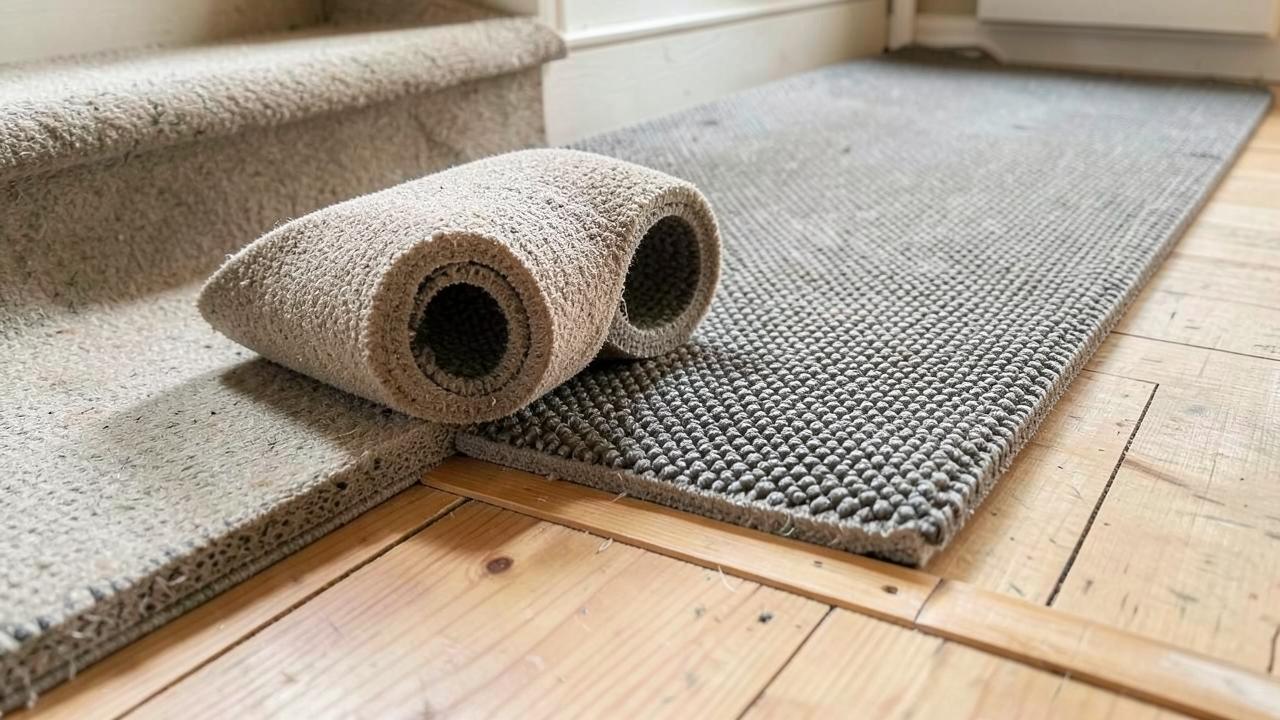 MaterialsStair Runner Underlay and PaddingWhy pad choice matters more on stairs than anywhere else, and how to specify density, thickness and cut.
- InstallationHow to Install a Stair Runner with RodsStep-by-step instructions for a professional-looking installation combining a fitted runner with decorative stair rods for a classic finish.