Design
Stair runner patterns, and how they behave on stairs
A pattern that looks balanced on a showroom roll can land badly on a staircase, because the stairs cut it into fixed widths and bend it over every nosing.
Written by the StairRunner.co editorial team · Updated 4 September 2026
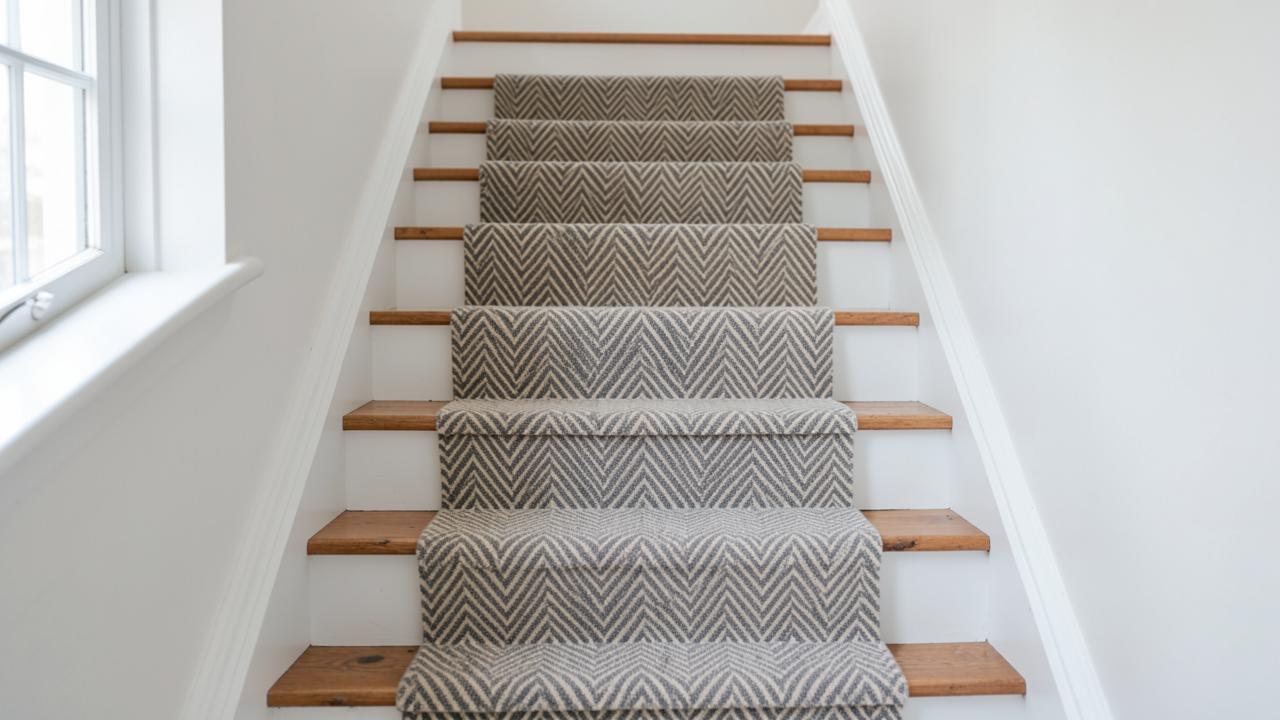
Pattern families on a staircase
| Pattern | Effect on the flight | Practical notes |
|---|---|---|
| Herringbone | Directional texture that draws the eye upward | Very forgiving of soil; the V must be centred on the width |
| Chevron | Sharper and more graphic than herringbone | Misalignment is obvious; needs a careful fitter |
| Vertical stripe | Lengthens the flight, formal and calm | Stripe placement must be symmetrical about the centre line |
| Plaid / tartan | Traditional, warm, visually dense | Two-directional matching means the highest waste allowance |
| Small geometric | Quiet texture from a distance, detail up close | The most practical choice for a busy family staircase |
| Animal print (leopard, antelope) | A single strong statement in an otherwise plain hall | Irregular repeats hide seams and wear unusually well |
| Floral / oriental | Softens a formal staircase; period-appropriate | Large motifs get cut by the stair width — check the repeat |
| Berber / loop texture | Reads as plain but with depth | Loops can snag on claws; keep the loop small and tight |
Pattern and the nosing
Every step folds the pattern through roughly ninety degrees at the nosing. Sharp linear patterns — thin stripes, precise chevrons — show any inconsistency in that fold as a wobble in the line, especially in raking light from a stairwell window. Textural and irregular patterns absorb it. If your treads vary in depth, which is common in older houses, prefer the forgiving option.
Matching, waste and cost
Pattern matching adds material. A plain runner needs only the standard waste allowance; a patterned one needs enough extra to align the repeat at every join and across landings. Two-directional patterns like plaid demand the most. This is a real cost, and it is the most common reason a quote comes back higher than the roll price suggested.
How to read a pattern repeat before you buy
Every patterned carpet has a stated repeat, usually given as a horizontal and vertical measurement in the product specification. Understanding this figure before ordering is the single most useful piece of technical knowledge in choosing a patterned runner, because it predicts exactly how the pattern will land on your stairs.
- Confirm your intended runner width first.
- Divide the width by the horizontal repeat measurement. A whole number, or a clean half, means the pattern will sit symmetrically. An odd fraction means one edge will show a partial repeat unless the width is adjusted.
- Check the vertical repeat against your tread depth. If the repeat is much larger than the tread, only a fragment of the design shows on each step, which can look arbitrary rather than deliberate.
- Ask whether the pattern is symmetrical about its own centreline. A symmetrical repeat is far easier to centre accurately than an asymmetric one.
Directional versus non-directional patterns
A directional pattern has a clear top and bottom, or a clear left and right, and every length cut from the roll must be laid the same way. Stripes, most chevrons, and any pattern with an obvious motif orientation fall into this category. A non-directional pattern — many small geometrics, most textured weaves, some tweeds — can be laid either way without it being visible, which gives a fitter more flexibility to minimise waste when cutting around winders or joining lengths for a long flight.
Establishing which category your chosen pattern falls into matters most on stairs with winders, where the runner has to twist through the turn. A strongly directional pattern will show that twist as a visible break in the design; a non-directional or textured pattern absorbs it far more comfortably.
Pattern scale and the psychology of a staircase
Pattern does more than decorate; it changes how the flight is perceived. A fine, dense pattern reads as calm and recedes, letting the architecture of the stairs — the balustrade, the treads, the light — take the attention. A large, high-contrast pattern draws the eye to itself and effectively becomes the main feature of the staircase, which is a legitimate design choice on a flight that has little else of architectural interest, but a mistake on a staircase whose joinery or setting is already the feature.
| Staircase's role in the room | Suggested pattern approach |
|---|---|
| Architectural feature (open, visible from multiple rooms) | Bold or textured pattern can lead the design |
| Functional link between floors, little architectural detail | Bold pattern can compensate for a plain setting |
| Period staircase with fine joinery, turned balusters | Quiet, traditional pattern that supports rather than competes |
| Narrow, enclosed stairwell | Small-scale or textured pattern to avoid visual clutter |
Pattern and long-term maintenance
Some patterns are easier to live with over the years than others, independent of how they look on day one. Multi-tonal patterns with several similar mid-tones hide gradual colour change from sunlight exposure near a window better than a pattern built from one flat colour and one strong accent, where any fading is obvious as a mismatch. Loop-based patterns such as Berber-style weaves resist crushing in the centre of the tread — the area under continuous foot traffic — better than cut-pile florals, which is worth weighing against how the pattern will look after several years rather than only on the showroom roll. General upkeep guidance across pattern types is in cleaning a stair runner.
Combining pattern with the rest of the hall
- If the hall floor is patterned — encaustic tile, parquet — keep the runner textural rather than motif-driven.
- If the walls carry wallpaper, let one of the two lead. A quiet runner under a bold paper usually reads better than the reverse.
- Pick up one colour from the fixed elements — the front door, the tile, the balustrade — rather than trying to match everything. See choosing a colour.
Pattern on curved and winder stairs
A curving flight or a run of winders is the hardest test for any pattern. The runner has to twist across the width of each step to follow the turn, and a rigid geometric or a large motif will show that twist as a visible distortion — the lines simply will not stay straight through the pivot. Textured, irregular or small-scale patterns disguise this far more comfortably, which is one reason many period staircases with winders are dressed in plain or lightly textured runners rather than bold prints, whatever the fashion of the day suggests.
Terminology worth knowing before you order
- Repeat: the distance before a pattern begins again, given horizontally and vertically.
- Drop match: a repeat that is offset rather than aligning straight across, common in some florals and harder to centre on a fixed width.
- Railroaded: a pattern woven to run along the length of the roll rather than across it, which affects how it behaves once cut into stair-length pieces.
- Colourway: the same pattern offered in a different palette; useful when the design suits the stairs but the default colours do not suit the hall.
Myths about pattern on stairs, corrected
A persistent myth is that pattern always hides dirt better than plain carpet. That is only true of pattern built from several similar mid-tones; a pattern that mixes a very pale ground with a dark motif can show soil on the pale areas just as readily as a plain pale carpet. Another myth is that bold pattern makes a narrow hall feel smaller. In practice a well-scaled pattern running the length of the flight can lengthen the perceived space, while a poorly scaled one — too large for the width, or badly centred — is what actually creates the cramped feeling people blame on pattern in general.
Checking a pattern against sample light
Stairwells often have unusual light — a skylight above, a window on a half-landing, or only artificial light with no natural source at all. Pattern contrast reads differently under each. A pattern that looks crisp under warm bulb light can look flat and washed out under a cool skylight, and the reverse also happens. Ask for a sample large enough to view in your own stairwell, at the time of day you actually use the stairs most, before committing.
When to simply choose plain instead
Pattern is not compulsory. A plain runner in a good fibre and a well-judged colour remains the safest, most flexible choice, particularly where the household is likely to redecorate the hall more often than it replaces the stair carpet. If in doubt between two patterns, it is often worth pricing a plain alternative in the same fibre for comparison before deciding.
Frequently asked questions
- Which pattern hides wear and dirt best?
- Mid-tone multi-colour patterns with small-scale texture — heathered herringbones, tweeds, small geometrics — hide soil and traffic lanes best. Large flat blocks of pale solid colour show everything, and very dark solids show lint and dust.
- Do patterned runners cost more to fit?
- Usually yes. A pattern has to be centred on the stair width and aligned step to step, which means extra material for matching and slower, more careful work. Ask the fitter to quote the extra waste allowance explicitly rather than discovering it later.
- Should stripes run up the stairs or across?
- Vertical stripes, running with the direction of travel, lengthen the flight visually and are the most common choice. Horizontal bands emphasise each step and can make a short flight look busy, but they suit wide, shallow staircases well.
- Is a bold pattern a mistake on a small staircase?
- Not if the scale is right. A small-scale bold pattern often works better in a tight stairwell than a timid large one, because the repeat completes several times across the width instead of being cut awkwardly.
- Do patterns need to be planned before or after choosing width?
- Width first. Once you know the runner width, you can check how many pattern repeats will fit across it and whether the design centres cleanly. Choosing pattern first and width second often forces an awkward compromise later.
- Can a pattern be matched across a landing?
- Usually yes, if the fitter has enough material and the pattern is planned before cutting. It requires extra length allowance and careful marking, and it is worth confirming explicitly with the fitter rather than assuming it will happen automatically.
- What pattern works best with a runner that has stair rods?
- Traditional stripes and small geometric repeats suit stair rods best, because the horizontal line of the rod complements a vertical or fine pattern rather than competing with a large motif.
Related guides
- DesignStair Runner Ideas That Actually WorkPattern scale, stripe direction, colour and border choices explained in terms of your staircase, not a mood board.
 DesignChoosing a Stair Runner ColourHow light, adjacent flooring, trim colour, traffic and dirt should drive the colour decision.
 MeasurementWhat Width Should a Stair Runner Be?How to set runner width and side margins from your stair width, stringers, balusters and pattern.
 DesignModern Stair Runner IdeasContemporary, traditional, farmhouse and vintage directions, and what makes each read as deliberate.