Reference
Stair runner glossary
The vocabulary fitters, suppliers and manufacturers use, defined in plain English so you can read a quote or a specification without guessing.
Written by the StairRunner.co editorial team · Updated 4 September 2026

Why the vocabulary matters
Stair runner terminology sits at the intersection of two trades — joinery and carpet fitting — and each brings its own words for overlapping ideas. A quote that mentions "Hollywood over a closed string with a serged margin" is describing a specific, checkable job. If you cannot translate that sentence, you cannot tell whether the quote matches what you asked for, or whether two quotes are even for the same work. This glossary exists so you can read a specification, a product listing or a fitter's explanation and know exactly what is being proposed.
Below, terms are grouped loosely by subject — staircase anatomy, carpet construction, installation method, and buying and care — and then listed alphabetically in full at the end for quick lookup.
Staircase anatomy
These are the physical parts of the staircase itself, independent of any carpet. A fitter measures and works around these features regardless of what covering you choose.
- Balusters
- The vertical posts between a tread and the handrail. On an open-sided staircase they set the line your runner margin should follow.
- Bullnose step
- A bottom step with one or both ends rounded, projecting past the width of the flight above. Almost always needs its own cut piece.
- Crease
- The internal corner where the back of a tread meets the riser above it. The runner is tensioned into this line and it is where fixings usually sit.
- Curtail step
- A decorative bottom step with a scrolled or spiralled end, common in period staircases.
- Flight
- A continuous run of steps between floors or landings. A staircase may have several flights joined by landings.
- Landing
- A flat platform interrupting or terminating a flight. Landings are fixed at their perimeter rather than tensioned into creases.
- Nosing
- The front edge of a tread, usually projecting slightly past the riser below. It takes most of the wear on any stair covering.
- Open string
- A stringer cut to follow the zigzag profile of the treads and risers, exposing the tread ends. Runners on an open string usually need a returned or finished edge rather than simply meeting a wall.
- Riser
- The vertical face between two treads. Some staircases are open-riser, with no face at all, which changes how a runner is fitted.
- Stringer
- The structural board running up each side of a flight, carrying the treads and risers. A closed string hides the tread ends; an open string exposes them.
- Tread
- The horizontal surface you step on. Tread depth is the main input to any runner length calculation.
- Winder
- A wedge-shaped tread used to turn a flight without a landing. Each one must be measured and templated individually.
Carpet construction and fibre
These terms describe how the carpet itself is made and how that construction behaves under the specific stress of stair use — repeated bending at the nosing, concentrated foot traffic in a narrow band, and, on an open string, exposed edges. See our guide to choosing carpet for a runner for how these properties combine into a buying decision.
- Axminster
- A weaving method that inserts each tuft of colour individually, allowing intricate multi-colour patterns. Common in traditional stair runner designs with borders and repeating motifs.
- Backing
- The material a carpet's tufts are anchored into and, on many constructions, a secondary layer laminated beneath it for stability. On stairs, a stiffer backing resists the flexing that causes premature wear at the nosing.
- Broadloom
- Carpet manufactured in wide rolls, typically several metres across. Most custom runners are strips cut from broadloom and finished at the edges.
- Carpet grade
- A general indication of a carpet's durability, usually communicated by the manufacturer as suitability for particular traffic levels. Only carpets graded for heavy or stair-specific traffic should go on a staircase.
- Density
- How closely packed the carpet's tufts are. The single best predictor of how a runner will hold up on stairs — high density resists crushing at the nosing.
- Face weight
- The weight of visible pile fibre per unit area, ignoring the backing. A useful comparative figure between carpets, though it should be read alongside density and twist rather than alone.
- Gauge
- The spacing between rows of tufts across the width of a woven carpet, which affects how fine a pattern can be rendered and how the surface feels underfoot.
- Hessian
- A woven jute fabric traditionally used as a carpet backing layer. Natural but more moisture-sensitive than synthetic backings, a relevant consideration near an entrance hall stair.
- Jute
- A natural plant fibre used both as a backing material and, less often, as a face fibre. Strong but softer and more moisture-sensitive than wool or synthetic fibres.
- Loop pile
- Carpet where the yarn loops remain uncut. Small tight loops wear well on stairs; larger loops can be pulled by claws or shoes.
- Moth protection
- A treatment applied to wool carpet to deter larvae from feeding on the fibre. Relevant to wool runners specifically, since synthetic fibres are not a food source for moths.
- Pile
- The upright fibre surface of the carpet. Pile height and density matter more on stairs than in any other location.
- Pile reversal
- A patchy shading effect where areas of pile lie in different directions and catch light differently. More visible on plain, cut-pile carpets than on patterned or looped ones, and not usually a manufacturing fault.
- Pilling
- Small balls of fibre that form on a carpet surface from abrasion, most often seen with certain synthetic blends in high-friction areas such as the nosing.
- Sculptured pile
- A carpet surface with a raised and recessed pattern created by cutting pile to different heights. Attractive but generally less durable on stairs than a flatter, denser construction.
- Sisal
- A stiff natural fibre from the agave plant, woven into flatweave floorcoverings prized for texture and durability, though generally less soft and more moisture-sensitive than wool.
- Solution dyed
- Fibre coloured throughout during manufacture rather than dyed at the surface. It resists fading and aggressive cleaning, which matters with pets.
- Stain resistance treatment
- A finish applied to fibre to slow the absorption of spills, giving more time to blot before a stain sets. It reduces risk but does not make a carpet stain-proof.
- Texture pile
- A cut-pile carpet finish with a deliberately irregular, twisted surface that hides footprints and vacuum marks better than a smooth cut pile.
- Tuft bind
- A measure of how firmly individual tufts are anchored in the backing. Poor tuft bind shows up as fibres pulling loose, particularly at a cut edge or a claw-marked nosing.
- Twist
- How tightly the yarn is spun. A tight, well-defined twist resists the untwisting and frizzing that repeated footfall causes.
- Wilton
- A weaving method using a continuous yarn drawn to the surface only where colour is needed, producing a durable, closely woven carpet well suited to stair use.
- Wool-rich blend
- A carpet fibre mix combining wool with a synthetic fibre, usually to gain some of wool's look and resilience while adding the synthetic's durability and lower cost.
Installation and finishing
These terms cover how the runner is fixed to the stair and how its edges are finished. The choice between them affects appearance, cost and how the runner ages — see waterfall versus Hollywood and our full installation guide.
- Binding
- A fabric tape stitched around the cut edge of a carpet to finish it. The most visible of the edge treatments, and often used as a design accent.
- Border
- A contrasting strip of colour or pattern along the long edges of a runner, usually created either by weaving it in or by adding a separate binding tape in a chosen colour.
- Cap and band
- Another name for the Hollywood installation method, where the runner is wrapped tightly over each nosing and into the crease.
- Doubling back
- A method of joining or finishing a runner where the material is folded rather than cut and bound, sometimes used at a bottom step or landing to avoid an extra seam.
- Fitter
- The tradesperson who installs the runner, as distinct from the retailer who sells it. On bespoke jobs the fitter usually also takes the final measurements.
- Hollywood installation
- Fitting the runner tightly against every surface so each step's shape reads through the carpet. The more tailored and durable of the two common methods.
- Margin
- The exposed strip of tread visible on either side of a runner, left uncovered by design. Margin width is a proportion decision, not a fixed rule, and it interacts with tread width and stringer style.
- Pad / underlay
- The cushioning layer between the runner and the tread. On stairs it should be firm and relatively thin — see our underlay guide.
- Return
- The point where a runner's edge is finished off rather than continuing, for example where it meets an open string or a bottom step. How a return is finished affects how tidy the whole installation looks.
- Rod pocket
- A sewn channel across the back of a runner sized to take a stair rod. Not all runners have these; some rods sit directly on the crease without a pocket.
- Serging
- A dense overstitched yarn edge finish that resembles a hand-finished rug. Subtler than binding and well suited to wool.
- Stair rod
- A bar fitted across the crease of each step. Most modern rods are decorative; only rods sold explicitly as holding systems secure the runner.
- Tack strip / gripper
- A thin timber strip with angled pins, fixed near the crease, that grips the carpet backing and holds tension.
- Waterfall installation
- Fitting where the runner drops straight from the nosing to the next tread rather than being pressed into the crease. Faster, softer looking, less supported.
Buying, measuring and pattern
- Pattern repeat
- The distance before a pattern starts again, measured in both directions. It determines how cleanly a pattern centres on your runner width and how much matching waste you need.
- Waste allowance
- Extra material ordered beyond the calculated length, to cover pattern matching, trimming and finishing. Larger for patterns, winders and landings.
Full A to Z
Every term on this page, in one alphabetical list, for quick reference when you already know roughly what you are looking for.
- Axminster
- A weaving method that inserts each tuft of colour individually, allowing intricate multi-colour patterns. Common in traditional stair runner designs with borders and repeating motifs.
- Backing
- The material a carpet's tufts are anchored into and, on many constructions, a secondary layer laminated beneath it for stability. On stairs, a stiffer backing resists the flexing that causes premature wear at the nosing.
- Balusters
- The vertical posts between a tread and the handrail. On an open-sided staircase they set the line your runner margin should follow.
- Binding
- A fabric tape stitched around the cut edge of a carpet to finish it. The most visible of the edge treatments, and often used as a design accent.
- Border
- A contrasting strip of colour or pattern along the long edges of a runner, usually created either by weaving it in or by adding a separate binding tape in a chosen colour.
- Broadloom
- Carpet manufactured in wide rolls, typically several metres across. Most custom runners are strips cut from broadloom and finished at the edges.
- Bullnose step
- A bottom step with one or both ends rounded, projecting past the width of the flight above. Almost always needs its own cut piece.
- Cap and band
- Another name for the Hollywood installation method, where the runner is wrapped tightly over each nosing and into the crease.
- Carpet grade
- A general indication of a carpet's durability, usually communicated by the manufacturer as suitability for particular traffic levels. Only carpets graded for heavy or stair-specific traffic should go on a staircase.
- Crease
- The internal corner where the back of a tread meets the riser above it. The runner is tensioned into this line and it is where fixings usually sit.
- Curtail step
- A decorative bottom step with a scrolled or spiralled end, common in period staircases.
- Density
- How closely packed the carpet's tufts are. The single best predictor of how a runner will hold up on stairs — high density resists crushing at the nosing.
- Doubling back
- A method of joining or finishing a runner where the material is folded rather than cut and bound, sometimes used at a bottom step or landing to avoid an extra seam.
- Face weight
- The weight of visible pile fibre per unit area, ignoring the backing. A useful comparative figure between carpets, though it should be read alongside density and twist rather than alone.
- Fitter
- The tradesperson who installs the runner, as distinct from the retailer who sells it. On bespoke jobs the fitter usually also takes the final measurements.
- Flight
- A continuous run of steps between floors or landings. A staircase may have several flights joined by landings.
- Gauge
- The spacing between rows of tufts across the width of a woven carpet, which affects how fine a pattern can be rendered and how the surface feels underfoot.
- Hessian
- A woven jute fabric traditionally used as a carpet backing layer. Natural but more moisture-sensitive than synthetic backings, a relevant consideration near an entrance hall stair.
- Hollywood installation
- Fitting the runner tightly against every surface so each step's shape reads through the carpet. The more tailored and durable of the two common methods.
- Jute
- A natural plant fibre used both as a backing material and, less often, as a face fibre. Strong but softer and more moisture-sensitive than wool or synthetic fibres.
- Landing
- A flat platform interrupting or terminating a flight. Landings are fixed at their perimeter rather than tensioned into creases.
- Loop pile
- Carpet where the yarn loops remain uncut. Small tight loops wear well on stairs; larger loops can be pulled by claws or shoes.
- Margin
- The exposed strip of tread visible on either side of a runner, left uncovered by design. Margin width is a proportion decision, not a fixed rule, and it interacts with tread width and stringer style.
- Moth protection
- A treatment applied to wool carpet to deter larvae from feeding on the fibre. Relevant to wool runners specifically, since synthetic fibres are not a food source for moths.
- Nosing
- The front edge of a tread, usually projecting slightly past the riser below. It takes most of the wear on any stair covering.
- Open string
- A stringer cut to follow the zigzag profile of the treads and risers, exposing the tread ends. Runners on an open string usually need a returned or finished edge rather than simply meeting a wall.
- Pad / underlay
- The cushioning layer between the runner and the tread. On stairs it should be firm and relatively thin — see our underlay guide.
- Pattern repeat
- The distance before a pattern starts again, measured in both directions. It determines how cleanly a pattern centres on your runner width and how much matching waste you need.
- Pile
- The upright fibre surface of the carpet. Pile height and density matter more on stairs than in any other location.
- Pile reversal
- A patchy shading effect where areas of pile lie in different directions and catch light differently. More visible on plain, cut-pile carpets than on patterned or looped ones, and not usually a manufacturing fault.
- Pilling
- Small balls of fibre that form on a carpet surface from abrasion, most often seen with certain synthetic blends in high-friction areas such as the nosing.
- Return
- The point where a runner's edge is finished off rather than continuing, for example where it meets an open string or a bottom step. How a return is finished affects how tidy the whole installation looks.
- Riser
- The vertical face between two treads. Some staircases are open-riser, with no face at all, which changes how a runner is fitted.
- Rod pocket
- A sewn channel across the back of a runner sized to take a stair rod. Not all runners have these; some rods sit directly on the crease without a pocket.
- Runner
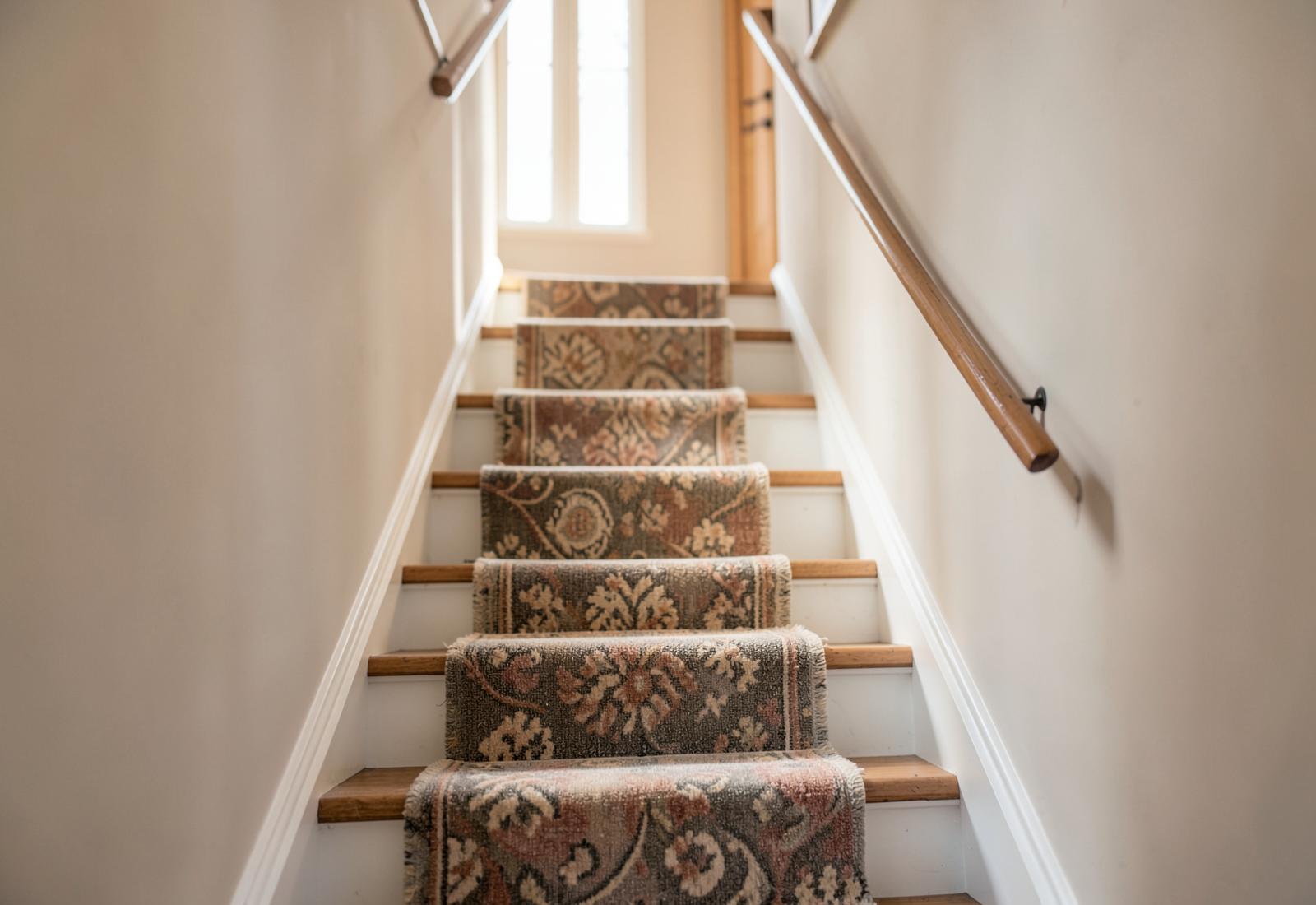
- A strip of carpet covering the central walking zone of a staircase, leaving the tread margins exposed.
- Sculptured pile
- A carpet surface with a raised and recessed pattern created by cutting pile to different heights. Attractive but generally less durable on stairs than a flatter, denser construction.
- Serging
- A dense overstitched yarn edge finish that resembles a hand-finished rug. Subtler than binding and well suited to wool.
- Sisal
- A stiff natural fibre from the agave plant, woven into flatweave floorcoverings prized for texture and durability, though generally less soft and more moisture-sensitive than wool.
- Solution dyed
- Fibre coloured throughout during manufacture rather than dyed at the surface. It resists fading and aggressive cleaning, which matters with pets.
- Stain resistance treatment
- A finish applied to fibre to slow the absorption of spills, giving more time to blot before a stain sets. It reduces risk but does not make a carpet stain-proof.
- Stair rod
- A bar fitted across the crease of each step. Most modern rods are decorative; only rods sold explicitly as holding systems secure the runner.
- Stringer
- The structural board running up each side of a flight, carrying the treads and risers. A closed string hides the tread ends; an open string exposes them.
- Tack strip / gripper
- A thin timber strip with angled pins, fixed near the crease, that grips the carpet backing and holds tension.
- Texture pile
- A cut-pile carpet finish with a deliberately irregular, twisted surface that hides footprints and vacuum marks better than a smooth cut pile.
- Tread
- The horizontal surface you step on. Tread depth is the main input to any runner length calculation.
- Tuft bind
- A measure of how firmly individual tufts are anchored in the backing. Poor tuft bind shows up as fibres pulling loose, particularly at a cut edge or a claw-marked nosing.
- Twist
- How tightly the yarn is spun. A tight, well-defined twist resists the untwisting and frizzing that repeated footfall causes.
- Waste allowance
- Extra material ordered beyond the calculated length, to cover pattern matching, trimming and finishing. Larger for patterns, winders and landings.
- Waterfall installation
- Fitting where the runner drops straight from the nosing to the next tread rather than being pressed into the crease. Faster, softer looking, less supported.
- Wilton
- A weaving method using a continuous yarn drawn to the surface only where colour is needed, producing a durable, closely woven carpet well suited to stair use.
- Winder
- A wedge-shaped tread used to turn a flight without a landing. Each one must be measured and templated individually.
- Wool-rich blend
- A carpet fibre mix combining wool with a synthetic fibre, usually to gain some of wool's look and resilience while adding the synthetic's durability and lower cost.
Terms that get confused
A handful of these words are routinely swapped for one another, which causes real confusion when reading a quote.
- Runner versus carpet. A runner leaves margins exposed; wall-to-wall stair carpet does not. See runner versus fitted carpet.
- Tread versus step. "Step" is used loosely for the whole unit; "tread" specifically means the horizontal surface, distinct from the riser beneath it. Our treads versus runner guide separates the two products people mean when they say "stair treads".
- Binding versus serging. Both finish a cut edge, but binding is a folded fabric tape while serging is dense overstitching directly into the edge yarns.
- Underlay versus padding. Different regions use different words for the same cushioning layer beneath the runner — see our underlay guide.
Where these terms come up
Tread, riser and nosing appear in every measurement. Tack strip, crease, waterfall and Hollywood belong to installation. Density, twist, pile and solution dyed belong to choosing the carpet. Binding, serging and broadloom come up when you order a custom runner. If you are budgeting a job, our cost guide uses most of the installation and construction terms above in context.
Related guides
 BasicsStair Runners: A Complete GuideWhat a stair runner is, how it differs from full carpet, and how to decide whether one is right for your staircase.
 MeasurementHow to Measure for a Stair RunnerThe tread-plus-riser formula, waste allowance, winders and landings, plus a calculator that shows its working.
 InstallationHow to Install a Stair RunnerWaterfall and Hollywood methods, staples versus rods, tools, sequence and quality checks.
 BuyingBest Carpet for a Stair RunnerThe specification checklist — fibre, pile, density, backing, width and pattern repeat — for stair-worthy carpet.