Comparison
Wool vs synthetic stair runners
The fibre argument is usually presented as wool good, synthetic cheap. On a staircase the picture is more specific than that.
Written by the StairRunner.co editorial team · Updated 4 September 2026
Head to head
| Property | Wool | Nylon | Polyester | Polypropylene |
|---|---|---|---|---|
| Abrasion resistance | Good | Excellent | Moderate | Moderate |
| Crush recovery | Excellent | Very good | Moderate | Poor |
| Soil hiding | Excellent | Good | Good | Good |
| Stain resistance | Moderate; absorbs liquids | Good when treated | Good | Excellent |
| Comfort underfoot | Warm, soft, dense | Firm | Soft | Firm, slightly plasticky |
| Relative price | Highest | Mid to high | Low to mid | Lowest |
Why stairs are the hard test
A staircase concentrates every footfall onto a narrow band and applies it at an angle, right over the nosing. That is a crushing and abrading load at the same time, on the one part of the runner that is also most visible from below. Fibres that merely feel nice in a bedroom show their weaknesses here within a year or two.
This is why crush recovery deserves more weight than most buying advice gives it. A fibre that resists staining but goes flat on the nosing will look tired long before it is technically worn out.
Construction changes the answer
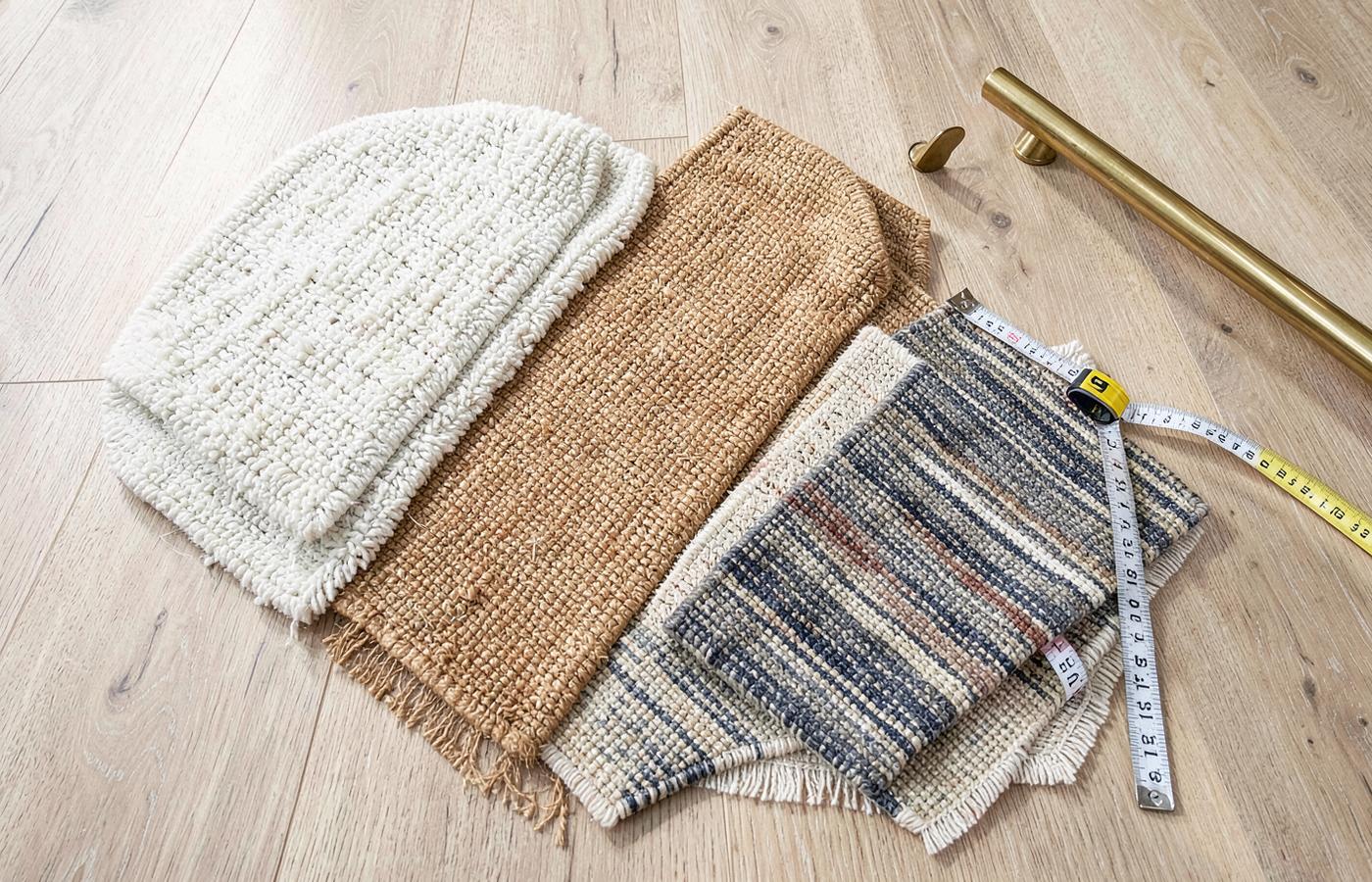
- Density. Bend the sample back on itself. Backing that grins through easily means sparse tufting — it will mat on the nosing whatever the fibre.
- Pile height. Low, dense pile beats tall, soft pile on stairs every time.
- Loop vs cut. Small tight loops wear well but can snag; cut pile is snag-free and hides seams better on a waterfall wrap.
- Dye method. Solution-dyed synthetics keep colour through aggressive cleaning; piece-dyed ones may not.
Cost over time, not price on the day
Compare fibres over the years you expect to keep the staircase looking good, not by roll price. A cheap runner replaced twice in a decade costs more in labour alone than one good runner fitted once, because the labour element is charged again each time. The reverse is also true: in a house you plan to leave in two years, the cheap runner is the rational choice.
Other differences worth knowing
Wool is naturally more difficult to ignite and tends to char rather than melt, which is one reason it is common in contract specifications. Synthetics vary; check the manufacturer's declared performance rather than assuming. Wool also handles humidity by absorbing and releasing moisture, which some households notice and others never do.
What "fibre" actually controls
Fibre choice sets the outer limits of how a carpet can perform, but it does not act alone. Density, twist, pile height and backing all sit on top of the base fibre and can push a middling fibre to perform better than a premium one that has been woven cheaply. That said, the fibre itself governs four things that no amount of clever construction can fully override: how it resists abrasion, how it recovers from crushing, how it takes and holds colour, and how it responds to water and stains. Those four properties are worth understanding individually before comparing named fibres against each other.
Abrasion resistance in plain terms
Abrasion resistance describes how the fibre copes with repeated rubbing rather than a single heavy load. On a staircase this matters enormously at the nosing, where the pile is compressed and then dragged sideways with every step. Nylon is generally considered the most abrasion-resistant common fibre, which is one reason it dominates commercial and contract carpet specifications where traffic is heaviest, such as hotel and office stairs. Wool is close behind in practice, particularly in a wool-nylon blend, while polyester and polypropylene both wear measurably faster under the same footfall.
Crush recovery and why it matters more than people expect
Crush recovery is the fibre's ability to spring back to its original height after being compressed. A stair tread compresses the same narrow band of carpet thousands of times a year, so a fibre with weak recovery develops a visible flattened lane down the centre of every step long before the carpet is technically worn through. Wool's natural crimp gives it the best recovery of the common fibres by a clear margin, which is the main reason it still commands a premium on stairs specifically, rather than on flatter, lower-traffic floors where the difference is less visible.
Polypropylene sits at the opposite end: its fibre structure does not have the same memory, so once it is crushed it tends to stay crushed. This is worth weighing carefully against its stain resistance, because a stain-proof runner that looks permanently trodden down in the middle is not necessarily the practical win it first appears to be.
How stains and spills actually differ by fibre
Wool is naturally somewhat stain-resistant to dry soil because of its scaled fibre surface, but it absorbs liquids readily and can be permanently marked by acidic spills such as wine or fruit juice if they are not treated quickly. Solution-dyed nylon and polypropylene both resist staining far better because the colour is locked through the entire fibre rather than applied afterwards, meaning most household spills can be blotted and cleaned without a lasting mark. Piece-dyed nylon, where colour is applied after the yarn is made, sits in between and can be stripped of colour by strong cleaning agents even though the fibre itself resists staining reasonably well.
A closer look at wool-nylon blends
An 80/20 wool-nylon blend is one of the most common specifications for stairs precisely because it targets both weaknesses at once: the small nylon content raises abrasion resistance noticeably above pure wool, while the dominant wool content keeps the crush recovery, the soil-hiding and the natural appearance that make wool desirable in the first place. Blends below about 80% wool start to lose some of wool's character; blends do not follow a strict linear rule, so ask the supplier for the specific blend's stair-rated performance rather than assuming any wool content behaves the same.
Matching fibre to the actual risk in your home
| Main risk in your household | Fibre to prioritise |
|---|---|
| Heavy daily foot traffic, few spills | Wool or wool-nylon blend, for crush recovery and appearance |
| Young children, frequent drink spills | Solution-dyed nylon, for stain tolerance with good durability |
| Pets with claws and shedding | Low cut-pile solution-dyed nylon or polypropylene |
| Tight budget, short ownership horizon | Polypropylene, accepting faster visible wear |
| Allergy-sensitive household | Wool, which traps allergens rather than releasing them until vacuumed |
Testing a sample before you commit
- Press your thumb hard into the pile for ten seconds and watch how quickly it recovers.
- Fold the sample sharply, as it would sit over a nosing, and check the backing does not show through.
- Drip a small amount of water onto an offcut and blot it after a minute to see how it reacts.
- Ask directly whether the dye is solution-dyed, piece-dyed, or yarn-dyed, and what that means for cleaning.
- Ask for the manufacturer's stated density and twist level rather than relying on feel alone.
How each fibre ages, year on year
Buying decisions tend to focus on how a carpet looks new, but the more useful comparison is how each fibre ages under real stair traffic. Wool typically loses very little of its visual quality for several years, then declines gradually and evenly, so an older wool runner often still looks presentable even once genuinely worn. Nylon holds its structure for a long period and then can show abrasion somewhat more suddenly once the pile finally gives way. Polypropylene tends to show its wear earliest, usually as flattening rather than fibre loss, which is often visible well before the carpet is technically worn out. None of this is a reason to avoid any one fibre; it simply means the ageing pattern, not only the starting appearance, should factor into the decision for a heavily used staircase.
Blends beyond wool-nylon
Wool-nylon is the most established stair blend, but other combinations exist and are worth asking about. Wool-polyester blends trade some of nylon's abrasion resistance for a softer handle and a lower price than pure wool, without matching nylon's stair performance. Nylon-polypropylene blends are less common but occasionally appear in budget-oriented stair products, aiming to add some of nylon's resilience to polypropylene's stain resistance and price. As with any blend, ask for the specific ratio and, where possible, the supplier's own view on how it performs on stairs specifically rather than on general household traffic.
A short glossary for reading a specification sheet
- Solution-dyed: colour is added before the fibre is formed, running through its full depth, which is why it resists fading and harsh cleaning so well.
- Piece-dyed: colour is applied to the finished carpet, which can be stripped by strong chemicals more easily than solution-dyed fibre.
- Heat-set: a process that locks the twist of a synthetic yarn in place, improving its resistance to untwisting and frizzing under traffic.
- Face weight: the amount of fibre by weight per unit area on the carpet face, a rough proxy for density though not a full substitute for it.
When to simply ask for a sample of both
If a household genuinely cannot decide between a wool-nylon blend and a solution-dyed nylon, the most reliable next step is to request identically sized samples of each, subject both to the same fold, thumb and water tests, and view them under the stairwell's own light rather than a showroom's. Specification tables settle most decisions, but a direct side-by-side comparison resolves the remainder faster than further reading.
Frequently asked questions
- Does wool really last longer than nylon on stairs?
- Not automatically. Wool recovers from crushing exceptionally well and hides soil, so it often looks better for longer. A dense, well-made nylon typically resists abrasion better. Construction density matters as much as fibre — a thin wool loses to a dense nylon, and a thin nylon loses to a dense wool.
- Is polypropylene acceptable for a staircase?
- It is the most stain-resistant and cheapest of the common fibres, and it is genuinely useful in a rental, a basement flight or a household with frequent spills. Its weakness is resilience: it flattens in the walking lane sooner than wool or nylon and does not spring back.
- What about wool-nylon blends?
- An 80/20 wool-nylon blend is a long-standing stair specification because the nylon adds abrasion resistance while the wool keeps the appearance and recovery. It usually costs less than pure wool and outperforms most polyester on stairs.
- Which fibre is best with pets?
- Solution-dyed nylon or polypropylene, because both tolerate repeated cleaning without colour loss. Loop constructions can snag on claws, so a low cut pile is often the safer combination. See our washable and pet-friendly guide.
- Does wool need special cleaning?
- Wool tolerates most routine cleaning well but is sensitive to high alkaline products and excessive heat, both of which can affect its natural fibre structure. Use a wool-safe cleaner and avoid oversaturating it with water, since wool dries more slowly than synthetics.
- Do synthetics ever outperform wool on appearance?
- A well-made solution-dyed nylon in a busy household can outlast wool visually simply because it resists staining so completely, even though wool usually wins on crush recovery. Appearance retention is the sum of several properties, not one, so the household's actual risks decide which fibre wins.
Sources and further reading
Where guidance differs between manufacturers, trade bodies or local building regulations, we say so rather than presenting one position as universal.
Related guides
- MaterialsStair Runner Materials ComparedWool, nylon, polypropylene, sisal and jute judged on stair-specific wear, comfort, cleaning and safety.
 MaterialsSisal and Jute Stair RunnersNatural plant-fibre runners on stairs: durability, texture, moisture behaviour, borders and honest limitations.
- BuyingBest Carpet for a Stair RunnerThe specification checklist — fibre, pile, density, backing, width and pattern repeat — for stair-worthy carpet.
 BuyingWashable and Pet-Friendly Stair RunnersWhat washable really means on stairs, and how to choose for pets, children and heavy household traffic.