Buying
Best carpet for a stair runner
There is no single best product, but there is a defensible specification. Judge every candidate against the same eight criteria and the shortlist writes itself.
Written by the StairRunner.co editorial team · Updated 4 September 2026
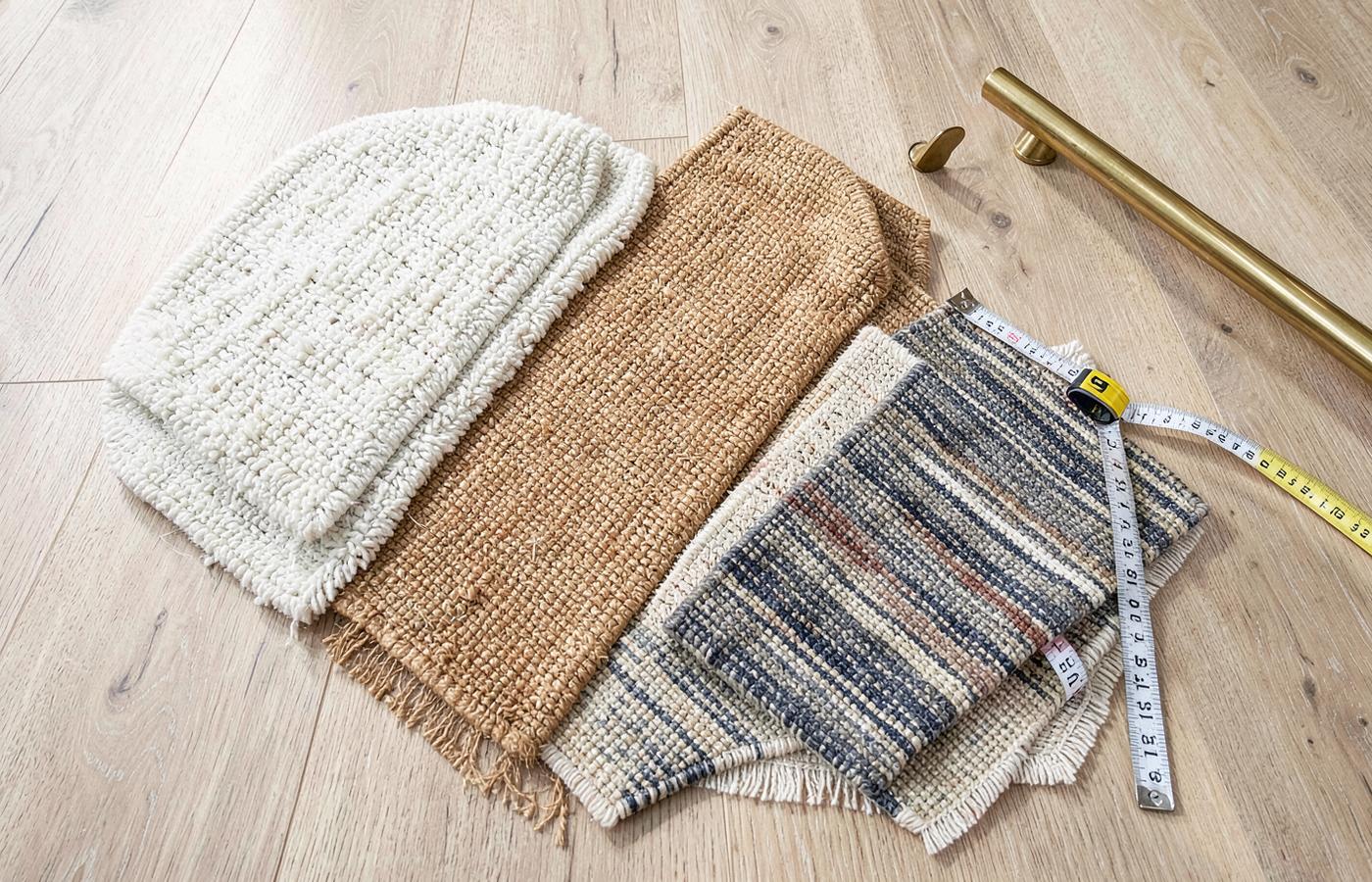
The eight specification points
| Criterion | What to look for | Why it matters on stairs |
|---|---|---|
| Fibre | Wool, wool-nylon blend, solution-dyed nylon | Crush recovery and abrasion resistance at the nosing |
| Pile height | Low | Tall pile crushes and looks tired in the walking lane |
| Density | High — backing hard to see when bent | The best single predictor of stair longevity |
| Twist | Tight, well-defined yarn ends | Loose twist untwists and frizzes under repeated load |
| Backing | Flexible enough to wrap a nosing cleanly | Stiff latex backings fight the fitter and cost more to fit |
| Width | Available at, or cuttable to, your target runner width | Determines margin symmetry and cutting waste |
| Pattern repeat | Small, or a repeat that divides into your width | Controls centring and pattern-matching waste |
| Colour | Mid-tone, multi-tonal, warm or cool to match the hall | Hides soil and traffic lanes |
Matching the specification to the household
- Busy family stairs: dense wool-nylon blend, small geometric or heathered colour, low pile.
- Pets: solution-dyed nylon cut pile — cleanable, no loops to snag. See pet-friendly runners.
- Formal period hall: wool, traditional pattern, bound edge, Hollywood fit.
- Rental or short-term: polypropylene, plain, standard roll width.
- Texture-led modern scheme: sisal or a wool-sisal blend, accepting the cleaning limits.
What to ask the supplier
- Is this product rated or warranted for stair installation?
- What is the pile density and the pile height?
- What is the pattern repeat in both directions?
- What roll widths is it made in, and can it be cut and bound?
- What pad does the warranty require? See underlay.
Once you have chosen the carpet, set the width, then calculate length with the runner calculator.
Why a general-purpose carpet often fails on stairs
Most carpet is designed, priced and marketed for flat floors, where the main stresses are even foot traffic and furniture indentation. A staircase adds two loads that flat-floor carpet is rarely tested against: repeated sharp bending around a nosing, and a shearing force as the foot pushes off at an angle rather than landing flat. A carpet can score well on general durability ratings and still fail early on stairs if its backing will not bend cleanly or its pile lacks the density to resist that shearing action. This is the reason suppliers sometimes describe a product as "suitable for stairs" as a distinct claim from general durability, and why that specific approval is worth asking for directly.
Fibre as the starting filter
Before evaluating any single roll, decide which fibre family fits your household. The full trade-offs are covered in wool vs synthetic stair runners, but as a starting filter: choose wool or a wool-nylon blend for the best all-round appearance retention, solution-dyed nylon where stain resistance is the priority, and polypropylene only where budget or a short ownership horizon makes the trade-off acceptable. Natural fibres such as sisal are a separate category again, covered in sisal and jute stair runners, and suit a texture-led scheme more than a spill-prone household.
Density and twist: the numbers that matter more than they sound
Density describes how much fibre is packed into a given area of backing; twist describes how tightly the individual yarn tufts are spun and heat-set. Both numbers matter more to stair longevity than fibre alone, because a sparse or loosely twisted construction in an expensive fibre still wears fast, while a dense, tightly twisted construction in a modest fibre can perform respectably. Reputable suppliers can quote both figures; treat vague answers as a sign to look elsewhere, or at least to test the sample more rigorously yourself.
Pile height and pile type in more detail
Low pile heights, broadly under about a centimetre, keep the fibre supported and upright under load, which is why almost every stair-rated carpet sits at the lower end of the pile height range regardless of fibre. Cut pile is the more common stair choice because it hides seams well and gives a clean, formal finish, particularly where the carpet wraps a waterfall or Hollywood fitting. Loop pile can work well too, provided the loops are small and tight; long or exaggerated loop constructions — often marketed as Berber styles — are better suited to flat floors, since they catch on shoes and claws far more readily on the edge of a step.
Backing: the specification people forget to ask about
The secondary backing determines how easily the carpet can be worked around a nosing and, on staircases with turns, around winders. A flexible action-backed or foam-backed product bends cleanly and is generally easier and cheaper to fit on stairs. A heavy, stiff-latex backing, common on some natural fibre and some traditional Axminster-style products, resists bending and can crease or crack along the fold over years of use if the product was not genuinely intended for stair use. Always ask the specific question — is this backing approved for stair fitting — rather than assuming from the front-face appearance.
Colour and pattern as functional decisions, not just aesthetic ones
A mid-tone, multi-tonal or lightly flecked colour hides both soiling and the gradual lightening of a walking lane far better than a flat, solid colour, particularly in pale or very dark shades where any change in the pile shows starkly. Pattern works similarly: a small busy design disguises wear better than a large, plain field, though a bold pattern also has to be planned carefully against your chosen runner width so the repeat centres correctly on every tread — see pattern matching on stairs for that process.
Common mistakes when specifying stair carpet
- Choosing a carpet on colour and texture alone without checking density, twist or stair approval.
- Assuming a sample that feels soft in the showroom will feel the same once bonded to a firm pad and fitted over a hard nosing.
- Buying a pile height or backing that the fitter then struggles to wrap around a curve or winder, adding cost and compromising the finish.
- Ignoring the manufacturer's pad and installation requirements, which can affect both performance and warranty validity.
- Selecting a pattern repeat that does not divide evenly into the chosen width, leading to an off-centre design for the length of the flight.
How manufacturer stair ratings actually work
Some manufacturers publish an explicit suitability rating for stairs, separate from their general durability or traffic rating, because the stresses on a stair tread differ from a flat floor in ways a general rating does not capture. Where this rating exists, treat it as a minimum filter rather than a guarantee of good looks — a carpet can clear a stair rating and still be a poor stylistic fit, or clear it while sitting at the bottom of the acceptable range. Where no explicit stair rating is published, fall back on the eight-point specification above and ask the retailer directly whether the product has been used successfully on stairs before.
Judging samples honestly against your own staircase
A sample card shown flat on a counter, under showroom lighting, tells you comparatively little about how a carpet will look folded over your own nosings under your own stairwell light. Where possible, take the sample home, prop it against a step, and look at it from the angle you would actually see it from — usually looking up the flight from the hall. Check it in daylight and again under artificial light in the evening, since colour and texture can shift noticeably between the two. This small amount of extra effort catches most of the mismatches that otherwise only become obvious once the runner is fitted.
Sustainability and material sourcing considerations
Fibre choice also has an environmental dimension worth weighing alongside performance. Wool is a renewable, biodegradable fibre, though its production has its own resource considerations; synthetic fibres derived from petrochemicals vary in how much recycled content they use, and some solution-dyed nylons and polyesters are made partly or wholly from recycled material. If sourcing matters to your decision, ask the supplier directly about fibre origin and recycled content rather than assuming from marketing language alone.
Reading a product's technical datasheet
Most reputable carpet manufacturers publish a datasheet alongside the product listing. Look past the marketing description for the pile density, pile height, twist level and backing type, and compare them directly against the eight-point checklist above rather than judging the product by its name or collection alone. A datasheet that omits these figures is itself informative.
Final shortlist checklist
- Confirm fibre and construction against the eight-point specification.
- Check the product is explicitly rated or approved for stair use.
- Order a sample large enough to fold over a real nosing.
- Check pattern repeat against your intended width, if relevant.
- Confirm the pad requirement before pricing the whole project.
Frequently asked questions
- What is the best carpet for a stair runner?
- A low, dense cut pile in wool, wool-nylon blend or solution-dyed nylon, in a mid-tone multi-tonal colour, on a flexible backing, in a width that suits your stairs. That specification handles stair traffic better than any single brand recommendation.
- Can I use any broadloom carpet as a runner?
- Most broadloom can be cut and bound into a runner, but not all of it should be. Very thick, very soft or stiffly backed carpets are difficult to wrap over a nosing and will not hold a crisp line. Ask the supplier whether the specific product is approved for stair use.
- Is loop pile suitable for stairs?
- Small, tight loops perform well and hide footprints. Large loops and long-pile Berbers can catch on claws and shoes, and once a loop pulls it runs. On a staircase, keep loops small or choose cut pile.
- How do I judge carpet quality in a showroom?
- Bend the sample back on itself — if the backing grins through, the tufting is sparse. Rub the pile hard with your thumb and see whether it recovers. Fold it sharply over an edge to simulate a nosing. Ask for the density and twist figures rather than the price per square metre alone.
- Does a more expensive carpet always perform better on stairs?
- Not automatically. Price reflects fibre, design, brand and finishing together, and some of those have little to do with stair performance. A mid-priced carpet that meets the eight specification points above will usually outperform an expensive but poorly specified one.
- Should stair carpet match the carpet elsewhere in the house?
- It does not need to, and a stair runner is one of the few places a different material or pattern reads as a deliberate design choice rather than a mismatch. Coordinate tone or undertone with adjoining rooms if you want continuity, but the specification requirements for stairs stand on their own.
Related guides
- MaterialsStair Runner Materials ComparedWool, nylon, polypropylene, sisal and jute judged on stair-specific wear, comfort, cleaning and safety.
- ComparisonsWool vs Synthetic Stair RunnersWool, nylon, polyester and polypropylene compared on stair-specific wear, cleaning, comfort and price.
 BuyingCustom Stair Runners and Carpet by the FootBroadloom cut to length, edge binding options, made-to-measure runners and what customisation really costs you.
 MaterialsStair Runner Underlay and PaddingWhy pad choice matters more on stairs than anywhere else, and how to specify density, thickness and cut.