Comparison
Carpet stair treads vs a continuous runner
Individual treads and a fitted runner solve overlapping problems in different ways. The right choice depends mostly on whether the installation needs to be permanent.
Written by the StairRunner.co editorial team · Updated 4 September 2026
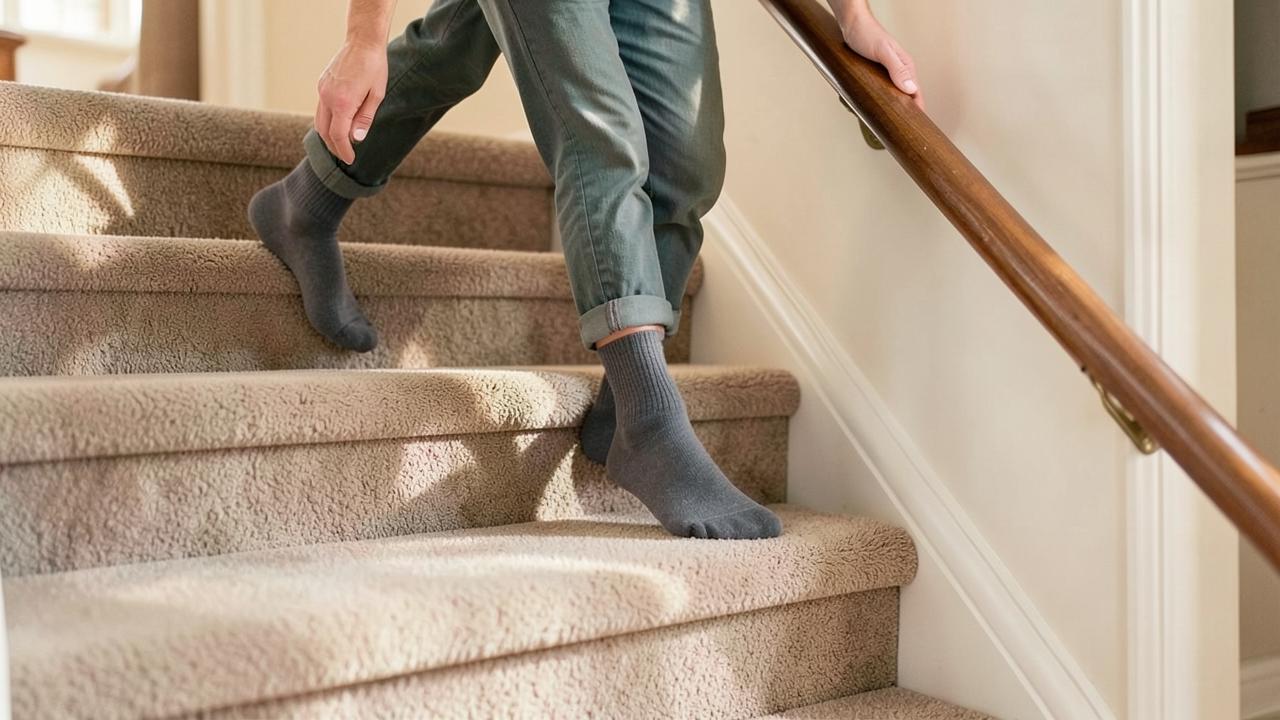
Side by side
| Factor | Individual treads | Fitted runner |
|---|---|---|
| Appearance | Segmented; risers stay bare | Continuous line down the flight |
| Installation | DIY in an hour or two, no tools | A day's skilled work, or a fitter |
| Permanence | Removable, leaves the stairs unaltered | Permanent; fixings mark the treads |
| Safety | Depends on each piece staying put | Immovable when correctly fitted |
| Cleaning | Some are machine washable individually | Cleaned in place; spot treatment by fibre |
| Cost | Lower up front, no labour | Higher up front, longer service life |
| Winders and curves | Hard to fit non-rectangular treads | Can be cut and fitted to shape |
Where treads genuinely win
- Rented homes where fixings are not permitted.
- Households wanting to add grip to a slippery flight without recovering it. Compare with stair safety measures.
- Trialling a colour or texture before committing to a full runner.
- Basement or utility flights where appearance is secondary.
- Ageing pets that need traction on a hard staircase.
Where a runner wins
- Any staircase visible from the main hall or entrance.
- Flights with winders or curves, where rectangular treads simply do not fit.
- Long-term ownership, where fitted longevity beats repeated tread replacement.
- Schemes where the runner continues onto a landing or hallway.
The middle option
If the appeal of treads is removability but the appeal of a runner is the look, consider a runner fitted with a clamping rod system, or a runner fitted conventionally on a staircase whose margins you were going to refinish anyway. Both give a proper appearance while limiting the permanent alteration. The trade-offs are set out in the installation guide.
Two different objects solving overlapping problems
Individual carpet stair treads and a fitted runner both add softness, grip and appearance to a bare or worn staircase, and from a distance they can look similar in a photograph. Up close they are entirely different objects. A tread is a discrete piece of carpet, usually rectangular or shaped to a single step, sold and fitted one per stair with its own backing and often its own fixing method. A runner is one continuous length of carpet that travels the whole flight, fixed at every step but structurally a single piece. That difference in construction is the source of almost every practical distinction between them.
Because a tread is independent, its failure mode is also independent: one tread can loosen, wear or fade without affecting its neighbours, and you replace only the one that has failed. Because a runner is continuous, it fails and is renewed as a whole, but it also behaves as a single fixed object rather than a stack of separate items that each need individual attention. Neither of these is automatically better; they are different trade-offs between convenience and consistency.
How each is actually held in place
Carpet stair treads rely on one of a handful of fixing methods: a non-slip rubber or gripper backing that relies on friction and the tread's own weight, double-sided adhesive strips or pads, a stapled or tacked fixing similar to a mini runner installation, or a bullnose design that wraps over the front edge and grips by shape alone. Friction and adhesive methods are removable and suit rentals; stapled or tacked treads are closer to a permanent fitting and behave more like a segmented runner.
A fitted runner is held by tack strip along both edges at each step, or by staples directly into the tread, tensioned by hand as the fitter works down the flight, and usually laid over a continuous pad. That continuous tensioning is what makes a correctly fitted runner immovable in a way that friction-backed treads generally are not — see stair runner underlay for how the pad interacts with this fixing. Some runners are fitted with decorative stair rods instead of, or in addition to, tack strip; the visual and mechanical trade-offs of that approach are covered in stair runner rods.
The case for treads, argued properly
Treads earn their popularity honestly in a specific set of situations. In a rented property where the tenancy agreement forbids fixings into the structure, friction-backed or adhesive-backed treads add real grip and warmth without leaving a mark that a deposit inspection would flag. When you want to test whether a colour, texture or pattern actually works on your particular staircase before committing to a full-length runner, buying two or three treads is a low-cost trial that a runner cannot match — cutting and fitting even a short length of runner is not something you would do speculatively.
Treads are also the fastest way to add grip to a slippery staircase. A flight of polished or varnished timber steps can be genuinely hazardous, and fitting a full runner is a project that takes planning, measuring and often a fitter's time. A set of treads can be down and doing useful work within an hour, which matters if the immediate concern is a fall risk rather than long-term appearance. For a fuller discussion of what actually makes a staircase safe underfoot, see non-slip stair runners.
Utility staircases, basement stairs, staircases in a workshop or a holiday let, and any flight where appearance is secondary to function are all reasonable homes for treads on a semi-permanent basis. So are households with an ageing pet that needs traction on an otherwise hard staircase but where a full renovation is not planned.
The case for a runner, argued properly
A runner wins decisively wherever the staircase is seen and judged as part of the house. Entrance halls, open-plan stairs visible from a living space, and any flight a visitor sees within moments of arriving all benefit from the continuous line a runner gives, where each riser and tread reads as part of one considered scheme rather than a series of separate mats. The gap at every riser that treads leave — because a tread covers the horizontal surface but rarely wraps down the vertical face in a way that reads as continuous — is the single visual giveaway that no amount of matching pattern fully disguises.
A runner is also the only realistic option once a staircase has winders, a curve, or any non-rectangular tread. Individual treads are manufactured as simple shapes and do not adapt to a pie-shaped winder tread without unattractive gaps or overhang; a runner is cut and fitted to the actual shape of each step as it goes. If your flight turns a corner, read runners on winder and curved stairs before considering treads for those steps at all.
For long-term ownership, a runner also tends to work out as less hassle over time, because renewing one continuous item on a planned cycle is simpler than monitoring, replacing and re-matching a dozen individual pieces that will not all wear out at the same rate. A runner that continues onto a landing or into an upstairs hallway, discussed in stair runner landings, extends this consistency beyond the flight itself in a way treads cannot.
Cost, honestly compared
Treads are cheaper to buy and, in their friction-backed or adhesive form, free to fit, because there is no labour cost at all. That comparison flatters treads if you stop there. A set of treads that needs replacing every few years because the fibre has worn or the backing has failed can cost more over a decade than a well-made runner fitted once and cared for properly. Whether treads or a runner represent better value depends entirely on how long each actually lasts in your household, which in turn depends on foot traffic, fibre quality and how well each is fitted — a badly fitted runner is not automatically more durable than a good set of treads.
Safety is not automatically on the runner's side
It is easy to assume a fitted runner is inherently safer because it is permanent, but permanence only helps if the fitting itself was done correctly. A runner fitted without proper tension is arguably worse than treads, because its failure is harder to spot — a whole flight can develop slack gradually rather than one obviously loose tread announcing itself. Treads have the opposite profile: each one is small enough to test individually by hand, and a loose tread is usually obvious the moment weight goes on it. The practical safety lesson is the same for both — nothing that can move underfoot should be left in service, and both formats need a genuine, repeated check rather than a one-off glance after fitting.
A short buyer's checklist
- If you rent, or expect to move within a couple of years, favour treads with a genuinely removable fixing and confirm with your landlord what is acceptable.
- If the staircase has winders, a curve, or an open side, favour a runner — treads cannot follow that geometry convincingly.
- If the staircase is on show to visitors, favour a runner for the continuous line; treads will always show a gap at the riser.
- If your priority is fast, low-cost grip on a slippery staircase and appearance is secondary, treads solve the immediate problem while you plan anything more permanent.
- Whichever you choose, test the fixing by hand periodically. A covering that can move is not doing its job, no matter how it is constructed.
Frequently asked questions
- Can I mix stair treads and a runner?
- It is unusual but possible. Some homeowners use individual treads on the main flight and a matching runner on a short secondary flight or a half-landing to maintain a theme while saving cost or complexity where it is most needed.
- Do carpet treads protect the wood from UV fading?
- Yes, but only the area they cover. If your staircase is in direct sunlight, be aware that the exposed margins will fade over time, while the wood under the treads will retain its original colour. This creates a permanent "shadow" that will be visible if you ever remove the treads.
- Are individual carpet stair treads safe?
- They can be, if each one is genuinely fixed and cannot slide. Their weakness is that there are as many independent pieces as there are steps, and each is a separate opportunity for movement. They need checking regularly in a way a fitted runner does not.
- Are stair treads cheaper than a runner?
- Usually, because there is no fitter and less material. Whether they are better value depends on how long they last — treads are typically replaced sooner and can look worn unevenly as individual pieces fail at different rates.
- Do treads work on a rental staircase?
- This is their strongest use case. They add grip and warmth without permanent fixings, and they can be removed when you leave. Confirm with the landlord whether any adhesive backing is acceptable on the treads.
- Can you get treads that look like a runner?
- Sets sold as matching treads plus a separate landing mat approximate the look, but the gap at each riser gives it away. If the continuous line is what you want, a fitted runner is the only way to get it.
Related guides
 ComparisonsStair Runner vs Full CarpetA side-by-side comparison of appearance, safety, noise, cleaning, cost and resale considerations.
 InstallationDIY Stair Runner InstallationAn honest assessment of doing it yourself: skills, tools, time, safety and the jobs worth handing over.
 InstallationInstalling a Stair Runner Over CarpetWhether a runner can go over existing carpeted stairs, when it is a bad idea, and safer alternatives.
- SafetyNon-Slip Stair Runners and Stair SafetyWhat actually makes a stair covering grippy: fitting tension, pile, pad and nosing coverage.
Installation ergonomics: DIY complexity compared
The physical act of installing these two options is worlds apart. Fitting a stair runner is an athletic task; it involves kneeling for hours, using a bolster to hammer carpet into creases, and operating a staple gun or tack strip cutter. It requires a high degree of hand-eye coordination to ensure the runner stays perfectly centered over a 15-foot drop. Installing carpet treads, by contrast, is an exercise in measurement and repetition. The hardest part is ensuring the first tread is perfectly straight; once that is set, the others follow the same template. For anyone with back or knee sensitivities, the tread option is significantly more accessible as a DIY project, whereas a runner almost always justifies the cost of a professional installer.
Resale value and staircase presentation
When it comes to the "property market" view of a home, a fitted runner is generally perceived as a premium architectural feature. It suggests a level of permanence and investment that individual treads do not. Treads can sometimes be viewed by potential buyers as a "quick fix" for a damaged staircase rather than a deliberate design choice. If you are renovating with the intent to sell within the next 2-3 years, a well-chosen wool runner in a neutral tone will likely add more perceived value to the hallway than a set of removable treads, even if the treads are of high quality. The continuous line of a runner draws the eye upward, making the hallway feel taller and more cohesive.
Sound dampening and insulation
Stairs are often the main conduit for noise in a two-story home. A fitted runner covers not just the treads (where feet land) but also the risers (which act as sounding boards). By covering both surfaces, a runner provides superior sound dampening, reducing both impact noise and the "echo" of the stairwell. Individual treads only dampen the impact on the horizontal surface, leaving the vertical risers to reflect sound. Similarly, from a thermal perspective, a runner provides a continuous layer of insulation that helps prevent draughts from rising through the gaps in older timber stairs. If your goal is a warmer, quieter home, the runner is the technically superior solution.