Materials
Polyester stair runner: PET, triexta and what really matters
Polyester carpet has moved from a budget alternative to a genuine contender for softness and colour, especially in PET and triexta forms. On stairs, where twist and density decide performance far more than the fibre name on the label, it needs a more careful reading than the marketing suggests.
Written by the StairRunner.co editorial team · Updated 4 September 2026
What polyester carpet fibre actually is
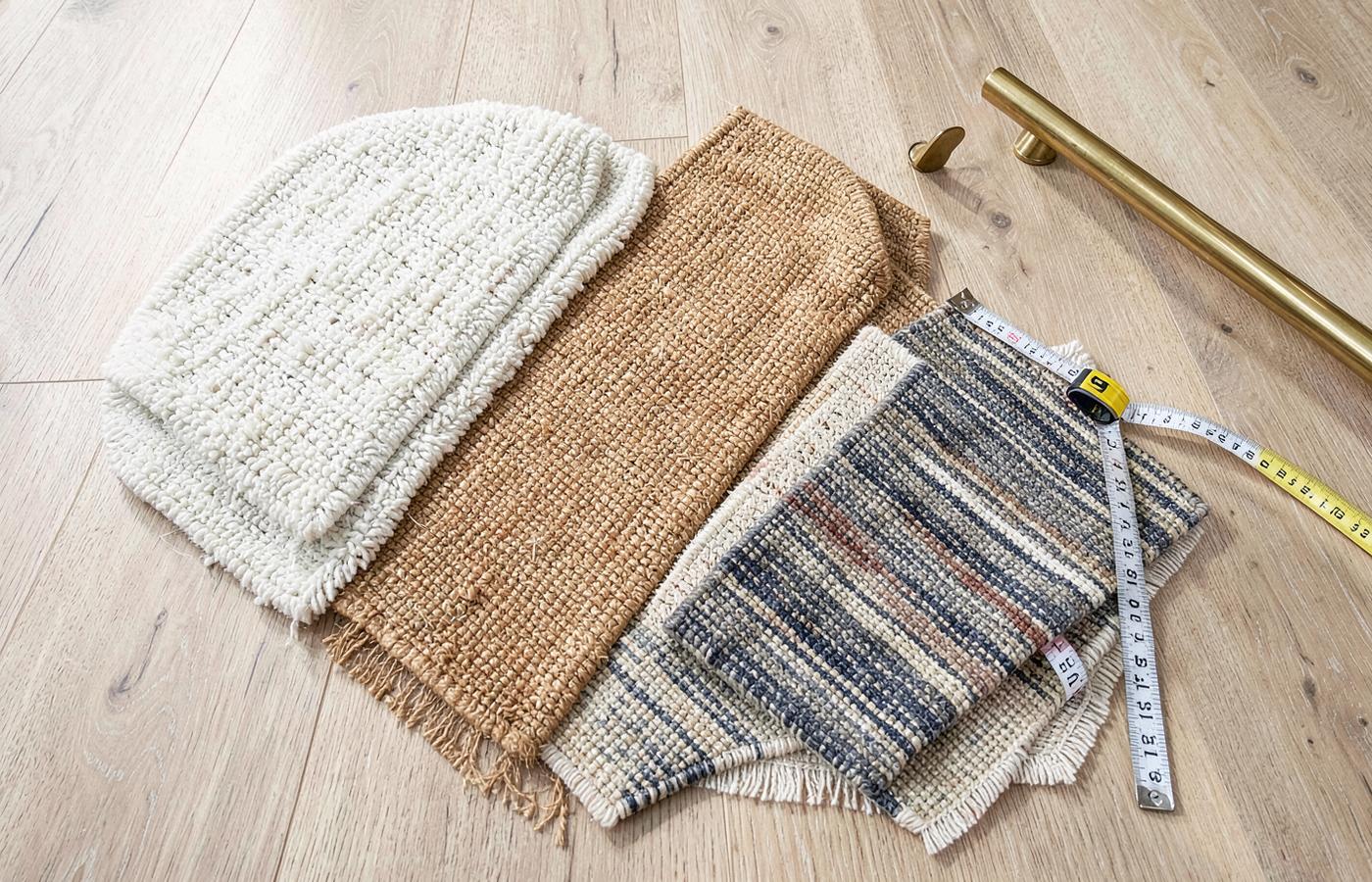
Polyester carpet fibre is most commonly PET, the same polymer family used in plastic bottles, and a substantial proportion of modern polyester carpet is manufactured from recycled bottle content. This gives polyester carpet a reasonable sustainability story compared with virgin synthetic fibres, alongside its practical qualities. A newer variant, triexta, is chemically related but distinct, generally marketed under its own brand names and positioned as offering improved resilience and stain resistance over standard PET while keeping the same soft hand. Triexta typically costs more than standard polyester but less than nylon.
Both forms share a defining characteristic: an inherently soft fibre with a pleasant hand feel, often compared favourably with wool for underfoot comfort, and an ability to take dye in exceptionally clear, saturated colours. This is why polyester is a common choice where a strong or unusual colourway is wanted — the fibre's chemical structure accepts dye more vividly and evenly than nylon does.
| Property | How it behaves on stairs |
|---|---|
| Softness | High; one of the fibre's main selling points, comparable with wool underfoot |
| Colour clarity | Excellent; dyes take exceptionally well, giving deep, vivid, even colour |
| Water-based stain resistance | Good; the fibre absorbs little moisture, so most spills sit on the surface |
| Oil-based stain resistance | Poor; oils bond to the fibre surface and resist standard water-based cleaning |
| Crush resistance | Moderate; better than polypropylene, generally behind nylon, varies with twist and density |
| Cost | Moderate; above polypropylene, below nylon and well below wool for equivalent weight |
Softness and colour: the two genuine selling points
Polyester's reputation for softness is deserved. The fibre filaments are inherently more pliable and rounded than nylon's, giving a plush, yielding feel underfoot that many households find preferable, particularly for a staircase used barefoot regularly. This softness is not purely cosmetic on stairs: a softer pile is somewhat more forgiving on bare feet and can slightly cushion an unsteady footfall, though it should never be relied upon as a safety feature in place of proper tread definition and grip, covered in non-slip stair runners.
Colour clarity is the other consistent advantage. Polyester fibre accepts dye deep into its structure and reflects it with a clarity and richness that nylon, in particular, struggles to match at a comparable price point. This makes polyester a strong choice where a bold, saturated colour or a subtle, complex multi-tonal pattern is central to the design brief, and it is one reason polyester has become popular in decorative and patterned stair runners rather than only in plain, practical ones. See stair runner colours and stair runner patterns for how colour and pattern choices interact with fibre selection.
Stain behaviour: strong against water, weak against oil
Polyester's stain resistance story has two very different halves, and understanding both is essential before fitting one on a staircase, where drink spills, food and general household traffic all pass through repeatedly.
Against water-based spills — soft drinks, juice, tea, most household liquids — polyester performs well. The fibre itself absorbs comparatively little moisture, so a spill tends to sit on the surface rather than wicking down into the pile and backing, which gives a reasonable window to blot it up before it sets. This is broadly comparable to how polypropylene behaves, though polyester is slightly more absorbent overall.
Against oil-based contamination — cooking oils, some skincare and haircare products, greasy food residue, and certain shoe-borne soiling — polyester is considerably weaker. Oils bond readily to the surface of polyester fibre, and once bonded they resist the standard water-based cleaning products used for most household stain removal. This oil affinity is a well-documented limitation of the fibre and it matters specifically on stairs because a staircase is exactly where shoe-borne soiling, including grease picked up outdoors or in a kitchen, gets tracked repeatedly over the same narrow traffic lane. A polyester runner in a household that cooks with a lot of oil, or where shoes are regularly worn on the stairs without being removed, should be treated with a degreasing-capable cleaning routine from the outset rather than waiting for a stain to become obvious.
Crush resistance and why it is moderate, not excellent
Standard PET polyester fibre sits in the middle of the resilience spectrum. It recovers from compression better than polypropylene, whose fibre structure has notably weak springback, but it generally falls behind nylon, which is engineered specifically for resilience and repeated recovery under load. Triexta closes some of this gap, generally offering improved resilience over standard PET, though opinions and test results vary by specific product and manufacturer.
On a staircase, where the pile is compressed and flexed at the nosing on every single step, this moderate resilience means polyester's real-world performance depends heavily on how it is constructed, far more than it does for nylon. A loosely twisted, low-density polyester pile will crush and mat within a relatively short period on a busy flight. A tightly twisted, dense, heat-set polyester pile can perform respectably for years. The fibre name on its own tells you comparatively little; the construction specification tells you much more.
Twist and density: the deciding specification
This is the single most important practical takeaway for anyone specifying polyester for stairs. Two products both labelled "polyester" can perform very differently depending on two construction variables:
- Twist level. Yarn twist is how tightly the individual fibre filaments are spun together before being tufted into the carpet backing. A tight twist, especially when heat-set to lock the twist in place, holds its shape under repeated compression far better than a loose twist, where individual filaments splay apart and untwist visibly under traffic. On stairs, where every tread sees repeated, concentrated pressure, twist level is arguably the single biggest factor separating a polyester runner that looks tired within a couple of years from one that still looks presentable after many.
- Density. As with any tufted fibre, packing more filaments into each square inch of pile spreads foot pressure across more individual fibres and reduces the load on any one of them. A dense polyester pile compensates meaningfully for the fibre's moderate natural resilience; a sparse one compounds the weakness.
When comparing polyester products for a stair project, ask for twist level and density figures specifically, rather than relying on general descriptions like "luxury" or "hard wearing". A denser, tightly twisted mid-range polyester will almost always outperform a loosely constructed premium-branded one on an actual staircase.
| Indicator | What to look for | Why it matters on stairs |
|---|---|---|
| Twist level | Tight, heat-set twist stated in the specification | Resists untwisting and splaying under repeated nosing compression |
| Pile density | A quoted weight or density figure, not a marketing adjective | Spreads foot pressure across more fibre, reducing crush per filament |
| Pile height | Low to medium rather than tall or shaggy | Less leverage on each fibre when flexed around the nosing |
| Fibre type | Triexta or a reputable branded PET where budget allows | Generally better resilience than unbranded standard polyester |
Comparing polyester with nylon and wool on stairs
Nylon remains the more resilient synthetic fibre overall, engineered specifically for repeated compression recovery, and it generally holds up better than polyester on a heavily used main staircase over many years. It typically costs more and does not match polyester's colour clarity or softness, but on pure durability against stair-specific crushing it has the edge. A detailed comparison of construction and performance across common fibres is in stair runner materials.
Wool sits above both synthetics for natural resilience, thanks to its crimped fibre structure, which gives it excellent long-term appearance retention on stairs without relying on twist or density to compensate. Wool also has a distinctive, premium hand feel that many consider superior even to polyester's softness. The trade-offs are cost, which is considerably higher, and a greater vulnerability to certain stains and alkaline cleaning products. The fuller natural-versus-synthetic decision is set out in wool versus synthetic stair runners.
Against polypropylene, polyester generally offers a softer feel, better colour clarity and somewhat better crush resistance, at a higher price. Where extreme moisture exposure or maximum bleach cleanability is the priority, polypropylene remains the more specialised choice, discussed in polypropylene stair runners.
Where polyester suits a staircase well
- Households prioritising a soft, plush feel underfoot over maximum durability.
- Design-led projects where a bold or complex colourway is central to the brief.
- Moderate-traffic staircases where water-based spills are the main risk rather than oil or grease.
- Mid-budget projects where nylon or wool is out of reach but polypropylene feels too utilitarian.
- Bedrooms-to-landing staircases with lighter, less constant footfall than a main household flight.
Where polyester suits a staircase poorly
- Very heavy daily traffic staircases where nylon's superior resilience will show its value over a decade.
- Kitchens-adjacent stairs or households that cook with a lot of oil, given the fibre's vulnerability to oil-based staining.
- Low-budget polyester products with loose twist and low density, which will crush and mat quickly regardless of the fibre's general reputation.
- Anywhere maximum long-term appearance retention outweighs softness and colour as priorities.
A sensible specification process
- Decide whether softness and colour, or long-term durability, matter more for this specific staircase.
- If polyester suits the brief, ask specifically for twist level and density figures, not general descriptions.
- Consider triexta over standard PET where budget allows and improved resilience is worth the extra cost.
- Choose a low to medium pile height rather than a tall, loose one.
- Fit an appropriate pad; it reduces the compression load the fibre itself has to absorb.
- Plan a cleaning routine that accounts for oil-based soiling specifically, not just general spills.
For the fitting and cleaning detail once a specification is chosen, see stair runner installation and cleaning and caring for a stair runner. The wider decision framework for choosing between fibres in the first place is in how to choose a stair runner, and how fibre choice affects overall spend is covered in stair runner cost.
A realistic verdict
Polyester has earned its growing popularity on genuine merits: a soft, comfortable feel and colour performance that few other fibres can match at a similar price. On stairs, where conditions are more demanding than on flat flooring, it rewards a careful specification rather than a purchase based on fibre name alone. Get the twist and density right, plan for oil-based soiling rather than being surprised by it, and polyester can be a genuinely satisfying long-term choice for a great many households and staircases.
Frequently asked questions
- Is polyester a good fibre for a stair runner?
- It can be, provided the twist and density are specified properly. A well-made, dense, tightly twisted polyester runner performs respectably on stairs; a cheap, low-twist one will crush and lose shape quickly, regardless of the fibre being technically the same.
- What is the difference between polyester and triexta stair carpet?
- Triexta is a specific type of polymer, chemically related to but distinct from standard PET polyester, often marketed under its own brand names. It generally offers better resilience and stain resistance than ordinary polyester while sharing its softness, at a higher price point.
- Does polyester carpet stain easily?
- Polyester resists water-based staining well, largely because the fibre itself does not absorb much moisture. It is considerably more vulnerable to oil-based staining, since oils can bond to the fibre surface and are harder to remove with standard water-based cleaning products.
- Is polyester softer than nylon for stairs?
- Generally yes. Polyester fibre has an inherently soft hand, which is one of its main selling points, and can rival wool for underfoot comfort. Nylon is engineered more for resilience and durability than for softness.
- How do I know if a polyester stair runner is good quality?
- Check the twist level and density rather than relying on the fibre name alone. A tightly twisted, heat-set, dense polyester pile will hold its texture far longer than a loosely twisted, low-density one, even if both are labelled simply as polyester.
- Does polyester crush on stairs?
- It can, particularly in lower-quality constructions. Standard PET polyester has moderate resilience, better than polypropylene but generally behind nylon, so density and twist level matter more for polyester than for nylon in resisting stair-specific crushing.
- Is polyester or wool better for a stair runner?
- Wool has superior natural resilience and a more premium long-term appearance, while polyester offers similar softness at a lower price with better resistance to water-based staining. The choice usually comes down to budget and how much weight is placed on long-term appearance retention versus upfront cost.
Related guides
- MaterialsStair Runner Materials ComparedWool, nylon, polypropylene, sisal and jute judged on stair-specific wear, comfort, cleaning and safety.
- ComparisonsWool vs Synthetic Stair RunnersWool, nylon, polyester and polypropylene compared on stair-specific wear, cleaning, comfort and price.
- MaterialsPolypropylene Stair RunnersOlefin on stairs: bleach-cleanable colour, moisture resistance, and the crushing risk you must design around.