Safety
Non-slip stair runners and stair safety
Marketing tends to treat non-slip as a product feature. On a staircase it is mostly a consequence of how the runner is fitted and what sits under it.
Written by the StairRunner.co editorial team · Updated 4 September 2026
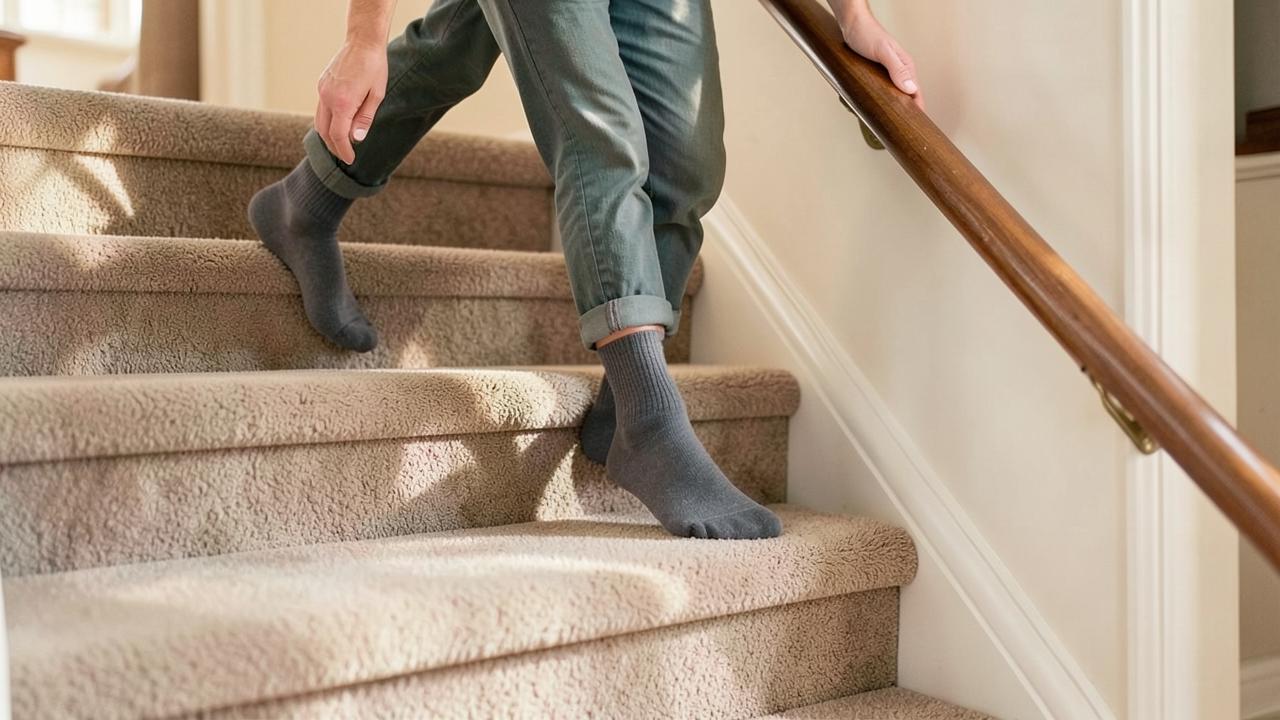
What actually determines footing
- Fixing and tension. The runner must be pulled tight into each crease and held by tack strip or staples that bite into solid timber. Nothing else compensates for this.
- Pad firmness. A soft, thick pad feels luxurious and behaves badly on stairs: the foot sinks and the nosing edge becomes vague. Stairs want a dense, thinner pad.
- Nosing coverage. The front edge of each tread takes the load. Runner material that stops short of the nosing, or lifts from it, is where slips start.
- Surface texture. Low dense cut pile and small tight loops give consistent friction. Hard smooth weaves give less.
- Step-edge visibility. Being able to see where each tread ends prevents missteps. Avoid patterns that visually dissolve the step edges.
Fixing a runner that moves
| Symptom | Likely cause | Appropriate action |
|---|---|---|
| Ripples on the treads | Insufficient tension at fitting, or relaxation over time | Refit — restretch and refix; a fitter can often do this quickly |
| Runner creeping downhill | Fixings pulled out, or fitted over an unsuitable substrate | Lift, inspect the treads, refit into sound timber |
| Lifting at the nosing | Staples missed, or the pad set too far forward | Refix at the nosing; reposition the pad |
| Loose treads underneath | Structural, not a covering problem | Repair the staircase first; get a professional if unsure |
Households that need more margin
Where older adults, young children, or anyone with reduced vision or mobility uses the stairs, add margin deliberately: strong tonal contrast at the step edge, good lighting at the top and bottom of the flight, a continuous graspable handrail, and a low dense pile rather than a plush one. These measures work together; none of them substitutes for the others.
What to be sceptical about
- Adhesive strips sold as a permanent stair fix — they depend on a clean, dry, sound surface and they degrade.
- "Non-slip" claims made about the carpet face alone, without reference to how it is fixed.
- Loose runners or rugs placed on stairs without fixing. See runners over existing carpet.
Building requirements for stairs, handrails and step geometry vary by jurisdiction. Where you are altering the staircase itself rather than its covering, check the rules that apply locally rather than relying on general guidance.
Reframing "non-slip" as an outcome, not a label
Retailers describe individual products as non-slip, but on a staircase safety is a property of the whole installed system rather than of any single component. A grippy-faced carpet fitted loosely over a slick pad is not safe, and a plainer carpet fitted correctly, tensioned into every crease and fixed into sound timber, can be. Treat "non-slip stair runner" as a question about the finished installation, not a filter you can apply while browsing carpet samples.
The forces involved on a step
A footstep on a stair applies force at an angle, not straight down, because the body is moving forward and up or down as it lands. That angled load is exactly what pushes a loose covering forward and eventually detaches it from its fixings, and it is concentrated most heavily at the front third of the tread, near the nosing. Understanding this explains why the nosing is repeatedly the weak point in slipping incidents: it is where the largest sideways force meets the covering, and it is also, on many installations, the hardest place to fix securely because it is close to the edge of the timber.
How fibre and construction contribute, realistically
Fibre choice affects friction at the surface, which is real but secondary to fixing. A low, dense cut pile gives your foot many small contact points and predictable resistance. Long plush piles compress unevenly underfoot and can feel unstable even though the fibre itself is not slippery — the sensation of instability comes from the pile shifting, not from a lack of grip. Very smooth, tightly woven flatweaves, and some natural fibres such as sisal, seagrass or coir, have noticeably less surface friction than a cut pile carpet, and manufacturers of these fibres often recommend against stair use for this reason. If you want the appearance of a natural fibre on stairs, read sisal stair runners for how that trade-off is usually handled, and wool vs synthetic for how fibre choice interacts with wear as well as grip.
Building a safe staircase step by step
- Start with the structure. Loose treads, worn nosings or a wobbly handrail are safety problems in their own right and no covering fixes them; deal with these first.
- Choose a dense, relatively thin pad rather than a soft, thick one — see underlay for stairs for the reasoning.
- Choose a fibre with predictable, consistent surface friction; avoid very smooth weaves and very long piles on stairs specifically, even if you would happily use them on a flat floor.
- Insist on full tension at fitting, fixed into sound timber at every step, with full coverage over the nosing.
- Maintain strong visual contrast at each step edge, particularly if anyone using the stairs has reduced vision.
- Check the fixing by hand periodically, and address any movement immediately rather than monitoring it.
Why very plush, deep-pile carpets are a poor stair choice
A carpet that feels wonderful underfoot on a bedroom floor can be a genuinely poor choice for stairs, independent of its friction rating, because depth of pile changes how clearly a foot can locate the step edge. On a flat floor this does not matter, because there is no edge to locate. On a stair, a deep, soft pile obscures the precise point where the tread ends and the riser begins, and it compresses unevenly under a foot placed near that edge, which can produce a slight forward roll exactly where stability matters most. This is a separate issue from slipperiness and one reason low pile heights are the default recommendation for stairs even when a household would prefer a plusher feel elsewhere in the home.
Contrast, lighting and the parts of safety that are not about the carpet at all
A significant share of stair falls are caused by misjudging where a step is, not by losing grip on it. Strong tonal contrast between the tread surface and the riser, or a contrasting edge strip at the front of each step, helps the eye register the change in level, which matters most at the top and bottom of a flight where a single step is easy to misjudge. Adequate, even lighting along the whole flight — not just at the top and bottom — removes one of the most common contributing factors in stair falls generally. Handrail height, continuity and graspability affect how well someone can catch themselves if a foot does slip; a handrail that stops short of the top or bottom step, or one with an inconsistent profile, undermines an otherwise well-fitted runner. None of these measures involve the carpet at all, and all of them work alongside it rather than instead of it.
Vulnerable users need layered, not single, solutions
For households with young children, older adults, or anyone with a mobility or vision impairment, no single measure is sufficient by itself, and it is worth resisting the idea that one purchase — a grippier carpet, a brighter light, a new handrail — solves the problem on its own. These measures are additive: a low dense pile plus good tonal contrast plus a continuous graspable handrail plus adequate lighting each remove one way a fall can start, and removing several at once is what actually reduces risk meaningfully. Reviewing a staircase against all of these factors together, rather than fixing the one that is easiest to address, is the more useful exercise.
Common myths worth correcting
- "Thicker padding is safer." Beyond a point, thicker padding makes the nosing less defined underfoot and increases the sense of sinking into the step, which reduces confidence in foot placement rather than improving it.
- "A non-slip label means the whole installation is safe." The label describes the material's surface friction, not how it will be fixed, tensioned or padded on your particular staircase.
- "Adhesive strips are a permanent fix." They depend on a clean, dry, sound surface underneath and lose adhesion over time, especially with repeated flexing on a stair.
- "If it looked fine when it was fitted, it will stay fine." Tension relaxes, fixings loosen and pads compress over years of use; periodic checking matters even for a professionally fitted runner.
Frequently asked questions
- Do stair runners make stairs safer?
- A properly fitted runner adds friction and a softer landing compared with bare polished timber, and it makes the walking zone visually obvious. A badly fitted one is more dangerous than bare stairs, because it can move under a foot. Fitting quality is the deciding factor.
- Why is my stair runner slipping?
- Almost always because it has lost tension or was never tensioned properly, or because fixings have pulled out of the tread. Occasionally the pad has degraded. Any runner that moves by hand needs to be refitted before it is used normally again.
- Are non-slip pads a substitute for proper fitting?
- No. A grip pad increases friction between runner and tread but does nothing to hold the runner in place at the nosing, which is where the load is applied. Pads support proper fixing; they do not replace it.
- Which pile is grippiest on stairs?
- A low, dense cut pile generally gives good grip and predictable footing. Very smooth flat weaves and hard natural fibres like seagrass have less surface friction, and long soft piles can feel unstable underfoot even though they are not slippery.
- Can I use double-sided tape for a non-slip finish?
- Tape is a temporary measure and often fails under the heat and pressure of foot traffic. It can also leave a residue that makes future professional fitting harder. Use mechanical fixings for safety.
- Does a 'non-slip' spray work on stair runners?
- Chemical sprays can increase surface friction temporarily but do nothing for the structural stability of the runner. They can also attract dirt, making the runner harder to clean over time.
Sources and further reading
- U.S. Consumer Product Safety Commission — stair and fall safety
- International Code Council — stairway provisions in model codes
Where guidance differs between manufacturers, trade bodies or local building regulations, we say so rather than presenting one position as universal.
Related guides
 InstallationHow to Install a Stair RunnerWaterfall and Hollywood methods, staples versus rods, tools, sequence and quality checks.
 MaterialsStair Runner Materials ComparedWool, nylon, polypropylene, sisal and jute judged on stair-specific wear, comfort, cleaning and safety.
 CareCleaning and Caring for a Stair RunnerRoutine vacuuming, spill response by fibre type, slipping and fraying, and when to call a professional.
 MaterialsStair Runner Underlay and PaddingWhy pad choice matters more on stairs than anywhere else, and how to specify density, thickness and cut.
The impact of footwear: socks, slippers and bare feet
Safety on a stair runner is not just about the carpet; it is about the interface between the floor and the foot. Bare feet and rubber-soled shoes generally have high friction on most carpet fibres, but socks — particularly synthetic blends — can be surprisingly slippery, even on a high-traction wool runner. If your household is a "socks-only" home, this increases the importance of a low-pile, dense construction that allows the foot to feel the edge of the step through the fabric. For vulnerable users, non-slip "gripper" socks or firm-soled slippers are a more reliable safety measure than any specific carpet treatment.
Maintenance as a safety factor
A neglected runner is a less safe runner. Over time, dust and fine grit act as a dry lubricant between the fibres, slightly reducing the surface friction of the carpet. More critically, as the runner settles and the fixings are stressed, the tension can relax. A runner that was perfectly tight three years ago may now have a few millimetres of "give" at the nosing. While this might seem minor, that small amount of movement under the ball of the foot is enough to trigger a stumble. Periodic checking of the tension — literally trying to wiggle the runner at the edge of each step — should be part of your annual home maintenance routine.
Safety for pets
Dogs and cats rely on their claws for traction on stairs. A very tight, low-loop pile or a dense cut pile is generally safest for pets; however, some "loop" constructions (like Berbers or certain flatweaves) can snag a claw, leading to injury or a panicked pull that damages the runner. If you have pets that frequent the stairs, look for "pet-friendly" labels that specifically guarantee the loops are tight enough to prevent snagging. Additionally, pets that shed heavily can leave a layer of fur that, if not vacuumed, reduces the effective grip for human feet.
Visual cues and depth perception
Beyond friction, safety depends on the eye's ability to identify the step edge. A runner that "dissolves" the nosing with a complex, small-scale pattern can be hazardous in low light. High-contrast borders or a solid colour that stands out against the wooden tread margin help the brain map the staircase more accurately. If you are choosing a pattern, ensure that the pattern repeat doesn't create an optical illusion of a flat surface where there is actually a drop. For further reading on structural safety, see our guide on preparing stairs for a new installation.