Pattern
Chevron stair runner ideas and fitting guide
The chevron is the architectural backbone of pattern—a precise, directional choice that can elongate a flight or distract from awkward turns, provided the alignment is perfect.
Written by the StairRunner.co editorial team · Updated 4 September 2026
Understanding the chevron geometry
The chevron is often confused with herringbone, but for a staircase, the distinction is vital. A chevron is a continuous zigzag where the 'V' shapes meet at a central axis. In a carpet runner, this is usually woven into the fabric. The visual result is a series of arrows pointing either up or down the flight. This directionality is what makes it so popular; it creates a strong leading line that draws the eye upward, making the hall and stairs feel more cohesive and intentional. Unlike a standard stripe, which only offers parallel lines, the chevron adds a rhythmic pulse to the climb.
When choosing a chevron, you are deciding on the 'angle of the dangle'. A shallow, wide chevron feels more relaxed and traditional, reminiscent of parquet flooring. A sharp, acute angle feels more modern and energetic. The choice should be dictated by the age of the property and the existing architectural lines. Victorian stairs, with their often steeper pitch, can handle a sharper chevron, whereas modern, wider flights might benefit from the grounding effect of a wider, more open pattern.
Pattern repeat and central alignment
The absolute rule of chevron runners is that the 'point' must be centered. If the runner is 60cm wide, the peak or the valley of the chevron must sit at exactly 30cm. If it is off by even a centimeter, the entire flight will look 'skew-whiff'—a term fitters use for a runner that seems to be sliding off the side of the stairs. Before ordering, check the width of your stairs and the width of the runner options. If you are having a runner cut from broadloom carpet, ensure the cutter understands that the pattern must be perfectly symmetrical across the width.
The vertical repeat—how long it takes for the V to repeat—is also crucial. On a staircase, you see the pattern in two planes: the horizontal tread and the vertical riser. A very long repeat might mean you only see one 'point' per step, or even one point every two steps. This can look disjointed. Ideally, you want a repeat that allows the eye to follow the pattern through the nosing (the edge of the step) without a jarring break in the logic of the shape.
| Chevron Scale | Visual Effect | Best For |
|---|---|---|
| Small (1-3cm) | Reads as a texture from a distance; very forgiving on alignment | Narrow flights, heavy traffic, modern interiors |
| Medium (5-10cm) | Clear geometric definition without being overwhelming | Standard Victorian or Edwardian townhouses |
| Large (15cm+) | Architectural statement; requires perfect centering | Wide, grand staircases with long straight runs |
Matching across treads and nosings
The nosing is where the chevron pattern is most vulnerable. As the carpet bends over the edge of the step, the pattern can appear to 'break'. A professional installation ensures that the chevron points are aligned so that they flow over the nosing in a way that feels continuous. This is easier to achieve with a 'Waterfall' installation method, where the carpet flows straight down from the nosing to the next tread. In a 'Hollywood' or 'Bolted' installation, where the carpet is tucked tight under the nosing, the pattern break is more pronounced and requires even more careful tensioning.
Consistency is key. If the pattern is stretched more on one step than another to make it reach, the chevrons will change shape. One step will look 'squashed' while the next looks 'pulled'. This is why using a high-quality stair runner underlay is essential; it provides the grip needed to hold the tension evenly across the whole flight, preventing the chevron from distorting over time.
Managing winders and turns
Winder stairs—those triangular steps that turn a corner—are the nemesis of the chevron pattern. Because the inner side of the carpet is being compressed while the outer side is being stretched, a straight chevron pattern will naturally begin to curve or slant. It is physically impossible to keep a geometric pattern perfectly square on a turn without intervention.
There are three ways to handle this. The first is the 'Natural Drift', where you allow the pattern to skew. This is only acceptable with very small, subtle patterns. The second is 'Mitring', where the fitter cuts the carpet at the turn and joins it back together at an angle so the pattern aligns. This looks spectacular but is highly skilled and increases the cost significantly. The third is to 'Break' the pattern at the landing, turning the corner with a plain or complementary landing piece before starting the chevron again on the next straight run. We discuss this further in fitting runners on winder stairs.
The impact of scale on staircase perception
Scale is your most powerful tool in interior design. A large-scale chevron (where the 'V' is very wide) acts like a series of arrows, widening the staircase. This is excellent for cramped, dark hallways. Conversely, a micro-chevron or 'salt and pepper' chevron acts more like a solid color from a distance, only revealing its geometric nature as you step onto it. This is a more sophisticated, quiet approach.
Consider the 'read' from the hallway. When you look at the stairs from the front door, does the pattern look busy and chaotic, or does it look like a structured path? Generally, the more colors involved in the chevron (e.g., a multi-colored weave), the smaller the scale should be. If you are using a bold, high-contrast duo-tone (like navy and cream), a medium to large scale often looks more intentional and high-end.
Material choice and wear patterns
Because chevron is a geometric pattern, wear shows up as a disruption in that geometry. On a staircase, the 'traffic lane' is usually the central 30cm. Over time, the pile in this area will flatten. In a plain carpet, this looks like a dull patch. In a chevron runner, it can make the pattern look slightly blurred in the middle while remaining sharp at the edges.
To mitigate this, choose a material with high resilience. Wool stair runners are excellent because the natural crimp of the wool fibre allows it to spring back after being stepped on, maintaining the sharp lines of the chevron. Synthetic options like polypropylene are also good for maintaining the 'visual' of the pattern, but they may flatten permanently more quickly than wool.
How chevron reads on different stair types
On a standard closed-string staircase (where the steps are enclosed by a wall on both sides), the chevron is a contained, rhythmic element. However, on an open-string staircase (where you can see the side of the steps), the chevron can look incredible if the edges are finished properly. A taped border in a contrasting color can 'frame' the chevron, preventing it from feeling like it is floating in space.
For those with stone or very light wood stairs, a dark chevron (charcoal, deep green, or navy) provides a dramatic contrast that defines the staircase as a separate architectural feature. For dark oak or painted black stairs, a lighter, more neutral chevron (oatmeal, grey, or soft blue) softens the look and adds a layer of comfort without losing the contemporary edge.
Practical considerations: Seams and joins
Unless you have a very short flight, your runner will likely need a join. With a plain carpet, a join is easy to hide. With a chevron, a join must be 'pattern-matched'. This means the fitter has to line up the points and the stripes exactly so that the join is invisible. This requires more 'wastage'—extra carpet that is cut away to reach the matching point in the repeat. When calculating how much carpet you need, always add an extra 10-15% for pattern matching if choosing a chevron.
Safety and visual clarity
One often overlooked benefit of the chevron is safety. The directional lines help to clearly define the edge of each step, which is vital for those with visual impairments or for preventing trips in low-light conditions. The 'V' shape naturally draws the eye to the center of the step, encouraging people to walk in the safest part of the flight. For more on this, see stair runner safety.
Choosing the right color palette
Chevron runners come in everything from bold rainbows to subtle tone-on-tone weaves. A 'monochrome' chevron (two shades of the same color) is the most timeless choice. It provides interest and texture without dominating the space. A 'high-contrast' chevron (e.g., black and white, or yellow and grey) is a bold statement that will become the primary design feature of your home. Be aware that high-contrast patterns can be 'dazzling'—some people find that a very sharp black and white chevron makes the steps difficult to judge as they descend.
If you have a busy wallpaper in the hallway, a simple, low-contrast chevron is usually the best partner. If your walls are a flat, neutral paint, you can afford to be much more adventurous with the colors and scale of your stair runner.
Maintenance of a chevron runner
Regular maintenance is the same as any other runner, but with one caveat: vacuuming direction. To keep the pile standing upright and the pattern sharp, try to vacuum in the direction of the pile (usually down the stairs). Avoid using a heavy beater bar on delicate flat-weave chevrons, as this can 'fuzz' the edges of the pattern over time, making it look blurry. Detailed advice can be found in our guide to cleaning and maintenance.
Summary of chevron selection rules
- Center the point: Always ensure the peak of the 'V' is exactly in the middle of the runner width.
- Check the repeat: Ensure the pattern repeat is frequent enough to be seen clearly on every tread and riser.
- Budget for wastage: Allow for extra material to match patterns at joins and turns.
- Consider the turn: Decide early if you will mitre winders or use a landing break.
- Match the scale to the room: Use large patterns for grand spaces and small patterns for narrow halls.
- Test the 'dazzle': Ensure the pattern doesn't make the steps difficult to see when looking down.
Failure modes and what to watch for
| Problem | Cause | Solution |
|---|---|---|
| Pattern skewing | Uneven tension during fitting or poorly planned winders | Ensure the fitter uses a bolster and checks alignment at every step |
| Blurry pattern | Pile flattening in the traffic lane or low-quality fibre | Choose high-resilience wool and vacuum regularly to lift the pile |
| Visible joins | Poor pattern matching or joining in a high-light area | Join carpet at the 'crotch' where the riser meets the tread for maximum concealment |
| Dizziness on stairs | Excessively high-contrast, small-scale pattern | Choose a mid-tone or larger scale to soften the visual impact |
Final design tips from the editor
A chevron stair runner is a commitment to a specific aesthetic—it says that you value precision and modern lines. It is the 'suit' of the flooring world; it looks best when it is tailored perfectly. If you are DIY-ing the installation, I would suggest a very small-scale, low-contrast chevron as it is much more forgiving of minor errors. If you are hiring a professional, go bold. A perfectly aligned, large-scale chevron mitred around a winder corner is one of the most impressive sights in interior design.
Remember that the runner does not live in isolation. Consider the rods you choose—a sleek, modern chrome rod complements the sharp lines of a chevron, while a traditional brass rod can provide an interesting 'heritage-meets-modern' counterpoint. For more ideas, see choosing stair rods.
Frequently asked questions
- Is chevron different from herringbone?
- Yes. In a chevron pattern, the ends of the stripes are cut at an angle so they meet at a point, creating a continuous V-shape. Herringbone uses rectangular pieces that butt up against each other, creating a broken zigzag. Chevrons are generally cleaner and more directional on a staircase.
- How do you align chevron points on stairs?
- The point of the 'V' should ideally sit exactly in the centre of each tread. A skilled fitter will align the pattern so it runs straight down the centre of the flight, ensuring the points meet consistently at every nosing for a symmetrical look.
- Do chevron patterns work on winder stairs?
- They are challenging. Because winders are triangular, a straight chevron pattern will appear to skew as it turns the corner. You can either allow the pattern to drift, or use a 'mitred' join where the pattern is cut and angled to follow the turn, though this requires more material.
- What scale of chevron is best for a narrow staircase?
- A smaller, tighter chevron repeat can make a narrow staircase feel wider by drawing the eye across the width. Large, bold chevrons can overwhelm a small space and make errors in alignment much more obvious.
- Will a chevron runner hide wear in the traffic lane?
- Moderately. The diagonal lines help to break up the visual 'path' that develops in the centre of the stairs, but very high-contrast chevrons (like black and white) will still show soiling and flattening more than a multi-tonal version.
Related guides
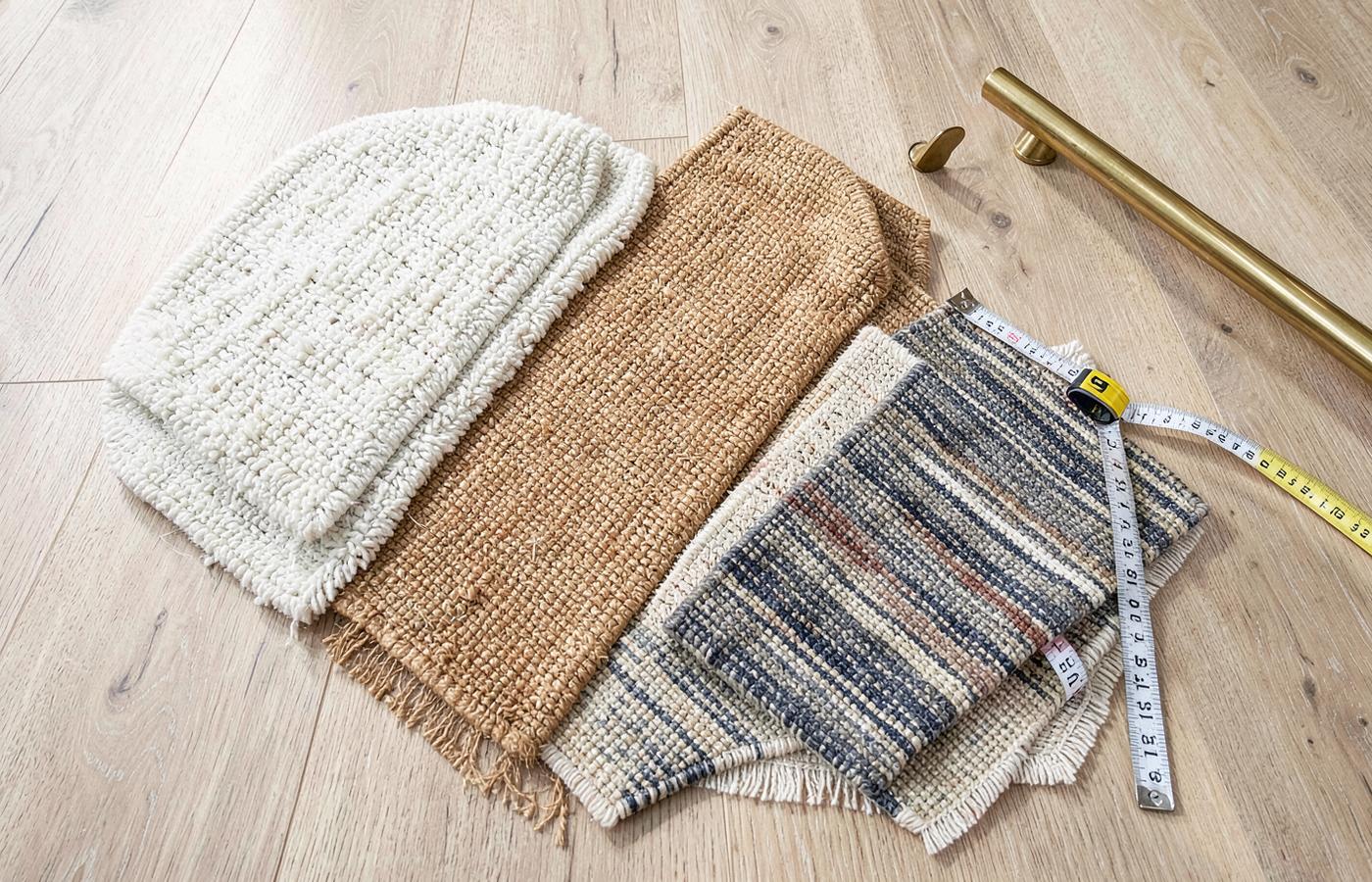 MaterialsStair Runner Materials ComparedWool, nylon, polypropylene, sisal and jute judged on stair-specific wear, comfort, cleaning and safety.
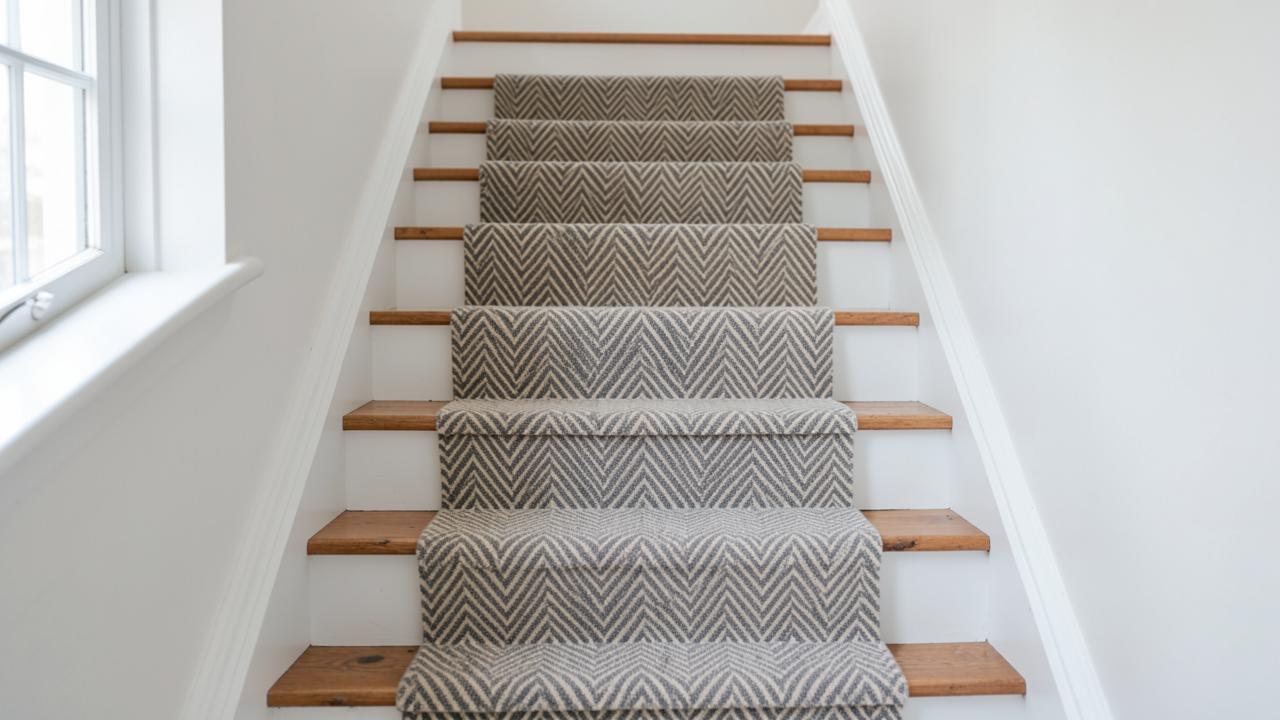 DesignStair Runner Patterns ExplainedHerringbone, chevron, stripes, plaid, geometrics and animal prints judged by how they behave on a staircase.
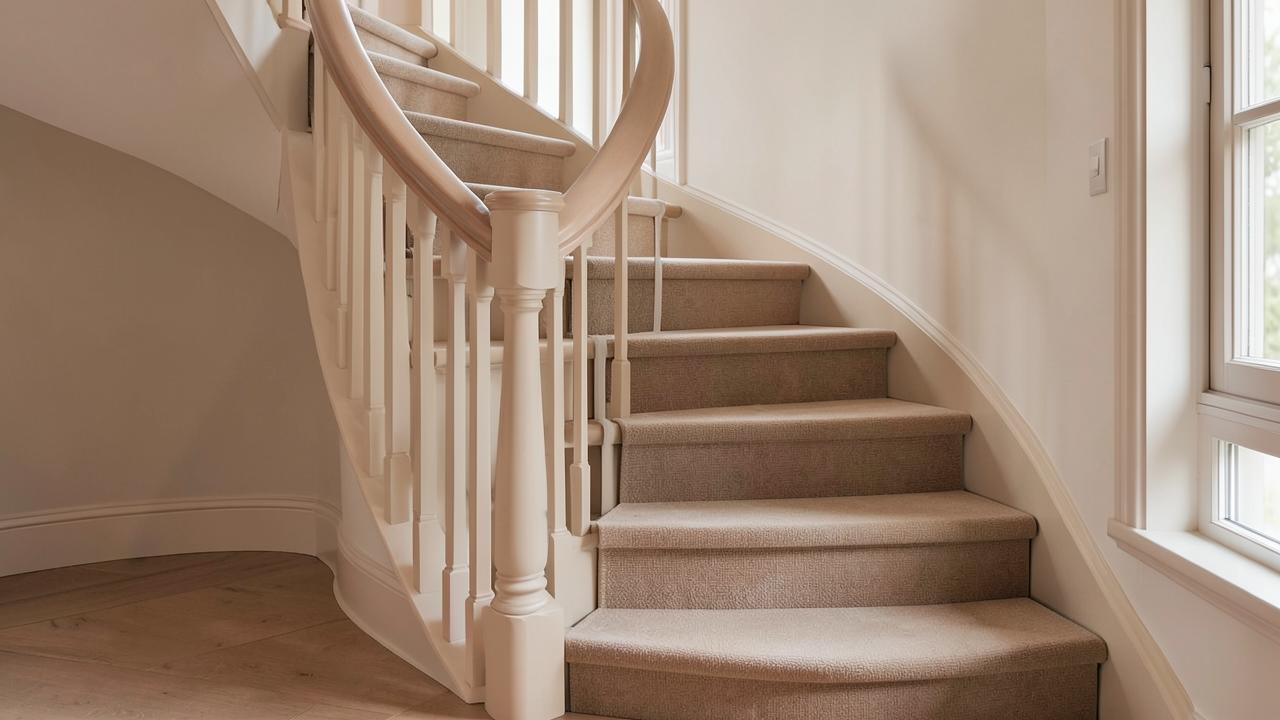 MeasurementRunners on Winder, Curved and Open StairsMeasuring and fitting where treads are not rectangles: winders, pie steps, curves and open-sided flights.