Construction
Loop pile stair runners: construction and performance
Loop pile offers a distinct aesthetic and structural profile, but its behaviour on the sharp radius of a stair nosing requires careful specification to avoid grinning and premature wear.
Written by the StairRunner.co editorial team · Updated 4 September 2026
Understanding loop pile mechanics on stairs
The fundamental difference between loop and cut pile lies in the integrity of the yarn. In a loop pile construction, the yarn is pulled through the backing and then looped back, creating a series of arches. This structure is inherently stable because each loop supports its neighbour. On a flat floor, this creates a rugged, textured surface that is excellent at hiding footprints and vacuum marks. However, a staircase is not a flat floor; it is a series of ninety-degree bends, and this is where the physics of the loop becomes critical.
When a loop pile carpet is bent over a stair nosing, the loops are forced apart. If the carpet is 'low gauge' (meaning the rows of loops are far apart), the primary backing becomes visible between the rows. This phenomenon, known in the trade as 'grinning', is the primary failure mode of poorly specified loop runners. To avoid this, technical specifications must prioritise density over pile height. A dense, tight loop will maintain coverage even when stretched over the nosing radius.
Beyond the visual aspect, the loop structure also affects how the carpet wears. On a flat surface, the weight of a footstep is distributed across the top of the loops. On a stair nosing, the weight is concentrated on a very small area, creating a 'pinch point'. If the loops are too tall, they can be crushed laterally, leading to a distorted appearance. This is why commercial-grade loops, which are typically very short and extremely dense, often perform better on stairs than domestic 'luxury' loops.
The 'Grin' factor: density, gauge and pitch
To truly understand how a loop pile will perform on stairs, one must look at the three pillars of carpet construction: gauge, pitch, and pile density. Gauge refers to the distance between the needles on the tufting machine; a 1/10th gauge means there are ten needles per inch of width. Pitch is the number of loops per inch along the length of the carpet. Density is the combination of these two, along with the weight of the yarn itself.
| Specification | Impact on Stairs | Recommendation |
|---|---|---|
| Low Density (5/32" Gauge) | Significant grinning at nosings; backing visible; poor crush recovery | Avoid for stairs unless using a very thick, felted yarn |
| Medium Density (1/8" Gauge) | Acceptable for domestic use; minor grinning may occur on sharp nosings | Suitable for low-to-medium traffic domestic flights |
| High Density (1/10" Gauge) | Excellent coverage; resists pile crushing; minimal grinning | Ideal for high-traffic domestic and commercial stairs |
| Multi-Level Loop | Breaks up visual gaps; excellent soil hiding; masks grinning | Very effective for patterned or textured looks on busy stairs |
When selecting a runner, ask for the technical specification sheet. You are looking for a high 'tuft bind' and a high 'face weight'. However, face weight alone can be misleading; a tall, loose pile can have the same weight as a short, dense one, but the short, dense one will perform significantly better on stairs. The goal is to maximize the number of loops per square inch to provide a continuous, supportive surface.
Berber versus level loop: aesthetic and practical trade-offs
The term 'Berber' originally referred to hand-woven wool carpets by the Berber people, but in modern manufacturing, it describes a loop pile with a chunky, flecked appearance. Level loop, by contrast, is uniform in height and usually finer in texture. On a staircase, a chunky Berber can look magnificent, providing a rustic, substantial feel underfoot. However, the larger the loop, the greater the risk of snagging and the more pronounced the grinning can be if the density is not managed.
Level loops are often used in contemporary settings where a clean, architectural line is desired. Because the loops are smaller and more uniform, they tend to 'grin' less than their chunkier Berber counterparts, provided the density is sufficient. When choosing between them, consider the radius of your stair nosings. Sharp, modern nosings require a tighter, more flexible weave, while rounded traditional nosings can accommodate a heavier Berber.
Multi-level loops offer a third option, combining different loop heights to create a sculptural effect. This is particularly useful on stairs because the variation in height helps to hide the inevitable 'shading' that occurs when the light hits the stairs at different angles. It also provides extra traction, as the foot encounters multiple levels of texture with every step.
Material performance: the physics of wool vs. synthetic loops
Material choice significantly impacts how a loop pile behaves over time. Wool is naturally resilient; the protein structure of the fibre has a 'memory' that helps it return to its original shape after being compressed. This makes wool loops excellent for the heavy traffic of a staircase. Furthermore, wool's natural oils (lanolin) provide a level of soil resistance that synthetics struggle to match without chemical treatments.
Polypropylene and nylon loops are popular for their stain resistance and lower price points. However, polypropylene is a plastic and lacks the natural 'bounce-back' of wool. In a loop construction, this can lead to 'matting' in the traffic lane, where the loops lose their roundness and become flattened and dull. Nylon performs better than polypropylene in terms of resilience but can be more expensive. For more on this comparison, see our guide on wool vs synthetic stair runners.
A recent innovation is the use of 'solution-dyed' synthetics in loop constructions. Because the colour is added during the liquid stage of polymer production, the fibre is colourfast even when exposed to harsh cleaning chemicals. This is a major advantage for loop pile, as the tight weave can sometimes trap soil, requiring more aggressive cleaning than a cut pile.
Installation challenges: tension, alignment and nosing wraps
Installing a loop pile runner requires a higher level of precision than a cut pile. Because the loops form distinct rows, any slight misalignment is immediately obvious, especially on a staircase where the eye follows the vertical line of the flight. The fitter must ensure that the runner is perfectly square to each riser and tread. If the runner is 'skewed' during installation, the rows of loops will appear to wander across the step, creating a visual defect.
Tension is another critical factor. A loop pile runner must be stretched sufficiently to prevent bagging on the treads, but over-stretching can exaggerate grinning at the nosings. The choice between 'Waterfall' and 'Hollywood' installation methods is particularly important for loop pile. In a waterfall installation, the carpet drapes over the nosing and falls straight down to the next tread. This places less stress on the loops but can feel less 'fitted'.
In a Hollywood installation (also known as a 'bullnose' or 'contoured' fit), the carpet is stapled directly under the nosing, following the curve of the wood. This creates a sharp, tailored look but puts maximum tension on the loops at the very point where grinning is most likely. Only high-density loops should be installed using the Hollywood method. We discuss these methods further in installation methods.
Durability and wear patterns: the role of yarn twist
Loop pile is often marketed as the 'ultimate' durable carpet, but its durability is specific to certain types of wear. It excels at resisting 'tracking'—the visible path left by feet in a plush carpet. Because the loops don't have tips that can be flattened in different directions, they maintain a consistent appearance.
However, loop pile is vulnerable to 'abrasive wear'. On a stair nosing, the top of the loop is the first point of contact for every footstep. Over years, this friction can wear through the top of the loop, causing it to 'fuzz'. This is where 'twist level' becomes important. Even in a loop pile, the individual yarns that make up the loop are twisted together. A higher twist level creates a harder-wearing yarn that resists fuzzing and pilling.
Another factor is 'crush recovery'. On the flat treads of the stairs, the loops are repeatedly compressed. A high-quality wool loop will spring back, but a budget synthetic may stay flattened, leading to a 'shiny' patch in the centre of the runner. This is not just an aesthetic issue; flattened loops offer less traction, potentially increasing the risk of slips.
Aesthetics: light play, texture and shading
One of the primary reasons designers choose loop pile is the way it interacts with light. The curved surfaces of the loops create a play of shadow and highlight that a flat cut pile cannot replicate. This adds depth to the staircase, making it a focal point of the interior design. Depending on the angle of the light, the same runner can look significantly different at different times of the day.
Texture also plays a role in safety. A loop pile runner provides a significant amount of 'bite' or traction for the foot. Unlike some velvet or saxony carpets which can feel slippery, the physical structure of the loops offers a high-friction surface. This is a key consideration for stair safety, particularly in homes with elderly residents or young children.
'Shading' or 'watermarking' is less of an issue with loop pile than with cut pile, but it can still occur. This is where areas of the carpet appear darker or lighter because the pile has been pushed in different directions. In loop pile, this is usually caused by the loops being tilted rather than flattened. Multi-level loops and patterned weaves are very effective at disguising this phenomenon.
Cleaning and maintenance: preventing the sandpaper effect
Cleaning a loop pile runner requires a different approach than cut pile. A vacuum cleaner with a powerful beater bar (rotating brush) can be too aggressive for some loops, particularly those made of wool or with a looser weave. The brush can catch the fibres and cause 'pilling' or 'fuzzing'. We generally recommend using the suction-only setting or a vacuum designed for delicate carpets.
The 'sandpaper effect' is a major cause of premature wear in loop runners. Grit and dirt fall into the gaps between the loops and settle at the base of the pile. As people walk on the runner, the loops are pressed against this grit, which acts like an abrasive, cutting through the fibres. Regular, thorough vacuuming is the only way to prevent this.
When it comes to spills, loop pile has a slight advantage: the tight weave can sometimes hold a liquid on the surface for a few seconds longer than an open cut pile, giving you a crucial window to blot. However, if a spill does penetrate, it can be harder to extract from the base of the loops. Regular professional cleaning using 'dry' or 'low-moisture' methods is often preferred for loops to avoid over-wetting the backing. For more tips, see stair runner cleaning.
Acoustic properties and underfoot comfort
Staircases can be noisy, acting as a sound box that amplifies the sound of footsteps throughout the house. Loop pile is an excellent acoustic dampener. The air trapped within the loops and the density of the weave help to absorb impact noise. However, the runner is only part of the equation; the underlay is equally important.
For loop pile, a firm underlay (such as a high-density rubber or a dense felt) is better than a soft, bouncy one. A soft underlay allows the carpet to flex too much, which can stress the loops and the backing, leading to premature wear. A firm underlay provides a solid foundation, ensuring that the impact of footsteps is absorbed by the underlay rather than the carpet pile. This combination provides both sound reduction and a secure, comfortable feel underfoot.
Structural integrity: the role of backings and adhesives
The 'hidden' part of a loop runner is just as important as the visible pile. In a quality loop carpet, the yarn is locked into a primary backing with a latex compound, and then a secondary backing (often jute or action-back) is applied for stability. On stairs, the strength of this bond is vital. Every time someone steps on the nosing, they are applying a shear force that tries to pull the loops out of the backing.
If the latex bond is weak or the backing is too flexible, the runner will eventually lose its shape. This is common in budget-grade loop carpets, which may look fine in the showroom but quickly fail under the unique stresses of a staircase. Always ask for a product with a high 'tuft bind' rating. Additionally, the type of adhesive used to bond the backings can affect the runner's flexibility. A runner that is too stiff will be difficult to fit around winders and nosings, while one that is too floppy will lack the necessary structural integrity.
Choosing colors and patterns for loop runners
Loop pile is particularly well-suited to certain types of patterns. 'Tweed' or 'heathered' effects, where multiple colours of yarn are twisted together, look fantastic in a loop construction. These multi-tonal looks are also practical, as they are very forgiving of minor stains and lint.
Geometric patterns can also be achieved in loop pile, either through printing or through the use of different coloured yarns. However, be aware that geometric patterns require absolute precision during installation. If the stairs are not perfectly square, a geometric pattern will highlight the irregularities of the building. For more on this, see stair runner patterns.
Striped loop runners are a classic choice for hallways and stairs. The vertical lines of the stripes can help to guide the eye up the flight, making a narrow staircase feel taller. When installing a striped loop runner, the fitter must ensure the stripes are perfectly aligned with the center of the stairs. Any 'drift' in the stripes will be highly visible.
Technical summary and final checks
When specifying a loop pile stair runner, use the following checklist to ensure you are getting a product that will last:
- Gauge: Aim for 1/10th or 1/8th for best nosing coverage.
- Tuft Bind: Ensure a high rating to prevent snags and pulls.
- Fibre: Choose wool for resilience or high-quality nylon for stain resistance.
- Installation: Discuss 'Waterfall' vs 'Hollywood' with your fitter based on the carpet's density.
- Underlay: Pair with a firm, high-density underlay (e.g., 8mm-10mm rubber).
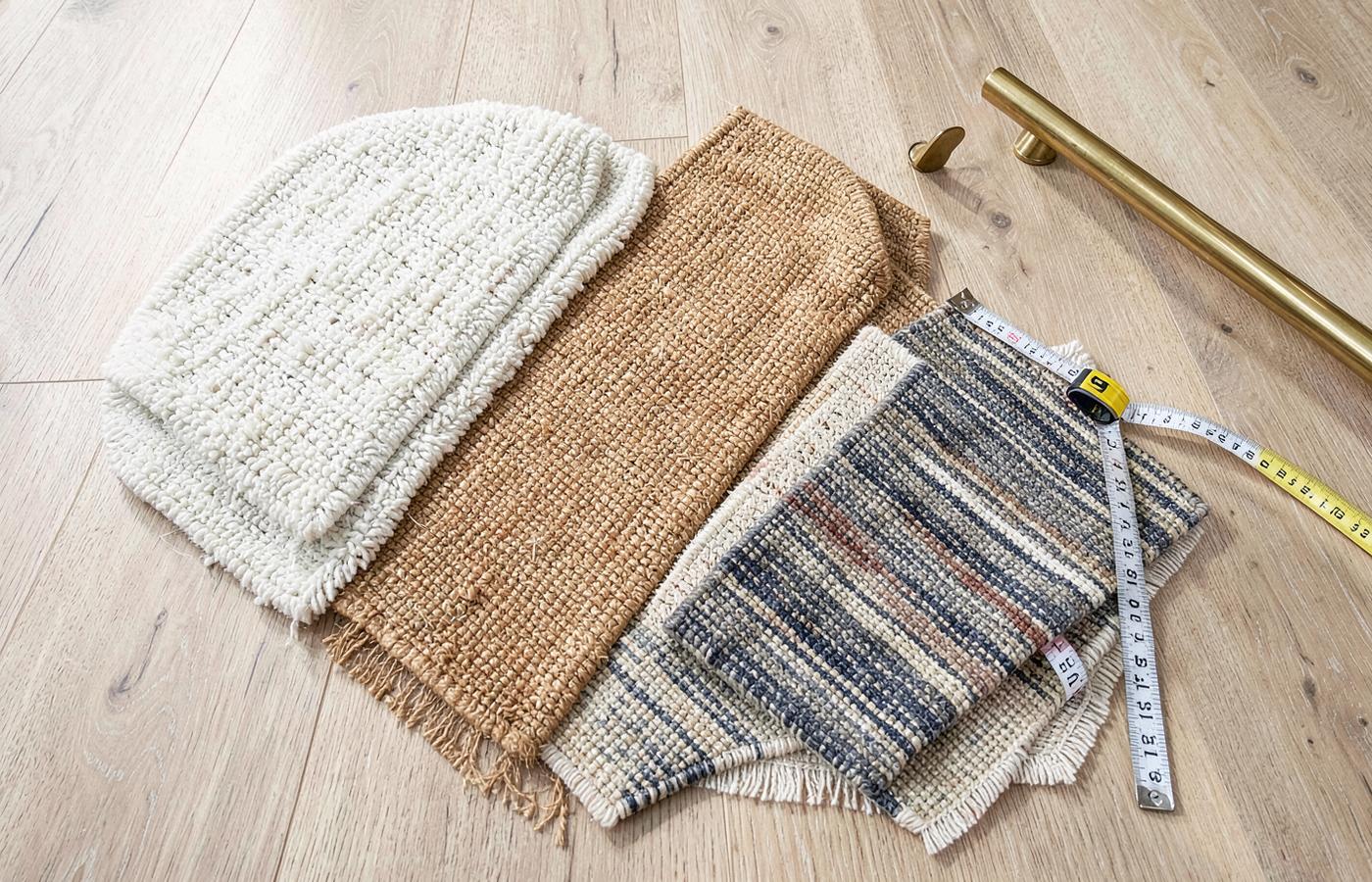
- Sample Test: Wrap a sample around a sharp edge to check for 'grinning'.
By paying attention to these technical details, you can enjoy the unique texture and durability of a loop pile runner without the common pitfalls of poor specification. For more help with your selection, visit our guide on how to choose a stair runner.
Frequently asked questions
- Do loop pile runners 'grin' on the edge of stairs?
- Yes, loop pile is more prone to 'grinning'—where the backing shows through the pile as it bends over the nosing. This is mitigated by choosing a higher density weave or a multi-level loop that masks the gap between loops. High-density 1/10th gauge constructions are particularly resistant to this issue.
- Are loop pile runners suitable for households with cats or dogs?
- Generally, no. Pet claws can easily snag the loops, leading to pulled threads that run down the length of the runner. If you have pets, a cut pile or a very low, tight commercial-grade loop is a safer choice. Once a loop is pulled, the damage can be difficult to repair invisibly.
- What is the difference between level loop and multi-level loop?
- Level loop has all loops at the same height, creating a uniform, flat surface. Multi-level loop uses varying heights to create patterns and textures, which is excellent for hiding footprints and soiling on busy staircases. The variation in height also helps to disguise any slight grinning at the nosings.
- How does loop pile handle heavy foot traffic?
- High-density loops are exceptionally resilient because the loop structure supports weight better than an open cut fibre. However, if the loops are too tall or loose, they can flatten and lose their texture over time. For high-traffic stairs, a low-profile, high-density loop is the optimal specification.
- Can you repair a snagged loop on a stair runner?
- Small snags can be carefully trimmed flush with the surface. You should never pull a loose thread, as this can unravel a long section of the weave. For significant damage, professional re-burling may be required, where a skilled technician weaves new yarn into the damaged area.
- Is wool or synthetic better for a loop pile runner?
- Wool offers superior natural resilience and soil resistance, making it ideal for the high-impact environment of a staircase. Synthetics like polypropylene are budget-friendly and stain-resistant but may flatten faster than wool and can sometimes take on a 'plastic' sheen in high-wear areas.
- What is 'tuft bind' and why does it matter for stairs?
- Tuft bind refers to the force required to pull a loop out of the primary backing. For stairs, where feet apply significant shear force at the nosing, a high tuft bind is essential to prevent loops from being pulled loose during normal use or vacuuming.
Related guides
- ComparisonsWool vs Synthetic Stair RunnersWool, nylon, polyester and polypropylene compared on stair-specific wear, cleaning, comfort and price.
 MaterialsStair Runner Underlay and PaddingWhy pad choice matters more on stairs than anywhere else, and how to specify density, thickness and cut.
- BuyingBest Carpet for a Stair RunnerThe specification checklist — fibre, pile, density, backing, width and pattern repeat — for stair-worthy carpet.