Measurement
Stair runner sizes: The complete guide to dimensions
Getting the size right is about more than just fitting the carpet; it is about the visual balance of your hallway and the safety of your stride.
Written by the StairRunner.co editorial team · Updated 4 September 2026
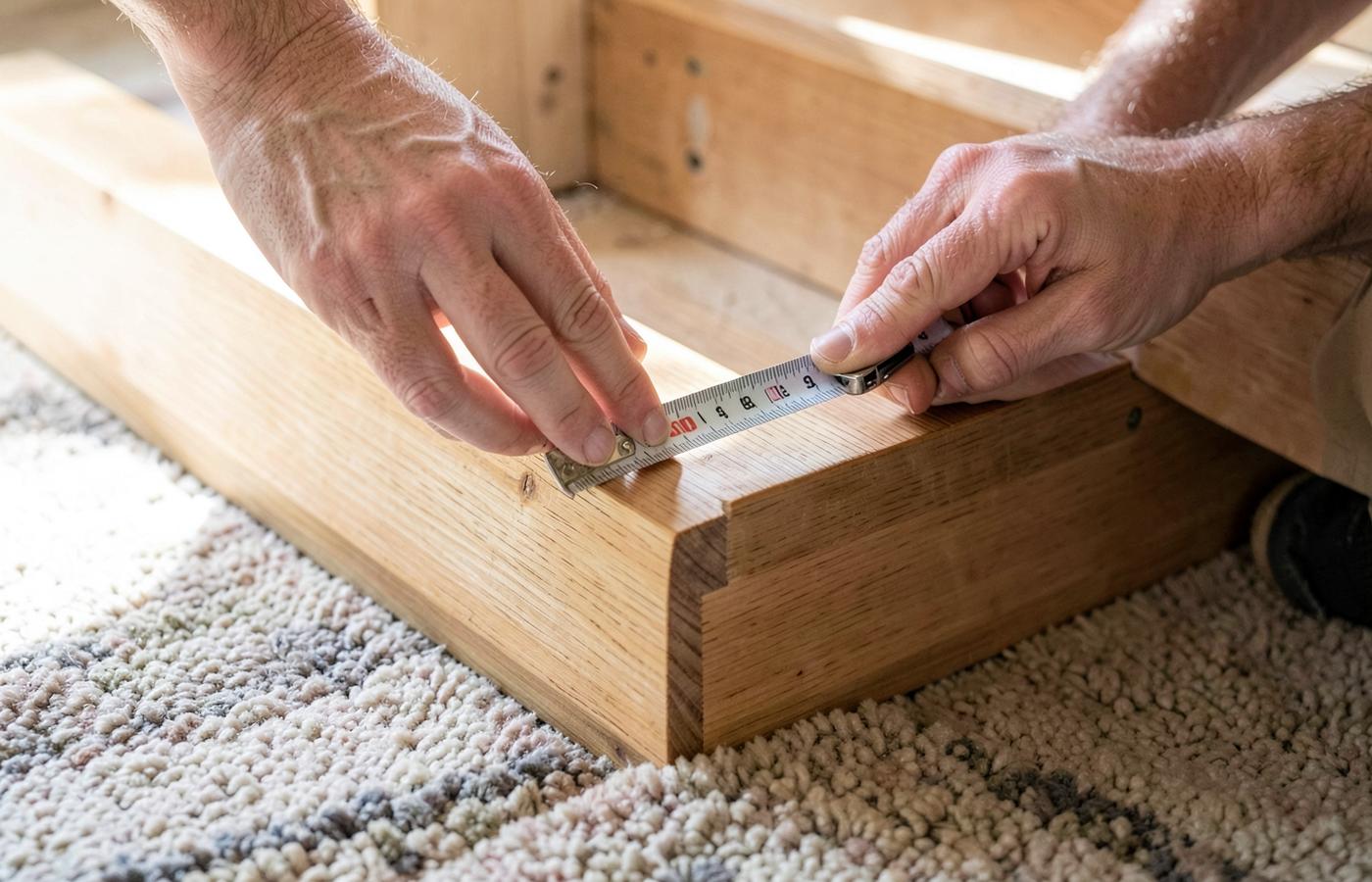
Understanding standard widths and Architectural Context
In the UK, stair runners have settled into a few 'standard' widths that cater to the majority of domestic architecture. Unlike broadloom carpet which is cut from a 4m or 5m roll, runners are often woven with a finished 'selvedge' edge at a specific width. This finished edge is a key part of the aesthetic, providing a clean, durable border that doesn't require separate binding. The choice of width is often a historical one; Victorian homes tend to have narrower stairs than modern open-plan new builds, and the runner should reflect that scale.
The most common widths you will encounter are:
- 57cm (approx. 22.5 inches): Often found in older, narrower cottage-style stairs or secondary service stairs. It creates a 'period' feel that is very authentic to smaller 19th-century properties.
- 60cm (approx. 24 inches): A very common standard that works well on stairs around 80cm-85cm wide. It provides a generous carpeted area without feeling crowded.
- 66cm (26 inches): The traditional 'standard' for many years, offering a substantial feel without overwhelming the flight. This is the go-to size for many flatweave manufacturers.
- 70cm (approx. 27.5 inches): Increasingly popular for modern, wider new-build staircases. If your stairs are over 1 meter wide, this is the minimum you should consider.
Choosing between these is rarely about what will 'fit'—as all of them will fit a standard 90cm staircase—but about the 'reveal'. The reveal is the amount of wood showing on either side. A small reveal feels more modern and cozy, while a large reveal feels more traditional and formal. For a deeper dive into the aesthetics of width, see choosing the right width.
Calculating the length: The master formula
Calculating length is where most DIY errors occur. A staircase is a three-dimensional object, and the runner must travel over every contour. The 'Master Formula' for a straight flight is as follows:
(Tread Depth + Riser Height) x Number of Steps + 50cm Allowance = Total Length
Let's break this down. The Tread Depth is the horizontal surface you step on. The Riser Height is the vertical face between steps. If your tread is 25cm and your riser is 20cm, each step requires 45cm of carpet. If you have 13 steps, that is 5.85 meters.
Crucially, you must add the Allowance. This covers the 'wrap' around the first and last steps, the small amount of material taken up by the 'Hollywood' or 'Waterfall' tuck (see waterfall vs hollywood styles), and a safety margin for the fitter. We recommend at least 50cm for a standard flight. If you are fitting it yourself for the first time, adding 100cm is a wise insurance policy against a wrong cut.
Measuring for Winders and Landings: The Geometry of Turning
Winders—the steps that turn a corner—are notoriously difficult to measure. Because the runner must remain straight while the steps turn, the material is usually 'cut and turned' or 'mitred' at the corner. This means you need significantly more length than a straight measurement would suggest. Each winder step essentially acts like a 'wider' step in the calculation.
When measuring winders, you must find the longest point of the turn—usually the outside edge—and use that for your calculation for that specific step. Professional fitters often 'template' winders with paper first to ensure they have enough material. If your flight has multiple turns, the waste percentage can jump from 10% to 25%.
| Configuration | Typical Steps | Estimated Length | Complexity |
|---|---|---|---|
| Straight Flight | 13 | 6.0m - 6.5m | Low |
| Flight with Half-Landing | 13 + Landing | 7.5m - 8.5m | Moderate |
| Flight with 3 Winders | 13 + 3 Winders | 8.5m - 9.5m | High |
| Grand/Double Winder | 15+ | 10.0m+ | Professional Required |
The 'Rule of Thirds' and Visual Proportion
Interior designers often use the 'Rule of Thirds' when deciding on runner width. Ideally, the runner should occupy roughly the middle two-thirds of the staircase, leaving one-sixth of the timber visible on either side. This balance ensures the runner feels like an integrated part of the architecture rather than a separate piece of furniture dropped onto the stairs.
For example, on a 90cm wide staircase:
- One-third is 30cm.
- The runner would be roughly 60cm wide.
- This leaves 15cm of timber on each side.
If you go much narrower than this, the runner can look like a 'racing stripe' and lose its luxury feel. If you go much wider, the staircase can look cluttered, and you lose the beautiful contrast between the carpet and the wood. This is discussed further in how to measure for a runner.
Custom Widths: When standard isn't enough
Sometimes, a standard 60cm or 66cm runner just doesn't work. This is common in period properties where stairs might be unusually narrow (e.g., 70cm total) or unusually wide (e.g., 120cm total). In these cases, you have two main options: bespoke weaving or 'cut and bind'.
Bespoke weaving is the pinnacle of the craft. Companies will weave a runner to your exact width, ensuring the pattern is perfectly centered and the edges are finished in the loom. The 'Cut and Bind' method is more flexible; a 4-meter wide carpet is cut into strips of your desired width, and the edges are finished with a separate binding tape. This allows you to use almost any carpet as a runner. See custom stair runners for more on this.
Height and Thickness: The 'Third Dimension'
When talking about 'size', we usually think of length and width. But the thickness (or 'pile height') of the runner is a crucial size dimension for stairs. A runner that is too thick will be difficult to wrap around the nosings and can actually make the 'effective' depth of the step shorter, creating a safety risk.
A thick carpet over a thick underlay can add 2.5cm to the front of every step. For someone with large feet, this can mean their heel no longer sits securely on the tread. A good stair runner should ideally be between 8mm and 12mm thick. Anything thicker than 15mm (including underlay) can start to feel 'spongy' and unstable underfoot. Always consider the combined height of the carpet and the underlay when calculating how the runner will sit against your skirting boards.
Margins and Clearances: The Technical Details
When specifying your runner size, you must also consider 'clearance' for other elements of the staircase. This is the 'working room' required for hardware and structural features.
- Stair Rods: If you plan to use stair rods, the rod itself must be wider than the runner. Typically, the rod should be 5cm to 10cm wider than the carpet to allow the brackets to be fitted securely into the wood without the rod looking 'pinched'.
- Spindles/Balusters: If your spindles are mounted on the treads themselves (common in some Victorian styles), your runner width is strictly limited by the distance between the spindles and the wall. You must leave at least a 2cm gap to avoid the carpet rubbing against the wood.
- Stringer Margin: Most people prefer the runner to be centered, but ensure the 'reveal' (the gap) is consistent on both sides, even if the staircase itself is slightly out of square.
Impact of Pattern on Size Requirements
If you choose a patterned runner—such as a large damask or a horizontal stripe—you will need to order more material. This is because the pattern must 'match' at the joins, especially where the runner transitions from a straight flight to a landing or a winder.
A 'Pattern Repeat' can be anything from 2cm to 100cm. If your pattern repeats every 30cm, you may need to add an extra 30cm of carpet for every join you have to make. This ensures that the stripe or floral motif continues seamlessly from one section to the next. This is a common place for budget-conscious buyers to get caught out, as they order the 'net' length and find they have no room to align the pattern. We cover this in detail in stair runner patterns.
The Importance of the 'Selvedge' Edge
A 'Selvedge' is the self-finished edge of a woven runner. When a runner is woven to a specific width (like 60cm), the loom creates a neat, strong edge that won't fray. This adds about 3-5mm to the total width compared to the 'pile' width. When measuring for tight spaces, always account for this extra few millimeters. If you are cutting a runner from a wider piece of carpet, you won't have a selvedge and will instead have a 'Bound Edge' which can be slightly thicker and may affect how the runner sits against the wall.
Psychology of Width: How size affects perception
The width of your runner significantly affects how people perceive the 'scale' of your home. A wide runner makes a hallway feel grander and more important, but it can also make a small space feel claustrophobic if not enough wood is showing. Conversely, a narrow runner can make a grand staircase feel 'meagre'. The goal is to find the 'sweet spot' where the runner feels like it was meant for that specific flight. Generally, a larger reveal (more wood) feels more 'architectural' while a smaller reveal (more carpet) feels more 'domestic' and comfortable.
How sizes vary by material
| Material | Common Widths | Customizable? |
|---|---|---|
| Sisal / Jute | 60cm, 66cm, 70cm | Rarely (usually pre-woven) |
| Flatweave Wool | 57cm to 120cm | Highly (often made to order) |
| Tufted Synthetic | Any (Cut from 4m roll) | Universal |
| Wilton/Axminster | 69cm (27 inches) | Limited |
Final checks before you order
Before you click 'buy' or sign off on a quote, perform these final checks. A mistake at this stage is expensive and usually non-refundable once the carpet is cut.
- Measure every single step: Don't assume all steps are the same size. In older houses, the 'bottom' step is often wider or deeper than the others, and the 'top' step might have a different nosing profile.
- Account for the 'tuck': If you are using staples and a 'Hollywood' fit, the carpet is tucked tight under the nosing. This uses about 3-4cm more material per step than a 'Waterfall' fit. Over 13 steps, that's half a meter!
- Check the landing: If the runner continues onto a landing, do you want it to stay the same width, or expand to cover the whole floor? This transition requires careful planning and extra material for the 'mitre' join.
- Verify the dye lot: If you are ordering a very long runner in multiple pieces, ensure they all come from the same dye lot to avoid a visible colour change halfway up the stairs.
For more advice on the buying process, visit our guide on how to choose.
The 'Creep' Factor in Long Runners
On very long flights (e.g., 15+ steps), the combined weight of the runner and the tension of the installation can cause the material to 'settle' over the first few months. This is especially true for natural fibres like wool or sisal which have a degree of 'give'. This can lead to the runner appearing to 'shrink' slightly in length. Professional fitters often 'over-measure' and leave a small amount of extra material tucked away at the top or bottom to account for this future adjustment. If you are DIY fitting, don't pull the carpet so tight that there is no room for this natural movement.
Frequently asked questions
- What is the standard width for a stair runner?
- The most common 'off-the-shelf' widths in the UK are 57cm, 60cm, 66cm (26 inches), and 70cm. However, the 'correct' width depends on the width of your staircase; usually, you want to leave 5cm to 10cm of visible timber on either side.
- How do I calculate the total length needed?
- Measure the tread (horizontal) and the riser (vertical) of one step, add them together, and multiply by the number of steps. Add an extra 30cm to 50cm as a 'waste' or 'fitting' allowance to ensure you don't run short.
- Do I need a wider runner for a wider staircase?
- Not necessarily, but it helps maintain visual proportion. A very narrow runner on a very wide staircase can look like a 'strip', while a runner that is too wide can make the staircase feel cramped. Aim for the 'rule of thirds' where possible.
- What size should I get for a winder staircase?
- Winder steps (the triangular ones that turn a corner) require much more material because the runner must be cut and joined or manipulated. Usually, you calculate based on the widest point of the winder. See our guide on winder stair runners.
- Can I get a custom width?
- Yes, many premium wool and flatweave runners can be woven or cut to your exact centimeter requirement. This is ideal for non-standard staircases or when you want a specific amount of timber showing.
Related guides
- MeasurementHow to Measure for a Stair RunnerThe tread-plus-riser formula, waste allowance, winders and landings, plus a calculator that shows its working.
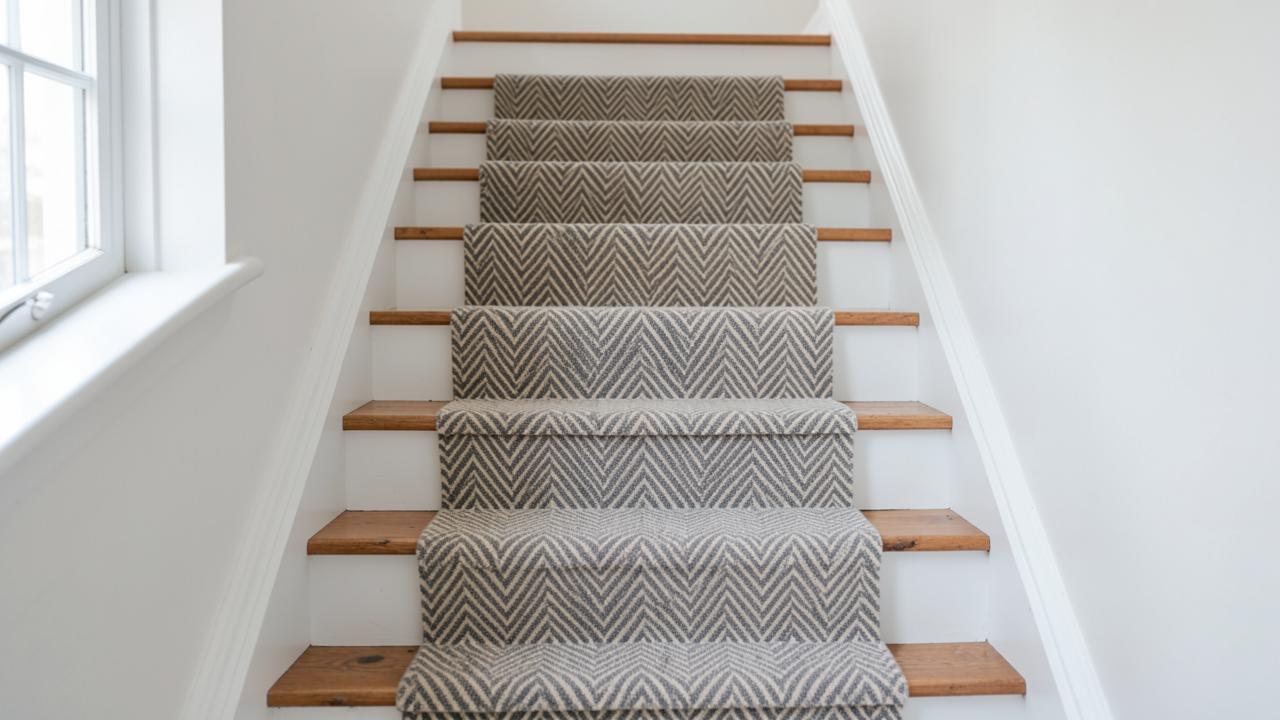 DesignStair Runner Patterns ExplainedHerringbone, chevron, stripes, plaid, geometrics and animal prints judged by how they behave on a staircase.
- MeasurementWhat Width Should a Stair Runner Be?How to set runner width and side margins from your stair width, stringers, balusters and pattern.