Materials
Tufted stair runners
Tufted construction covers the majority of stair runners sold, ranging from thin, sparse products to dense, long-lasting ones. Knowing what to check separates a good tufted runner from a disappointing one.
Written by the StairRunner.co editorial team · Updated 4 September 2026
How tufting actually works
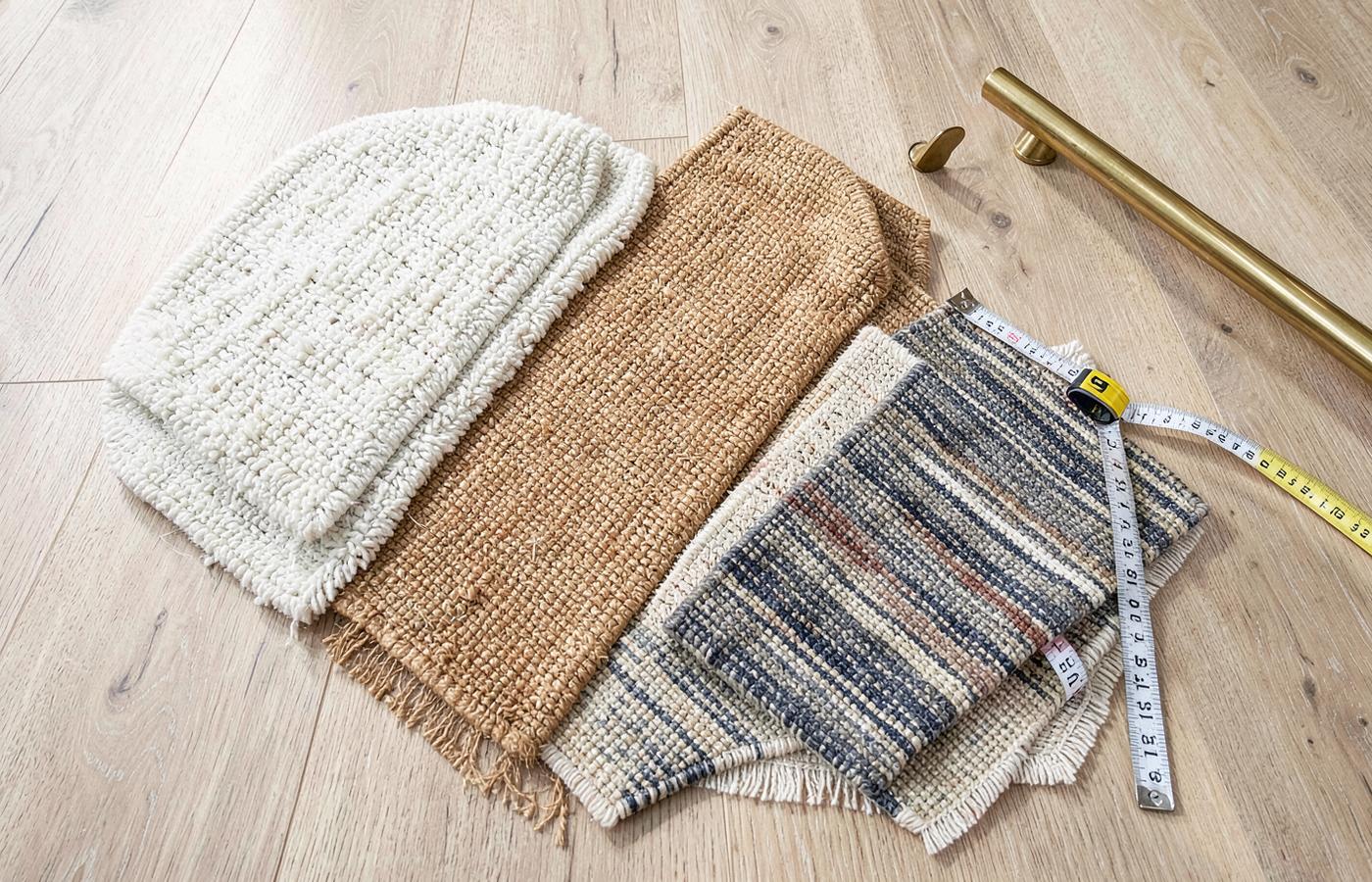
A tufting machine drives hundreds of needles carrying yarn through a primary backing fabric in a single continuous pass, creating loops or cut ends of pile on the face side. A layer of latex adhesive is then applied to the underside to lock the tufts in place, and in most quality products a secondary backing fabric is bonded over that latex layer to add strength, stability and a cleaner underside finish. The whole process happens at considerable speed compared with weaving, where the pile yarn is interlaced with the backing yarns during the weaving process itself rather than inserted afterwards.
This difference in manufacturing process is the reason tufted carpet is generally more affordable than woven carpet of comparable fibre and pile height — the machinery runs faster and the process requires less setup complexity for a given pattern or colour. It does not, on its own, tell you anything about how a particular product will perform on a staircase, which depends far more on the specific density, backing and fibre chosen.
Tufted versus woven: what actually differs
| Factor | Tufted | Woven |
|---|---|---|
| Manufacturing process | Yarn inserted into a pre-made backing and bonded with adhesive | Pile and backing yarns interlaced together during weaving |
| Typical price range | Wide range, generally more affordable at entry level | Generally higher, reflecting slower production |
| Pattern capability | Printed patterns common; some jacquard tufting available | Complex woven patterns built into the structure itself |
| Dependence on backing quality | High — a poor backing significantly weakens the product | Lower — the weave structure itself provides inherent stability |
| Range of quality available | Very wide, from thin budget products to dense premium ranges | Narrower, generally starting at a higher quality baseline |
A more detailed look at woven construction and Axminster and Wilton weaving in particular is in woven stair runners and Axminster stair runners.
Why the backing matters so much on a tufted runner
Because tufted pile is held in place by adhesive rather than by being interlaced through the backing structure, the quality of that adhesive bond and the backing fabric behind it has an outsized effect on how the carpet performs, particularly on a staircase where the carpet is bent sharply over every nosing and flexed repeatedly with foot traffic. A thin primary backing with a light latex application can allow tufts to work loose over time, especially at the leading edge of each tread where wear concentrates. A proper secondary backing, bonded separately over the latex layer, spreads this stress and adds the dimensional stability that keeps the runner lying flat and square as it is stretched and fixed down the flight.
Density: the single most useful quality indicator
Pile density — how tightly individual tufts are packed together — is the best available indicator of how a tufted runner will wear, and it applies regardless of fibre type or price point. A dense construction resists both crushing underfoot and the matting that heavy traffic produces, while a sparse one flattens quickly and can look worn within a year or two even if the fibre itself is reasonably hard-wearing.
You can get a reasonable sense of density by parting the pile with your fingers on a sample and looking at how much backing is visible; a dense construction shows very little backing through the fibre, while a sparse one shows it easily. For a firmer comparison, ask your supplier for the weight specification, usually expressed in grams per square metre, and compare it directly against another product being considered for the same staircase.
Fibre options within tufted construction
Tufted stair runners are made in the full range of common carpet fibres: wool, wool-blend, nylon, polypropylene, polyester and triexta among others. The tufting process itself does not favour one fibre over another, so fibre choice should be made on its own merits — durability, softness, stain resistance and budget — rather than being tied to the construction method. See wool versus synthetic stair runners and nylon stair runners for how the common fibre choices compare on a staircase specifically.
Loop, cut pile and cut-and-loop tufted constructions
Within tufted manufacturing, the needles can be set to leave uncut loops, to cut the loops into individual tufts, or to combine both in a single design for a textured, sculpted surface. Loop pile tends to be more durable in very heavy traffic because there are no cut fibre ends to fray, but it is more vulnerable to snagging from pet claws or catching heels. Cut pile gives a softer, plusher surface and avoids the snag risk, at some cost to raw durability in extreme traffic. Cut-and-loop constructions combine both to create texture or pattern, which can also help disguise soiling in the traffic lane. See loop pile stair runners and cut pile stair runners for a fuller comparison.
Where tufted runners perform best
- Budget-conscious refurbishments where a dense, well-backed tufted product delivers strong value against a tighter budget than woven alternatives allow.
- Households wanting a wide colour and pattern choice, since tufted ranges typically offer a broader palette than the more limited runs common in woven carpet.
- Rental or short-term properties where a lower-cost, still durable option makes more financial sense than investing in a premium woven runner.
- Family staircases specified with a dense synthetic tufted pile, which combines good stain resistance with acceptable cost for a heavily used flight.
Common tufted stair runner grades and where they suit different homes
Retailers rarely label tufted products with a single agreed grading system, but a useful working distinction is between entry-level, mid-range and premium tufted runners. Entry- level products typically use lower density pile and a simple latex-only backing, and suit light-traffic staircases such as a rarely used second staircase or a rental property where budget matters more than a long service life. Mid-range products add a proper secondary backing and higher density, and generally suit a typical family staircase in daily use. Premium tufted ranges push density and backing quality further still, sometimes rivalling woven products in durability while remaining more affordable, and suit busy households or staircases expected to look good for many years without replacement. Matching the grade to the actual traffic level of your staircase, rather than buying the cheapest or most expensive option by default, produces the best value outcome.
Printed pattern versus solid colour on tufted runners
Because tufted construction allows patterns to be printed onto the pile surface after manufacture rather than woven into the structure, tufted runners offer access to a very wide range of patterns and colourways at a lower cost than an equivalent woven pattern would require. The trade-off is that a printed pattern sits on the surface of the fibre rather than running through it, so as the pile wears down over years of use a printed pattern can fade or thin slightly ahead of a woven one, where the colour is carried by the yarn itself all the way through. This is rarely a concern for a well-specified, dense tufted product over a normal number of years, but it is worth knowing about if you are choosing between a strongly patterned tufted runner and its woven equivalent for a very long-term installation. See choosing a patterned stair runner for more on pattern selection generally.
Environmental and practical considerations
Some tufted ranges use recycled content in either the pile fibre or the backing, and it is worth asking suppliers directly about this if it matters to your buying decision, since it is not always prominently advertised. On the practical side, tufted runners are generally easier to source in a wide range of stock widths and lengths than woven equivalents, which can shorten lead times for a straightforward domestic project. If your project needs a bespoke width, border, or exact colour match, confirm with the supplier whether their specific tufted range can be custom-ordered, since not all tufted products are offered with the same degree of customisation as bespoke woven runners.
Where a woven construction may be worth the premium instead
For a very high traffic staircase, a period property where an authentic construction matters to the overall character of the house, or a complex woven pattern that a printed tufted product cannot replicate accurately, a woven runner — particularly Axminster or Wilton construction — remains the more durable and more traditionally appropriate choice. The decision generally comes down to budget, expected lifespan, and whether the specific pattern or texture wanted is available in tufted form at all.
What to check before buying a tufted stair runner
- Ask whether a secondary backing is included, and what it is made from.
- Ask for the pile weight or density specification, not just a marketing description.
- Check the pile height and whether it suits the stair nosing profile you have.
- Confirm the fibre and whether it is solution dyed if stain resistance matters.
- Ask what warranty applies specifically to stair use rather than general flooring use.
Fitting considerations specific to tufted runners
Because tufted carpet relies on its backing for stability, a fitter needs to handle it carefully during stretching and fixing to avoid stressing the latex bond, particularly around winders or tight corners where the carpet is manipulated more than on a straight flight. A competent fitter familiar with tufted products will know to avoid excessive pulling at any one point and to use fixings appropriate to the specific backing rather than treating every runner identically. See stair runner installation for the general fitting process and what a professional installation should include.
Care and longevity
A well-specified tufted runner, properly fitted and maintained, can last many years on a domestic staircase. Regular vacuuming to remove the grit that accelerates fibre wear, prompt attention to spills, and periodic professional cleaning all extend the working life of the carpet regardless of whether it was tufted or woven. What differs most with tufted products is the importance of choosing a dense, well-backed specification from the outset, since the construction offers less inherent forgiveness for a sparse or thinly backed choice than weaving does. See stair runner maintenance schedule for a routine that keeps any construction looking its best.
Frequently asked questions
- What does tufted mean on a stair runner?
- Tufted describes a construction method where pile yarn is pushed through a pre-made backing fabric with needles and then secured with adhesive, rather than being woven through the backing during manufacture. It is the most common and generally most affordable way carpet is made.
- Is tufted carpet less durable than woven carpet for stairs?
- Not necessarily, but the range of quality within tufted construction is wider. A dense, well-made tufted runner with a good backing can outperform a poorly specified woven one. Density, pile height and backing quality matter more than the construction method alone.
- Can a tufted stair runner be used with stair rods?
- Yes. Stair rods are a fixing method that sits on top of the runner at the base of each riser and are independent of how the carpet itself was constructed, so tufted runners can be fitted with rods in the same way as woven ones.
- Why is tufted carpet generally cheaper than woven carpet?
- Tufting is a faster, more automated manufacturing process than weaving, which allows higher volumes at lower cost. This does not automatically mean lower quality, but the cost saving does mean the market includes a wide range of tufted products at very different quality levels.
- What backing should a tufted stair runner have?
- A secondary backing, usually a woven synthetic scrim bonded with latex, adds dimensional stability and helps the runner hold its shape over the nosing of each stair. Ask specifically about secondary backing rather than assuming all tufted products include one.
- How do I judge the quality of a tufted runner before buying?
- Check the pile density by looking at how tightly the tufts are packed when you part the fibres, ask for the weight specification, and check whether a secondary backing is included. Avoid judging quality from image or price alone.
- Does a printed pattern on a tufted runner wear differently to a woven pattern?
- A printed pattern sits on the surface of the pile, so on a very long timescale it can thin or fade slightly ahead of a woven pattern, where colour runs through the yarn itself. For most households and normal replacement cycles this is not a significant practical concern.
- Are tufted stair runners available in bespoke widths and borders?
- Many are, but not universally. Confirm directly with your supplier whether the specific range you are considering can be custom-ordered to your width or with a border, since customisation varies more between tufted ranges than it does across most woven collections.
Related guides
- ComparisonsWool vs Synthetic Stair RunnersWool, nylon, polyester and polypropylene compared on stair-specific wear, cleaning, comfort and price.
- MaterialsAxminster Stair Runners: A Guide to Woven QualityExplore the heritage, durability, and intricate patterns of Axminster stair runners. Learn why woven construction remains the gold standard for high-traffic British homes.
 BuyingCommercial Stair Runners: Durability and ComplianceA professional guide to commercial stair runners for hotels, offices, and public buildings. Focus on fire ratings, slip resistance, and heavy-duty wear.
- MaterialsWoven Stair RunnersEverything you need to know about traditional woven runners, from the stability of Axminster and Wilton construction to how they wear on stairs and why they last a lifetime.