Buying
Where to buy a stair runner, and what to check before you pay
The source you choose changes the price, the choice and — most importantly — who carries the risk if the material is wrong. Here is how the options actually differ.
Written by the StairRunner.co editorial team · Updated 4 September 2026
Know your numbers before you shop
Every conversation with a supplier goes better if you arrive with three figures: the length you need including allowances, the width you have decided on, and the number and type of any turning steps. Without them you will be quoted for a hypothetical staircase.
Work the length out with the calculator or the method in how much carpet you need, and settle the width using the width guide. Do this first; it eliminates most of the products you would otherwise waste time considering.
The four sources
Carpet retailers
A conventional carpet shop cuts a runner from a broadloom roll to your length. The advantages are that you can see and handle the material, get advice from someone who handles staircases regularly, and often arrange binding, underlay and fitting through the same order. Responsibility stays in one place, which is worth more than people realise when something goes wrong.
The limits are range and price. A shop stocks what it stocks, and the convenience of a single supplier is priced in.
Runner and rug specialists
Specialists sell runners as a product rather than as a cut of carpet, which usually means the edges are finished, the proportions are designed for stairs, and the staff understand questions about winders and margins. Choice tends to be narrower but better targeted, and border and binding options are more developed. If you want a bordered runner or an unusual edge treatment, this is the likeliest source.
Online sellers
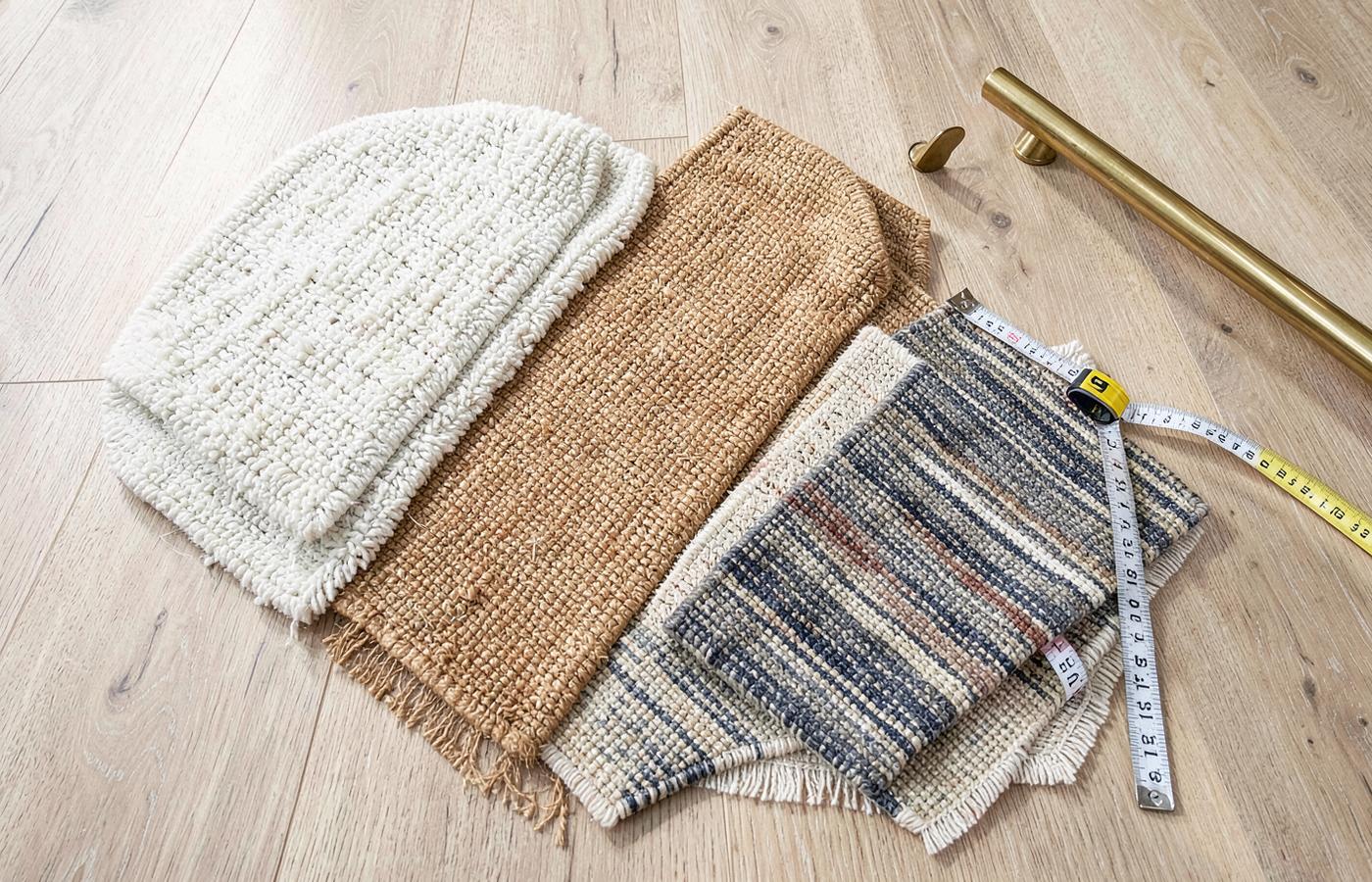
The widest choice by a distance, and the source where preparation matters most. Some sell fixed lengths, some cut to measure, some make to order. Colour on a screen is unreliable — two monitors will not agree, and a photograph cannot convey texture or how a fibre catches light on a vertical riser.
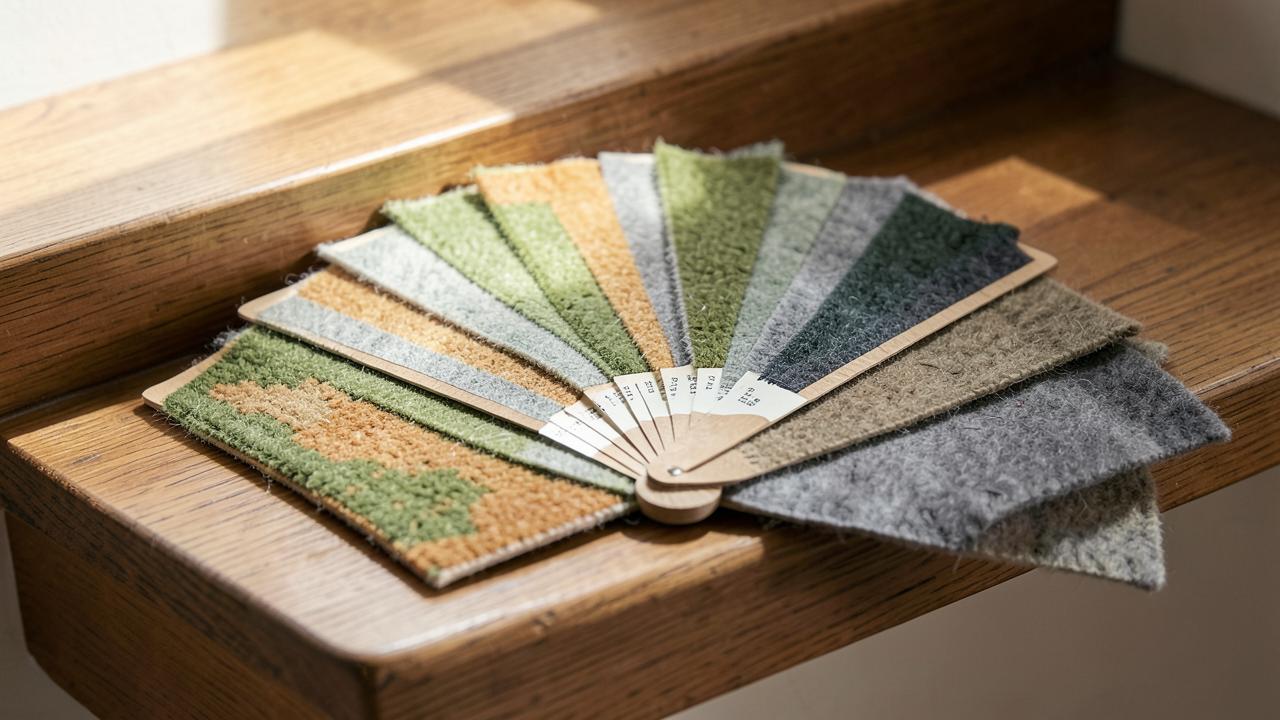
Order samples. Look at them on the actual staircase, in daylight and under the lights you use at night, and look at them lying flat and folded over a step edge, because a pile reads differently on the horizontal and the vertical. Then read the returns policy carefully: cut-to-order material is frequently non-returnable, which is entirely reasonable and entirely your problem if the colour is wrong.
Remnants, roll ends and clearance
Discounted runners are real, not a marketing device. Roll ends, discontinued ranges, cancelled orders and clearance lines all reach the market at genuine reductions. The catch is quantity: what exists is what exists.
The test is simple. Is the available length comfortably longer than your calculated requirement including all allowances? If it is exactly long enough, walk away. A staircase project with no margin for a mis-cut is a project that can fail at step twelve with no way to recover, because the batch no longer exists.
| Source | Choice | Risk | Best for |
|---|---|---|---|
| Carpet retailer | Moderate | Low — one point of responsibility | Anyone who wants supply and fitting handled together |
| Runner specialist | Focused | Low | Bordered runners, unusual edges, considered design |
| Online seller | Widest | Moderate — colour, returns, and no local recourse | Buyers who will order samples and measure carefully |
| Remnant or clearance | Whatever exists | High — quantity cannot be repeated | Short flights and flexible buyers with margin to spare |
What to confirm in writing before paying
- Cut length and width. The exact figures, not "approximately". Cut-length orders are usually final.
- Edge treatment. Whether the long edges are bound, how, and in what colour. Unbound broadloom edges will fray on a staircase.
- Dye lot. That the whole quantity comes from one batch. This is the single most overlooked question.
- Fibre and construction. Not just "wool" or "synthetic" — the construction affects stair wear as much as the fibre. See wool vs synthetic.
- Lead time. Made-to-order runners can take weeks; a fitter booked for next Tuesday needs to know.
- Returns. Especially on cut or made-to-measure material.
- What the price includes. Underlay, delivery, binding and fitting are often separate lines.
Buying material and fitting separately
Splitting supply from fitting can save money, and plenty of good fitters will work with customer-supplied material. Two cautions.
First, ask before you buy. Some fitters decline supplied material entirely, and finding out after the runner has arrived is an expensive way to learn.
Second, understand where liability sits. If the runner is short, the width is wrong, or there is a fault in the weave, the fitter is not responsible and the supplier will point out that fitting is not their concern. When both come from one place, that argument cannot happen. Weigh the saving against that. Our installation cost guide covers how fitters price and what they need to know.
Made to measure, custom and bespoke
Where the staircase is unusual — a strong curve, an awkward width, a specific border — a made-to-measure runner removes the compromise, at a cost and a lead time. This is a different buying process, involving a specification and often a site visit rather than a product page. Our custom runner guide explains what is genuinely bespoke and what is simply a stock product cut to length.
Natural fibres and specialist materials
Sisal, seagrass, jute and coir tend to come from a narrower set of suppliers than wool or synthetics, and the differences between them matter more than the marketing suggests. If you are shopping for one of these, read the natural-fibre guide first so you can ask about moisture behaviour, texture underfoot and edge treatment rather than only price.
Signs of a supplier worth using
- They ask about your staircase before quoting, including winders and landings.
- They send samples without a fuss.
- They state the dye lot position without being pushed.
- They are specific about fibre and construction, not just colour and price.
- They tell you what the price excludes.
- They are willing to say a product is unsuitable for stairs.
That last one is the strongest signal. A supplier who will talk you out of the wrong product is worth returning to.
After you have bought
Check the delivered material against the order before anyone starts fitting: length, width, binding, colour consistency along the roll, and any visible fault. Faults are far easier to resolve before the runner is cut. Then prepare the staircase properly — see preparing stairs for a runner — because a good purchase can still be spoiled by a poor substrate.
Frequently asked questions
- What is a 'remnant' and is it safe for stairs?
- A remnant is a roll end or an offcut from a larger installation. They are perfectly safe for stairs as long as the material itself is rated for 'heavy domestic' use. The only risk is that the piece might be too short for your flight; always measure your staircase first and add a 10-15% margin before buying a remnant.
- Can I buy the runner from one shop and the rods from another?
- Yes, and this is very common. Most stair rods are universal and will work with any runner, provided the rod is wider than the carpet. Just ensure you coordinate the delivery times so your fitter has everything they need on the day.
- Where can you buy a stair runner?
- Four broad sources: carpet retailers who cut runner lengths from broadloom, runner and rug specialists who sell finished bordered runners, online sellers offering fixed-length or made-to-measure runners, and trade or remnant outlets selling ends of rolls. Each suits a different combination of budget, choice and certainty.
- Is it safe to buy a stair runner online?
- Yes, if you resolve colour, texture and dimensions before ordering. Order physical samples, view them on your own staircase in daylight and at night, and confirm the cut length, the binding, the dye lot and the returns position in writing. Screen colour is not a reliable guide to a textile.
- Where do discounted stair runners come from?
- Usually roll ends, discontinued ranges, clearance lines and returned or cancelled orders. The saving is genuine; the constraint is that the quantity is fixed and cannot be repeated. If a roll end is exactly long enough for your staircase with no margin, it is not a bargain.
- Should I buy the runner and hire a fitter separately?
- You can, and it sometimes saves money, but it splits responsibility. If a supplied runner turns out to be short, the wrong width or faulty, the fitter is not liable and you carry the problem. Ask a fitter whether they will fit customer-supplied material before you buy.
- What should I confirm before paying?
- Exact cut length and width, whether the edges are bound and how, the dye lot, the fibre and construction, lead time, the returns policy on cut-to-order material, and whether the price includes any fitting, underlay or delivery. Get all of it in writing.
Understanding trade vs retail specifications
When shopping, you will encounter terms like 'Heavy Domestic', 'General Contract', and 'Extra Heavy Use'. For a staircase, you should generally ignore anything labelled for 'Light Domestic' or 'Bedroom' use. The stairs are the highest-traffic area in the home, and the 'turning' action of a foot on a nosing is incredibly abrasive.
A trade supplier might offer a 'contract' grade carpet. This is designed for hotels or offices and is exceptionally durable, but it can be harsher underfoot and comes in a more limited range of designs. A high-end retail 'Heavy Domestic' wool runner is usually the sweet spot for most homes, balancing comfort with the necessary resilience.
Ask the supplier for the 'tog' rating (for heat insulation) and the 'pile weight'. A higher pile weight usually indicates a denser construction, which will hold its shape better on the nosings. However, a very high tog rating can be a problem if you have under-carpet heating, which is rare but not unheard of on landings. See our materials guide for more on these specs.
The role of the 'cut-length' surcharge
If you buy from a carpet retailer, you might see a 'cut-length surcharge' on your quote. This is a fee charged by the manufacturer to the retailer for cutting a specific length from a 4-metre or 5-metre wide roll, rather than the retailer buying the whole roll.
While it seems like an extra cost, it actually saves you money. Without it, you would have to pay for the full width of the carpet, most of which would end up as waste offcuts. Some online specialists avoid this surcharge by holding their own stock of pre-cut widths (usually 60cm, 70cm, or 80cm), which is why they can sometimes be significantly cheaper for standard sizes.
When comparing prices, always ask if the quote includes this surcharge, as well as VAT and delivery. A 'cheap' per-metre price can quickly become expensive once these are added at the checkout. Our cost guide breaks down a typical invoice.
Auction sites and the second-hand market
It is tempting to look for 'used' stair runners on auction sites or local marketplaces. While you can find high-quality material this way, the risks are substantial.
A runner that has been fitted to another staircase will have permanent creases where it was folded over the nosings and tucked into the risers. These creases almost never line up with a different staircase. Even if the length is identical, the 'wear pattern' (the slight flattening of the pile where people walk) will be visible and will look 'wrong' in a new setting.
The only safe second-hand purchase is a 'new-old-stock' runner—one that was bought but never fitted. Even then, check for 'moth damage' if it has been stored in an attic or garage, as wool runners are a prime target for pests if not properly wrapped.
Sourcing for period properties and traditional homes
If you live in a Georgian, Victorian, or Edwardian house, a standard modern runner might look out of place. Period properties often have narrower staircases and steeper pitches that benefit from traditional 'flatweave' runners.
Specialist suppliers often recreate historic patterns and use traditional widths (often measured in 'quarters', where one quarter is 9 inches or approx 22.5cm). These suppliers are harder to find and rarely advertise on the high street.
When buying for a period home, consider the 'binding'. A traditional linen or cotton tape binding is much more authentic than a modern 'overlocked' (stitched) edge. Some specialists will even allow you to provide your own fabric for the binding, allowing for a completely bespoke look that matches your curtains or upholstery. See our custom runner guide for these higher-end options.
The 'Hidden' costs: Delivery and handling
A 10-metre roll of heavy wool runner is surprisingly heavy and awkward to transport. If you buy online, check the delivery method. Some couriers will only deliver 'kerbside', meaning you'll have to carry the roll into the house yourself.
If you live in a flat or have a long driveway, this can be a problem. Trade-focused suppliers often assume you have the means to move heavy rolls, whereas retail-focused companies are more likely to offer a 'two-man' delivery service to your room of choice.
Also, be aware of 'dye lot' risks when buying in two separate orders. If you realize you are a metre short and order more a week later, there is no guarantee the second piece will match the first perfectly. Always buy your entire requirement (plus a safety margin) in a single transaction from a single supplier. Check our measuring guide to make sure you get the quantity right the first time.
Buying during 'Sales' and promotional periods
Like all home furnishings, carpet and runners go on sale, typically in January and late summer. However, the '70% off' deals you see in big-box retailers are often on stock that was overpriced to begin with.
A better way to get a deal is to ask for 'roll-end' discounts at local independent shops. They would often rather sell a 6-metre piece at a 30% discount today than have it taking up space in their warehouse for another six months. These pieces are often high-quality remnants from a large hotel or luxury home project and offer the best value-for-money in the entire market.
Finally, don't forget the 'fittings'. Buying your rods, underlay, and gripper from the same place you buy the runner can often lead to a 'package discount' that you wouldn't get if you bought them piece-by-meal. Our installation cost guide explains what a fair price for these extras looks like.
Related guides
- MaterialsStair Runner Materials ComparedWool, nylon, polypropylene, sisal and jute judged on stair-specific wear, comfort, cleaning and safety.
 CostWhat Affects Stair Runner CostThe material, labour and complexity variables behind a runner quote, and how to compare estimates fairly.
 BuyingCustom Stair Runners and Carpet by the FootBroadloom cut to length, edge binding options, made-to-measure runners and what customisation really costs you.
- BuyingHow to Choose a Stair RunnerA decision order that starts with the staircase and ends with colour, not the other way round.