Style
Animal print stair runners: a buying guide
From a soft, tonal leopard effect to a graphic zebra stripe, animal print brings texture and confidence to a staircase, and it is one of the more forgiving patterns to live with day to day.
Written by the StairRunner.co editorial team · Updated 4 September 2026
Why animal print works so well on a staircase
Animal print has become one of the more enduring pattern choices for stair runners, and the reasons are largely practical as well as decorative. Unlike a geometric or floral design, which is built from a regular, repeating motif that needs careful scaling and centring, most animal prints, particularly leopard and cheetah designs, are made up of small, deliberately irregular markings scattered across a mid-tone background. This irregularity means there is no obvious repeat to break awkwardly at a winder or turn, and no large motif that can look cropped once confined to a runner's width. It is one of the more forgiving patterns to fit onto a real staircase for exactly this reason. For a broader look at how pattern generally functions on stairs, see stair runner patterns.
Choosing a print: leopard, cheetah, zebra and beyond
The animal print family covers a range of distinct visual textures, each with a slightly different character. Leopard print uses irregular, rosette-shaped markings, often with a darker outline surrounding a lighter centre, set against a warm mid-tone background, and it tends to read as the most versatile and adaptable of the group. Cheetah print uses smaller, solid, more evenly spaced spots and can feel slightly more contemporary or graphic than leopard. Zebra print is a different proposition altogether: bold, linear, usually in strong black and white or black and cream, and considerably more of a statement than the spotted prints. There are also tiger and other exotic prints available from some suppliers, generally used more sparingly as accent pieces than as a full-flight specification.
| Visual character | Best suited to | |
|---|---|---|
| Leopard | Irregular rosettes, warm mid-tone base | Most versatile; works in both period and contemporary hallways |
| Cheetah | Small, uniform, solid spots | Slightly more graphic, contemporary interiors |
| Zebra | Bold linear stripes, high contrast | Confident, statement-led interiors |
| Tiger | Bold, irregular striping, warm tones | Accent use or smaller landings rather than a full flight |
Colour depth: the real decision to make
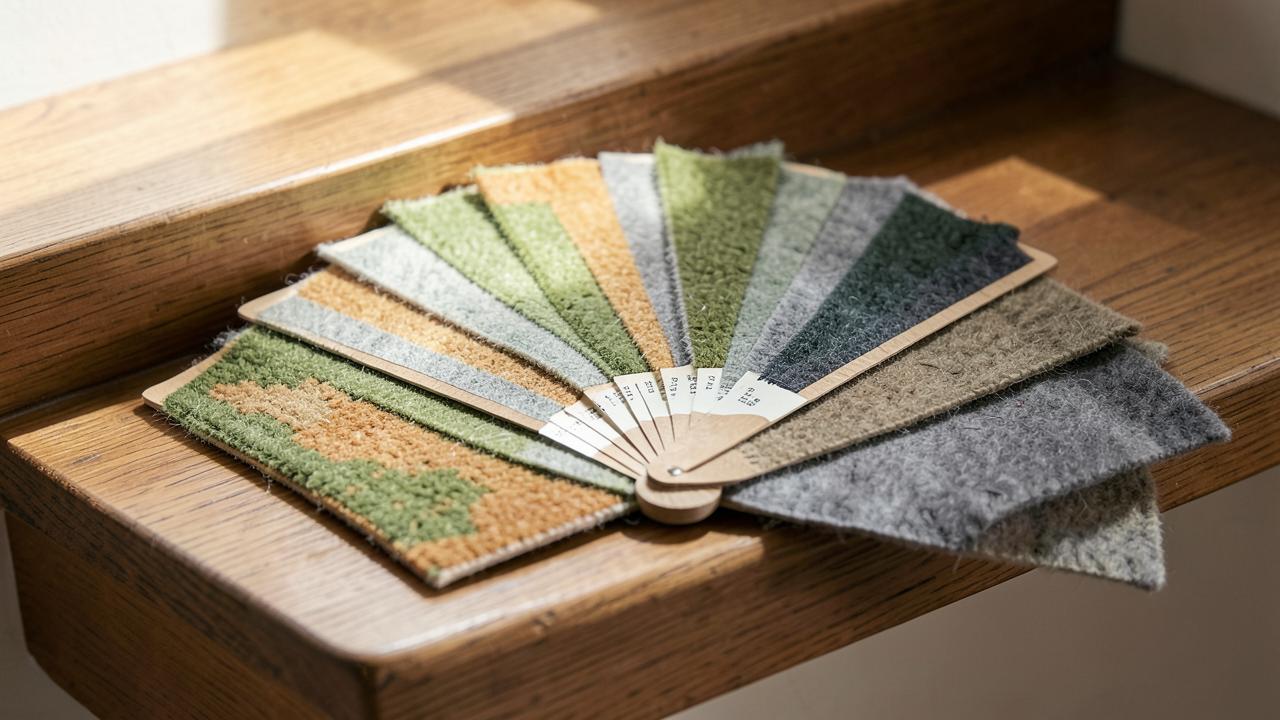
More than the choice between leopard, cheetah or zebra, the colourway is what determines how a print reads in a real hallway. A muted, tonal leopard print in warm beiges, browns and creams behaves almost like a textured neutral: it adds interest and depth without announcing itself the way a bright or high-contrast version would, and it tends to suit the widest range of interiors. A darker, richer colourway with charcoal or black markings against a deeper base reads as more dramatic and works well in a hallway with strong existing architectural character. A stark black and white print, most commonly seen in zebra designs, is the boldest option and suits a confident, minimal interior rather than a busy or heavily decorated one. For wider guidance on colour choice, see stair runner colours.
Practical benefits: hiding everyday wear
One of the most underrated advantages of animal print on a staircase is how effectively it disguises the marks of daily life. The small, irregular, multi-tonal markings that make up most animal prints are, structurally, an extremely effective camouflage for dust, light footprints, pet hair and minor spotting, arguably more effective than many conventional geometric or floral patterns. This makes animal print a genuinely practical choice for a household with pets or children, quite apart from its decorative appeal, and it is one of the reasons the pattern has remained popular for stairs specifically rather than only for smaller accent rugs. Households specifically prioritising pet resilience may also find it useful to read stair runners for dogs alongside this guide.
Woven versus printed animal designs
As with other patterned carpets, animal print runners are produced either by weaving the design into the pile during manufacture or by printing it onto the surface of a plain woven or tufted base afterwards. A woven print, common in higher-end wool or wool-blend Axminster and Wilton constructions, tends to hold its definition for longer under the concentrated wear a staircase receives, since the colour runs through the actual fibre structure rather than sitting on top of it. A printed design can look just as convincing when new and is often more affordable, but is more prone to gradual fading or thinning in the traffic lane over years of heavy use. Ask your supplier which construction method has been used and factor this into your budget and expected lifespan. Our wider guide to choosing the best carpet for a stair runner covers fibre and construction in more depth.
Scale and how it behaves on narrow versus wide stairs
Because most animal prints are built from small, irregular markings rather than a large repeating motif, they generally translate well onto both narrow and wide staircases without the scaling problems that affect large florals or geometric designs. That said, it is still worth checking the size of the individual markings relative to your tread width: a very large-scale leopard print, with markings several centimetres across, can look slightly different in character once confined to a narrow runner compared with how it appears on a large sample board, so it remains worth viewing a sample folded over an actual tread and riser before committing to the full order.
Fitting around turns and winders
The irregular nature of most animal prints is a genuine advantage when it comes to fitting around a turn or a set of winder treads. Because there is no large, obviously repeating motif to align, a fitter has considerably more flexibility in how the runner is laid at a turn than they would with a geometric or floral pattern, and any join in the design is far less likely to be noticeable. This does not remove the need for a competent, careful fitter, but it does reduce one of the more common sources of disappointment with strongly patterned runners on flights that are not perfectly straight. See fitting a runner around a winder for more on how turns are generally handled.
Pairing animal print with the rest of your hallway
A bold print benefits from a calmer surrounding scheme. Pair a strong animal print runner with plain painted walls, simple woodwork and restrained window treatments in the hall and on the landing, and let the staircase provide the visual interest rather than competing with several other strongly patterned elements nearby. In a muted, tonal colourway, animal print is versatile enough to sit alongside a wide range of existing decor, but a bright or high-contrast version, particularly zebra, tends to work best when it is clearly the single statement piece in the space.
Common mistakes to avoid
- Choosing colour depth from a screen or catalogue image. Photographs frequently misrepresent how muted or bold a print actually is in person.
- Assuming all animal prints behave the same way. A soft leopard and a stark zebra sit at very different points on the boldness scale despite both being "animal print".
- Overlooking construction method. A printed design generally wears pattern definition faster in the traffic lane than a woven one.
- Combining a bold print with an already busy hallway. Keep surrounding surfaces calmer so the runner reads as a considered choice rather than clutter.
Maintaining an animal print runner
The maintenance routine for an animal print runner is the same as for any other stair carpet: regular vacuuming of the traffic lane, prompt blotting of spills, and periodic professional cleaning to remove ground-in soiling that regular vacuuming cannot reach. The pattern's natural ability to disguise everyday marks between cleans is a genuine bonus, but it is not a substitute for the underlying care that keeps the pile itself in good condition over years of use. See cleaning and caring for a stair runner for fibre-specific guidance.
A note on longevity and changing taste
Animal print has moved through several waves of popularity in interior design over the decades, but a muted, well-chosen leopard or similar tonal print has proven considerably more durable in taste terms than the boldest, most trend-driven colourways. If you intend the runner to remain in place for many years, a softer, more neutral colourway is generally the safer long-term choice, while a bold, high-contrast zebra print is better suited to a household that expects to refresh its decor more frequently or simply wants maximum impact now.
Frequently asked questions
- Are animal print stair runners too bold for most homes?
- Not necessarily. A muted, tonal animal print in soft browns and creams reads as a textural neutral rather than a loud statement, while a high-contrast black and white zebra print is much more of a deliberate design choice. The effect depends heavily on the colourway, not just the motif.
- Does animal print hide dirt well on stairs?
- Very well, generally. Leopard, cheetah and similar irregular prints are built from dozens of small, uneven markings across a mid-tone background, which is one of the most effective pattern structures for disguising everyday soiling, dust and pet hair between cleans.
- What is the difference between leopard and cheetah print for a runner?
- Leopard print uses irregular rosette-shaped markings, often with a darker outline and lighter centre, while cheetah print uses smaller, solid, more uniformly spaced spots. Both work similarly well on stairs; the choice comes down to which visual texture you prefer.
- Can animal print work in a period property?
- Yes, particularly in a muted, tonal colourway rather than a high-contrast one. Animal print has a long history in traditional decorating as an accent, and a soft leopard-effect runner can sit comfortably in a period hallway when paired with classical furnishings.
- Is animal print carpet more expensive than other patterns?
- Not inherently. Cost is driven mainly by fibre, construction method and pile quality rather than by the specific design printed or woven onto it, so an animal print runner sits within the same price range as other patterned options in a comparable specification.
- Will an animal print runner suit a narrow staircase?
- Yes, more readily than many other pattern types, because the irregular, small-scale markings in most animal prints do not rely on a large repeat to read correctly, unlike a big floral or geometric motif that can look cropped on a narrow runner.
Related guides
 DesignStair Runner Patterns ExplainedHerringbone, chevron, stripes, plaid, geometrics and animal prints judged by how they behave on a staircase.
- DesignChoosing a Stair Runner ColourHow light, adjacent flooring, trim colour, traffic and dirt should drive the colour decision.
- DesignBold Stair Runner Ideas & Design AdviceHow to use bold patterns, vibrant colours, and maximalist designs on your stairs. Learn about pattern scale, colour psychology, and architectural balance.
- DesignCheetah Print Stair Runner Design & FittingThe definitive guide to cheetah print stair runners. Understand the difference between cheetah and leopard, choosing the right spot scale, and expert styling advice.
- DesignLeopard Print Stair Runner Styling & SelectionHow to select and install a leopard print stair runner. We cover pattern scale, matching at the seams, hiding traffic wear, and balancing bold print with your hallway decor.
- DesignZebra Print Stair Runner Guide: Style & SafetyExpert advice on zebra print stair runners. Learn about high-contrast pattern safety, stripe directionality, fibre choices, and how to style a monochrome hallway.