Installation
How to join a stair runner to landing carpet
The junction at the top of a flight is small, highly visible, and the place where an otherwise good installation most often looks improvised.
Written by the StairRunner.co editorial team · Updated 4 September 2026
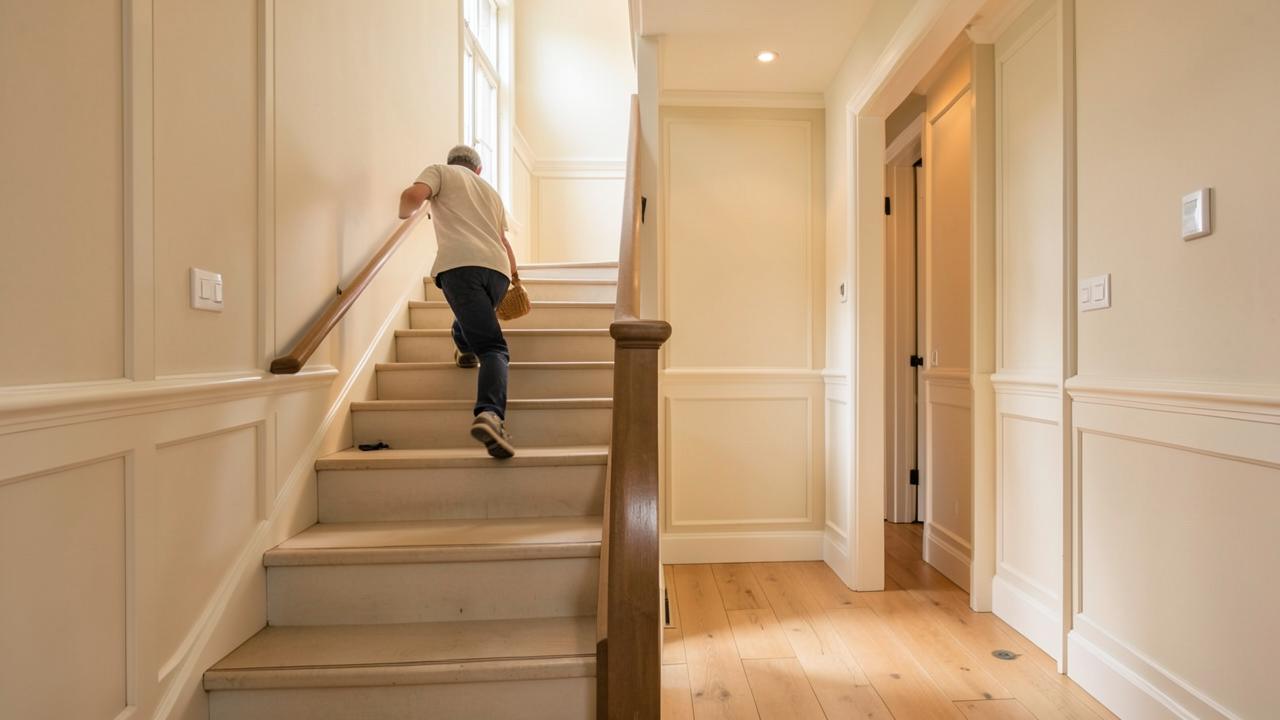
Why this junction is difficult
Three things collide at the top of a staircase. The geometry changes from vertical to horizontal. The traffic pattern concentrates, because everyone arriving at the top step places a foot in roughly the same place. And two coverings meet that were almost certainly not made as a pair.
Add to that the fact that this junction is at eye level for anyone climbing the stairs, and it becomes the detail most worth planning properly. A poor junction here undoes the impression of a careful installation everywhere else.
The four ways to handle it
Seam the two together
The runner and the landing carpet meet edge to edge, joined so they read as a single surface. This is the right answer when the two are the same product, or genuinely close enough that a join will not draw the eye.
The seam belongs in the crease where the top riser meets the landing floor: in shadow, held under compression, and off the main walking line. A seam on the open landing or over the nosing is visible and short-lived. Done properly this is the most invisible solution; done poorly it is the most obvious.
Run the runner onto the landing as a band
Instead of hiding the transition, the runner continues across the landing as a distinct strip over the landing covering or over bare boards. This treats the runner as a deliberate path rather than as carpet that ran out.
It works well where the landing is generous and the runner has a border or binding that gives it a designed edge. It reads as intentional, which is the whole trick with junctions. Our landings guide covers how to set the line and the proportions.
Terminate the runner and start again
The runner finishes at the top of the flight — wrapped under the nosing of the top step or taken over the top riser and stopped — and the landing carpet begins as its own thing. There is no join at all; there is a clean edge and then a different surface.
This is the honest solution when the two coverings are frankly different, and it is usually better than attempting a seam between materials that will never match. The detail that matters is the termination itself: it must be properly finished, properly fixed and completely flat. See finishing a runner at the top of the stairs.
Use a threshold bar
A bar or trim covers the junction mechanically. This is a legitimate choice where the two coverings differ noticeably in thickness and a seam would create a step.
The caution is placement. A bar at the head of a flight sits exactly where a trip has the worst consequences. It must be fitted flush, fully secured, and ideally set back onto the landing rather than on the top nosing itself. If a seam is feasible, prefer the seam.
| Method | Best when | Main risk |
|---|---|---|
| Seam in the crease | Same product, or a genuinely close match | A visible or opening seam if placed badly |
| Runner continues as a band | Bordered runner, generous landing | Looks arbitrary if the line is not set deliberately |
| Terminate and restart | Coverings that clearly differ | An untidy or lifting edge at the top nosing |
| Threshold bar | Significant thickness difference | A proud edge at the most dangerous point in the house |
Matching, or deliberately not
A near-match is the worst outcome. Two greys that are almost the same read as a mistake; two colours that are clearly different read as a decision. If matching is the goal, the two coverings should be the same product, and ideally from the same dye lot — batches of the same specification differ subtly, and a staircase's raking light exposes that difference more than any flat floor.
If matching is not achievable, stop trying and design the junction instead. A bound runner edge against a plain landing carpet is a clean, confident detail. Our colour guide covers how adjoining surfaces interact.
Working with an existing fitted landing carpet
Where the landing is already carpeted, the junction is constrained by what is there.
- Check the thickness of the existing carpet against your runner build-up including pad. A significant difference points towards a bar or a terminated edge rather than a seam.
- Establish how the existing carpet is fixed near the head of the flight before cutting anything. Cutting into a fitted carpet is not reversible.
- Consider whether the landing carpet is close to the end of its life. Replacing both at once is far easier than making a new runner meet a tired carpet.
- Watch for a sun-faded or worn band where the existing carpet meets the stairs; it may not match its own body colour any more.
Fixing and safety at the junction
The top of a flight carries concentrated load and the consequences of a failure here are the most serious anywhere on the staircase. Whatever the junction method:
- Fix both coverings independently. Neither should rely on the other to stay put.
- Keep the runner's top anchor strong. If the top fails, the whole runner migrates down the flight — see securing a stair runner.
- Do not leave any raw cut edge exposed. Bind, bar or tuck it.
- Re-check the junction after a few weeks. It is the point that settles most.
Half landings and turns
Where the landing is a half landing between two flights, the same choices apply twice — once where the lower flight arrives and once where the upper flight leaves. Handle both the same way, or the landing reads as two unrelated decisions.
If the flights turn as well as meet, the geometry adds another layer. Our guides to turns and corners and winder staircases cover how the runner's line is set through the change of direction, which in turn determines where the junction can sit.
What to avoid
- A raw cut edge tucked under and hoped for the best.
- A near-match sourced from a different product because it was available.
- A seam on the open landing where the eye and the feet both go.
- A proud threshold bar on the top nosing.
- Relying on the landing carpet to hold the runner, or the reverse.
- Deciding the junction after the runner has been cut.
Frequently asked questions
- Should the landing carpet be thicker than the runner?
- Ideally, the two should be of similar thickness to ensure a flush transition. If the landing carpet is significantly thicker, it can create a 'lip' at the top of the stairs which is a trip hazard. If you must have a thick landing carpet, use a transition bar or 'ramp' the underlay beneath the runner to even out the height.
- How do I hide the staples at the landing join?
- Use a 'bolster' or a flat-head screwdriver to push the pile of the carpet over the staple heads after they are fired. If you are using a wool runner, the fibres will naturally close over the staple. Avoid using large-headed nails or tacks for this join, as they will always remain visible and can be felt through socks.
- How do you join a stair runner to landing carpet?
- Four approaches work: butt the two coverings together with a seam placed in the crease at the top of the flight, run the runner onto the landing as a distinct band, stop the runner under the top nosing and let the landing carpet start independently, or use a threshold bar where the two meet. The best choice depends on whether the coverings match.
- Should the runner match the landing carpet?
- It does not have to. A deliberate contrast, with a clean junction, reads better than a near-match that is obviously not quite the same. If you want them to match, they should come from the same product and ideally the same dye lot, not merely be a similar colour.
- Where should the seam go?
- In the crease at the very top of the flight, where the top riser meets the landing. That line is in shadow, under compression, and away from the walking line at the head of the stairs.
- Can you use a threshold bar between a runner and landing carpet?
- Yes, and it is a legitimate solution where the two coverings differ in thickness. It must be fitted so nothing stands proud at the head of a flight, which is the worst possible place for a trip point. A tidy seam is usually preferable if the coverings are close in thickness.
- What if the landing carpet is already fitted?
- Work to it rather than against it. Decide whether you are cutting into it to seam, or terminating the runner cleanly before it. Cutting an existing fitted carpet is not easily reversible, so plan the junction fully before any blade goes near it.
Waterfall vs Hollywood: How the wrap affects the join
The style in which the runner is fitted to the final step determines how it meets the landing. In a 'Waterfall' installation, the carpet flows straight from the nosing down to the next tread without being tucked into the riser. This creates a softer, more modern look but can make the transition at the very top nosing look 'bulkier'.
A 'Hollywood' (or tailored) fit wraps the carpet tightly around the nosing and staples it to the riser. This is generally the preferred method for landing transitions because it creates a very sharp, defined edge at the top of the flight. This sharp edge makes it much easier to butt a landing carpet up against the runner with a clean, straight seam.
If you are going for a Waterfall fit on the flight but want a clean landing join, most fitters will still 'Hollywood' the very top step to ensure stability. Transitioning from one style to the other is a subtle detail that sets professional work apart. See our Waterfall vs Hollywood guide for more on these styles.
Sub-floor preparation at the head of the stairs
The junction is only as good as the floor beneath it. Often, the landing floorboards and the top tread of the staircase are not perfectly flush. A difference of even 3mm will be felt through the carpet and will cause the seam to wear prematurely along the 'high' edge.
Before fitting, check this transition with a straight edge. If there is a step, you may need to sand down the high board or use 'ply-lining' on the landing to bring it up to the level of the tread. Ensuring this transition is a smooth, flat plane is the secret to a seam that 'disappears'.
Also, ensure the top riser is rock solid. If it flexes when you push the runner into the crease for a seam, the seam will eventually open up as the house moves. A few well-placed screws (sunken and filled) into the riser can save a lot of trouble later. Read more in preparing stairs.
Visual continuity: Sightlines and symmetry
When you stand at the bottom of the stairs and look up, the junction at the landing is often the focal point. If the runner is perfectly centred on the flight but the landing carpet join is slightly 'off', the whole flight will look crooked.
This is especially common if the landing turns a corner. You have to decide whether to align the seam with the edge of the stairs or with a feature on the landing (like a doorway or a newel post).
A good rule of thumb is to prioritise the view from the stairs. The 'path' of the runner should feel like it continues naturally onto the landing, even if it terminates there. If you are using a bordered runner, the way the border 'returns' or meets the landing carpet requires careful planning to avoid looking like a sudden stop. Check our design ideas for visual examples of these junctions.
Dealing with bullnose and feature bottom steps
While this guide focuses on the landing (the top), the junction at the bottom is just as important. If your staircase starts with a 'bullnose' (a step that curves around the side), the runner has to transition from a straight line to a curve while meeting the hallway floor.
This usually involves 'pleating' the carpet around the curve. Like the landing join, this creates a concentrated point of wear and a complex fixing task. Many people choose to leave a decorative bullnose step bare, starting the runner on the second step, to avoid a messy junction with the hallway carpet.
If you do take the runner to the floor, ensure the 'tail' is secured with a proper gripper or a binder bar. A loose tail at the bottom of the stairs is a major trip hazard for anyone coming *down* the flight.
The 'Seasoning' period for new joins
A new seam between a runner and a landing carpet will 'settle' over the first few weeks. As the pile is stepped on, the fibres from the two different pieces will begin to interlock.
During this time, you might notice a few 'sprouts'—long fibres that poke out from the seam. Do not pull these; snip them flush with sharp scissors. If you pull them, you risk unravelling the seam. If after a month the seam feels 'bumpy' or you can see the backing, the tension wasn't high enough during fitting and it may need to be re-stretched.
Keep a close eye on the junction if you have a vacuum with a powerful beater bar. Set the vacuum to a higher height setting when crossing the seam to avoid 'plucking' the join. More maintenance tips are in our cleaning guide.
When to call a professional for the junction
Joining two carpets is one of the most skilled parts of carpet fitting. While a straight flight can be a DIY project, creating a clean, durable seam at the head of a flight is difficult without the right tools (like a carpet stretcher and a seam iron).
If your runner is an expensive wool Wilton or a patterned Axminster, the cost of a professional to handle the landing junction is a small price for the security and finish they provide. A failed DIY seam at the top of the stairs can mean having to replace the entire runner if there isn't enough length to re-cut and re-join. Our DIY vs Pro guide helps you weigh this decision.
Related guides
 InstallationHow to Install a Stair RunnerWaterfall and Hollywood methods, staples versus rods, tools, sequence and quality checks.
- InstallationStair Runners on Landings and TurnsCarrying a runner across a landing, around a turn and into a hallway without breaking the line.
- InstallationFinishing a Stair Runner at the TopThe four ways to end a runner at the top step, and how to pick the one your staircase allows.
 SafetySecuring a Stair RunnerWhy runners creep, lift and curl, and how to hold one properly or re-fix a loose one.