Style
Tiger print stair runners
Tiger stripes are one of the most recognisable animal prints in interiors, and one of the most versatile on a staircase — provided the scale, colourway and setting are chosen with some care.
Written by the StairRunner.co editorial team · Updated 4 September 2026
Why tiger print works on stairs
A staircase is a narrow, vertical run of pattern seen from multiple angles and distances — from the hallway below, from the half-landing, and close up underfoot as you climb. Most bold patterns struggle with this range of viewing distances: a large motif that looks striking on a rug can feel chaotic when repeated down twelve or fourteen risers. Tiger stripes behave differently. The irregular, organic stripe is designed by nature to break up an outline rather than repeat as a neat, mechanical unit, so it reads as rich texture from a distance and as a considered pattern up close, without the jarring repetition that a smaller geometric print can produce on a flight of stairs.
The pattern also does useful practical work. Multi-tonal, high-contrast animal prints are among the most forgiving carpet patterns for everyday household life, because dust, pet hair, and the general soiling that accumulates in a stair's traffic lane simply becomes part of the visual texture rather than standing out as a mark against a flat, plain colour.
Choosing the right scale of stripe
| Stripe scale | Visual effect on stairs | Best suited to |
|---|---|---|
| Fine, tightly repeated | Reads almost as a textured solid from a distance | Narrow stairs, subtle schemes, small hallways |
| Medium, irregular | Clearly a tiger motif but not overpowering | Most standard domestic staircases |
| Large, high-contrast | Dominant, statement-making pattern | Wide, well-lit stairs with restrained surrounding decor |
As a general rule, the narrower the stair, the finer the stripe scale should be. A large, bold stripe compressed into a 60cm wide runner can look cramped, with the pattern cut off awkwardly at the edges rather than flowing naturally down the flight.
Colourway: warm and tonal versus graphic and contrasting
Tiger prints are most commonly interpreted in one of two directions. The first is a warm, tonal palette — camel, rust, chocolate and cream — that stays close to the animal's natural colouring and tends to sit easily against most wall colours, timber tones and existing furnishings. This is the safer choice for anyone nervous about the print reading as too costume-like or theatrical.
The second direction is a cooler, more graphic interpretation, using charcoal, black, grey or even blue-black against a pale ground. This version reads as a considered, contemporary pattern choice rather than a literal reference to an animal skin, and it suits a more modern interior with plain walls and simple, dark hardware.
Whichever direction you choose, resist pairing a bold tiger runner with other strong patterns nearby. A patterned runner works hardest as a single statement in an otherwise calm hallway; wallpaper, a patterned door mat and a printed stair runner competing in the same sightline rarely works, however much each element is liked in isolation.
Fibre and construction
Tiger print stair runners are available as both printed carpet and jacquard-woven constructions, and the difference matters more than it might first appear. A printed construction applies the pattern to the surface of a plain woven or tufted base, which keeps costs down but means the pattern can wear thin in the traffic lane over time, gradually fading toward the base colour. A jacquard-woven construction builds the pattern into the pile itself, using different coloured yarns woven through the full depth of the carpet, so the stripe remains visible even as the surface wears.
For a wool-rich blend, expect deeper, more saturated colour and a noticeably better hand-feel underfoot, at a higher price point than a synthetic equivalent. For a solution-dyed synthetic, expect better resistance to fading in a sunlit stairwell and easier cleaning after spills, which matters if the stairs see daily use from children or pets. More on the trade-offs between the two is covered in wool versus synthetic stair runners.
Framing the pattern with margin and border
A patterned runner is only as good as the frame around it. Leaving a consistent bare timber margin on either side — enough that the eye clearly separates the pattern from the wall and skirting — lets a bold tiger stripe read as a considered feature rather than wall-to-wall carpet that has simply been cut narrow. A woven binding or a contrast border in a solid colour taken from the stripe reinforces this frame further, and gives the fitter a clean, finished edge to work to on every tread.
Guidance on getting this margin right, including how it should change with stair width, is set out in how wide should a stair runner be.
Setting the scheme around a tiger print runner
Because the runner itself carries visual weight, the rest of the hallway benefits from restraint. Plain painted walls, simple architrave, and stair rods in a single warm metal — brass works particularly well with the warmer tiger colourways — let the pattern remain the focal point without competing elements. If the staircase turns or includes a landing, keep any landing carpet in a complementary plain colour rather than extending the print across a much larger floor area, where its impact changes considerably; see stair runner and landing carpet for how to handle that transition.
Practical performance on a real staircase
Beyond the visual argument, animal prints have a genuine practical advantage: their irregular, multi-tonal surface disguises the everyday soiling that a stair's traffic lane accumulates far more effectively than a plain colour of similar tone. This does not remove the need for regular vacuuming or periodic professional cleaning, but it does mean the runner looks presentable for longer between cleans, which is worth factoring in for a busy household hallway that gets seen by every visitor.
If the staircase carries heavy daily traffic — a family with children and pets, or a hallway that doubles as the main route to a garden or utility room — pairing the pattern with a durable, solution-dyed synthetic pile and a dense, low-profile construction will keep it looking sharp for years rather than months. See durable stair runners for how construction and fibre choice affect longevity under heavy use.
Common mistakes to avoid
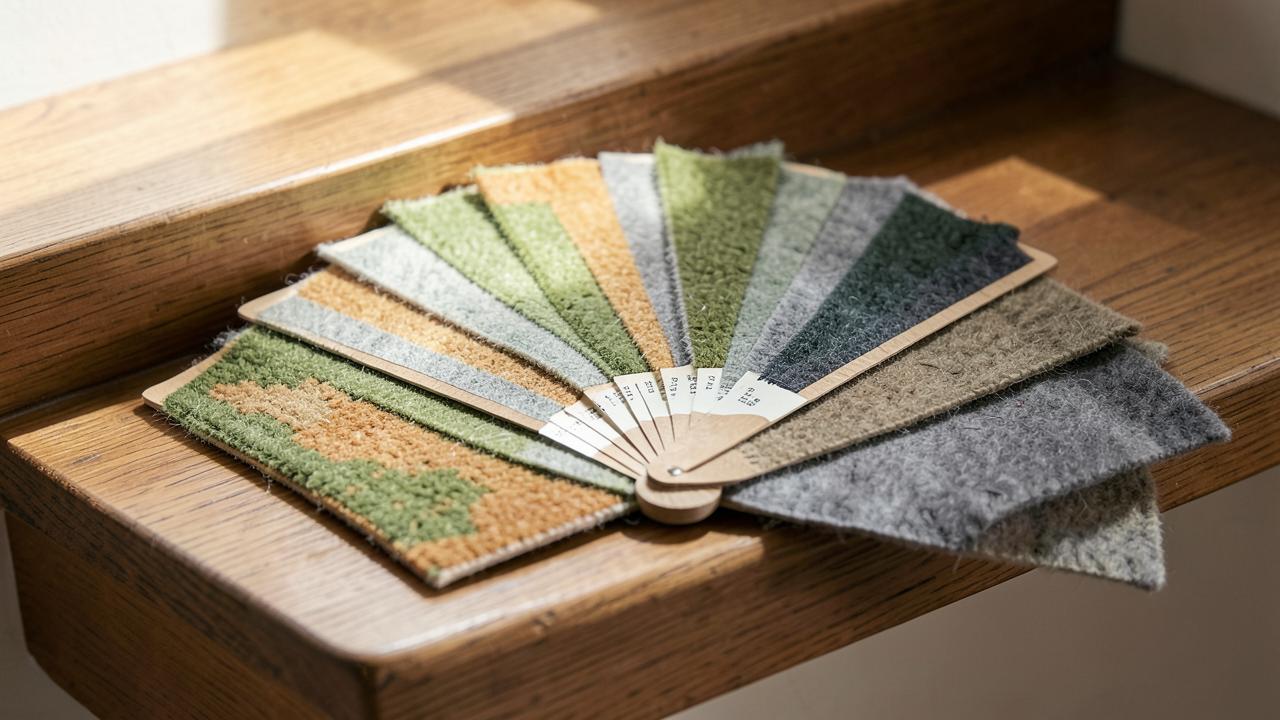
- Choosing scale from a small sample. A stripe that looks balanced on an A4 sample card can look either too fine or overwhelmingly large once repeated down a full flight — always view as large a sample as the supplier can provide, ideally on the stairs themselves.
- Skipping the margin. Running a bold pattern edge to edge across the full width of the stair removes the frame that makes it look intentional.
- Fighting the print with other pattern. A striped or geometric wallpaper behind a tiger print runner usually looks busier rather than more considered.
- Underestimating fade in direct sun. A stairwell with a skylight or a large window at a half-landing needs a fade-resistant, ideally solution-dyed, fibre regardless of how the print is applied.
How a tiger print runner compares to other animal prints
Among animal-print stair runners, tiger stripe sits at the bolder, more graphic end of the spectrum, with stronger tonal contrast than a leopard spot and a more linear, directional pattern than a mottled cheetah print. If the tiger stripe feels a step too bold for a particular scheme, a leopard or cheetah pattern in the same warm palette can deliver a similar sense of texture and forgiveness with a softer, less linear visual effect. See leopard stair runners and cheetah print stair runners for comparison, or animal print stair runners for the broader category.
Care and maintenance
Care for a tiger print runner follows the same principles as any patterned stair carpet: regular vacuuming of the traffic lane, prompt blotting of spills, and periodic professional cleaning rather than heavy home treatments that can dull a printed or woven pattern over time. A full routine, including what to avoid on wool-blend constructions, is set out in cleaning and caring for a stair runner.
Budgeting for a tiger print runner
Patterned and woven runners generally sit above plain synthetic runners in price, reflecting the more complex manufacturing involved in either printing a repeat pattern accurately or weaving a jacquard construction with multiple yarn colours. Wool-rich jacquard versions carry a further premium over printed synthetic equivalents. Whichever route you take, factor in the extra length usually needed to match a directional pattern across a full flight, since this can add noticeably to the total metreage compared with a plain colour runner of the same stair. For a general sense of how stair runner costs are structured, see stair runner cost in the UK.
Where a tiger print runner suits the rest of the house
A tiger print used on the stairs does not have to stop there. Carrying the same colourway, if not the identical pattern, into an adjoining hallway runner creates a sense of continuity as visitors move from the front door toward the stairs, rather than a single feature that feels disconnected from the rest of the ground floor. See hallway carpet runners for how to plan that transition, including where a change of pattern or a plain colour works better than a continuous run of the same print.
Ordering and fitting considerations
Patterned runners with a directional stripe need more careful planning at the ordering stage than a plain colour, particularly around how the pattern will match at any join and how it will be centred on winders if the stair turns. Discuss pattern placement with your fitter before cutting begins, and confirm how much extra length has been allowed for pattern matching, which is usually more than the standard allowance calculated for a plain runner. See how to measure for a stair runner and stair runner installation for the wider process.
Frequently asked questions
- Is a tiger print stair runner too bold for a hallway?
- It depends on scale and colourway more than the motif itself. A muted, tonal tiger stripe read from a distance as a rich texture rather than a literal print, while a large-scale, high-contrast version will dominate the hallway and should be balanced with plain walls and simple joinery.
- What colours work best with a tiger print runner?
- Warm neutrals such as camel, chocolate, cream and soft ochre echo the natural palette of the print and let it sit comfortably against most wall colours. Cooler greys and stark whites create more contrast and a more graphic, contemporary look.
- Does a tiger print runner suit a period house or a modern one?
- Both, depending on how it is framed. In a period hallway, a tiger stripe with a traditional woven border and brass stair rods reads as a heritage animal-print carpet. In a modern setting, a wider bare-margin install with a plain frame keeps the same runner feeling current.
- Will a busy tiger pattern show wear less than a plain runner?
- Generally yes. Multi-tonal, high-contrast patterns are far more forgiving of everyday soiling, pet hair and light traffic marks than a flat solid colour, which is one of the practical reasons animal prints remain popular on stairs.
- What fibre should a tiger print stair runner be made from?
- Printed and woven versions exist in both wool-blend and synthetic constructions. A wool-rich blend gives the best depth of colour and hand-feel; a solution-dyed synthetic is the more practical choice for a household with pets, children or a lot of daily footfall.
- How wide should a tiger print runner be relative to the stair?
- The usual guidance for any patterned runner applies: leave enough bare timber margin either side, typically around 5 to 10cm per side, so the stripe pattern is not visually squeezed by the edge of the stair and the border reads as a deliberate frame rather than an afterthought.
Related guides
- DesignAnimal Print Stair Runners: A Buying GuideChoosing an animal print stair runner: scale, colour depth, fibre and how leopard, zebra and other prints work on real treads and risers.
- DesignCheetah Print Stair Runner Design & FittingThe definitive guide to cheetah print stair runners. Understand the difference between cheetah and leopard, choosing the right spot scale, and expert styling advice.
- DesignLeopard Print Stair Runner Styling & SelectionHow to select and install a leopard print stair runner. We cover pattern scale, matching at the seams, hiding traffic wear, and balancing bold print with your hallway decor.
- DesignPatterned Stair Runners: Style & Fitting GuideA comprehensive guide to patterned stair runners. Learn about scale, pattern matching on winders, and how to balance bold designs with your hallway decor.